

 November 6, 2026
Raquel Sanchez: A Time to Create


The last few years have presented unique challenges to the people of Israel living in Israel, and as artists in general tend to feel things deeply, the shock and trauma are palpable within the creative community. At the same time, throughout history, it has been just these sorts of times that have impelled artists to greater levels of achievement. It is precisely the struggle to find meaning and beauty in adversity that drives the human impulse to create enduring monuments of hope and expressions of the triumph of the human spirit.
Israeli art today is not only contending with the struggle for survival of the Jewish people in the face of enemies seeking to destroy us. Already for generations, it has had to contend with voices within the cultural establishment of Israel itself who are devoted to the destruction of the Jewish identity of the indigenous culture and of religion and nationalism as “legitimate” bases for artistic expression. The artist in Israel who dares to incorporate themes of Jewish spirituality or to acknowledge the particularity of Israel’s national experience is not only defying world opinion but also the biases of the established institutions and individuals within Israel who, over a lifetime, have been installed as the gatekeepers and arbiters of what constitutes art in the local context.
Raquel Sanchez is an immigrant to Israel with a cosmopolitan background. In any other context, in today’s prevailing cultural climate, she’d be hailed as an exemplar of progressive contemporary art, giving voice to important national, ethnic, and gender identities. In Israel, however, she must struggle constantly against accusations of parochialism and regression for no other reason than the fact that she identifies as Zionist and religiously observant.
Sanchez is the daughter of the poet laureate of Venezuela, Juan Sánchez Peláez, and a Jewish mother, the accomplished Jewish painter Ellen Lapidus, who made aliyah many years ago. She was raised across South America, Europe, and the United States, where she lived among many of the leading artists and musicians of the twentieth century, before making aliyah to Israel about thirty years ago. She is an accomplished poet, in addition to being a visual artist, and her works have been published in several languages. She often integrates the sensibility of her poetry – sometimes even the words themselves – into her art.
Sanchez has been living through the struggles of the present cycle of violence and destruction alongside all of the people of Israel, but she has also suffered considerable setbacks in her personal life, not to mention the headwinds of a systemically anti-religious artistic establishment already noted above. Her response to all this has been to create beauty, to seek the light in the darkness, encouraging herself to persevere, and with her work, to seek to bring others along with her.
There are many themes that she incorporates into her art, which we will only be able to briefly survey in this article. Prevalent throughout them is an acute appreciation of the structure of light and color as they enervate our reality and ennoble us as unique individuals to rejoice in the world of our consciousness as we interact with the visual experience of material reality. In spite of – or because of – the struggles that make it so difficult to live in the world today, Sanchez invites us to find and to celebrate the noble and glorious in our experience of the physical as an expression of Divine Will.
She works in a variety of media, although she has particularly emphasized heavy paints (oil and acrylic) on various surfaces such as canvas, paper, wood, stone, and tile. The centrality of material in her work is notable and illustrative of her approach to the act of creation. She works on various types of paper of different thicknesses and textures, experimenting with different pigments so that the interplay of the material and the form of the paper itself are conspicuous in her approach. She has produced different series of works that may be characterized by the material on which they’ve been drawn or painted, with subtle variations in style and composition that follow from, and are evoked by, the feel of the surface and the way the pigment adheres to it. For example, she completed an entire series of drawings on thin paper because someone once told her that to be an artist, she has to have a “thick skin.” Often, as she begins work, she spends a long time looking for just the right pencil or consistency of paint because it has to “feel right” in her hand.
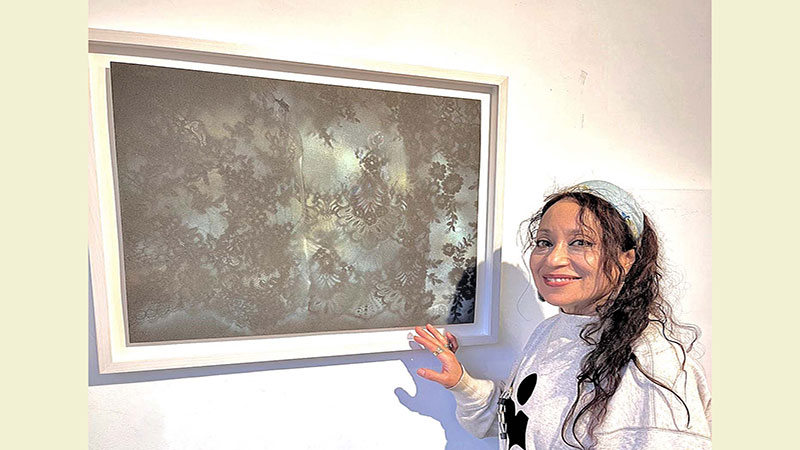
In the wake of the October 7 massacre and the ensuing war for survival, she has been creating a series of works on sandpaper, elucidating the physical struggle and frequent discomfort of trying to create order and lasting beauty in a world so inhospitable to Jews and to artists. Recurring in this series are images of goats (i.e., the “scapegoat”) and dancing, to memorialize the victims who were cut down while dancing. She also has integrated a suggestion of lace in the “ceiling” and “floor” of the composition to symbolize “how women were hurt on October 7.”
During the coronavirus scare, when art supplies stores tended to be shut down, Sanchez couldn’t find new canvases to work on, “so I did all these paintings on canvas I found in the street that people were throwing out. And [on] tiles and rocks [too].”
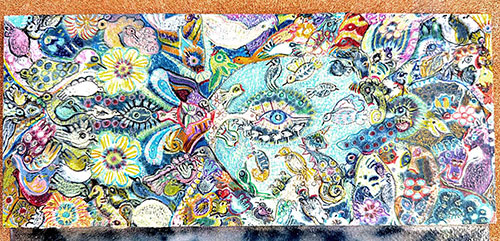
There are two themes which are conspicuous in her broad approach to visual art. These come from a common spiritual root but are, in an important sense, almost contradictory or paradoxical. On the one hand, her works tend to include an almost obsessive attention to detail, with very fine and intricate figures and patterns (most frequently this technique is found in her drawings more than paintings) drawn almost as fractal patterns, separating into obsessive minutiae even as they expand across the image with sweeping patterns evocative of motion and progress.
But where Sanchez has perhaps distinguished herself best – and has achieved the most recognition among critics and collectors in recent years – is in her treatment of light and of motion. The desire to bring “life” and animation to two-dimensional surfaces has been a preoccupation of artists since at least the emergence of the Impressionists as a response to classicism in the nineteenth century, but it probably can be traced to advances in framing and perspective as far back as the Renaissance. Sanchez elicits this kinetic sensibility in her painting through her skilled manipulation of the medium of the paint itself. She lays on thick layers of paint, almost sculpting the texture, in a manner most suggestive of Van Gogh. But when she is done, the resulting patterns of light within the substrate of darker colors are hypnotic, almost prismatic in their effect. The light seems to be kindled within the painting, reflecting back at the viewer almost as the moon might, or a righteous individual reflecting some higher but invisible light source. Between the physical construction of the material and the deeper logic of the pattern and structure of the composition itself, the works embody a dance and play of light and forms that draw the viewer in and participate in a conversation about what it means to see and to live and to feel in a world so full of light but also of darkness.
Gallery owner and collector Uri Rosenbach, who has been an early and persistent champion of Sanchez’s work, had this to say: “When you look at Raquel’s work, I always say there’s a kinetic aspect to it… as the light changes, the art changes. [This is] as opposed to other artists where you move [rather than the light source moving] and it changes.”
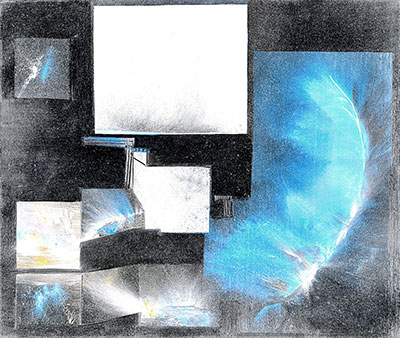
Two of Sanchez’s most ambitious projects to date are a series she entitled “Light from Darkness” and her “Prayer” series, which was inspired by the black boxes of tefillin. These works employ the techniques examined above, with various touches specific to the thematic material that drives them. In all cases, the light is the subject of the painting.
In “Light from Darkness,” as the title would suggest, the light is depicted finding itself and achieving palpable substance that emerges triumphantly from the chaos of color and shadow that otherwise engulfs the canvas. The unique manner of molding paint and anticipating the movement of light and shadow upon display creates the impression of a dramatic struggle where light and love can be seen to prevail.
In the “Prayer” series, the works are overwhelmingly black and dark, with subtle texture and patterns barely perceptible in the blackness, evocative of the blackness of the tefillin that inspired them. The composition is ambiguous, and the canvases can be turned and rotated without substantially changing the overall impression. This too is a kinetic aspect of the painting. But the paintings, named individually for different Jewish expressions of prayer (e.g., Shav’ah, Tze’akah, Rina, Tachanunim)conceal a brilliant light hidden behind the thick black frames. The light escapes through “windows” in the canvas where the soul of the artist – as an expression of the collective soul and the prayerfulness of Israel – can almost be heard screaming for succor. Yet at the same time, the whole composition becomes defined by these bits of emerging light which create ambiguity as to whether the black is the background or the foreground after all. In the end, as in the material world, the darkness is known to be only an illusion – a mask, seeking unsuccessfully to conceal the searing light of the prayer. Sanchez’s next series, currently in progress, is to be called “Light from Light.”
The art of Raquel Sanchez is of particular importance to the expression of Israeli culture and identity in this moment of existential struggle and debate over what it means to be Jewish and Israeli. But it also has much to say about what it means to be human in an era when people increasingly rely upon technology to understand and express basic ideas and when authenticity is exceedingly hard to find. In “The Work of Art in the Age of Mechanical Reproduction,” first published in 1935 as the Nazis were rising to power in his native Berlin and their shadow spreading over all Europe, Walter Benjamin struggled with the implications of technology for the authenticity of art and the voice of human creativity altogether. Upon publication, this essay was almost immediately acknowledged as a classic and as an act of defiance against totalitarianism in general and the mass mobilization of culture and entertainment by fascism to mold collective beliefs and actions in particular. Against the rising doctrine of Nazi cultural imperatives and against Bolshevik exploitation of art and artists (ironically, because he otherwise identified as a socialist), Benjamin insisted on the irreducibility and irreplaceability of the human creative as the source of all authentic art and of the human spirit as an audience. Without this discourse, there is no communication, there is no meaning, and there is no art.
Raquel Sanchez’s art not only defies the calcified orthodoxies of Israeli and contemporary post-structuralist art and artistic criticism, but it demands acknowledgment as the product of a human creative spirit intended for the spiritual edification of human beings. In its evocation of light emerging as an exemplar of hope, of love, and of redemption, it carries a message for those who believe in a better future and a higher wisdom. It is, by design, inaccessible to the tools of structural or scientific analysis.
But above all, Sanchez’s art is a full-throated challenge to the forces of hatred and destruction, to those who are actively seeking to bring about the end of the artist and her nation. It is a prayer and a battle cry that life matters, that love and light can always be found, and that now – indeed, in the midst of war and mayhem – is a time to create.
Raquel Sanchez’s work can be seen in various exhibitions around Israel. Select pieces are on display and available for purchase at the Rosenbach Contemporary Gallery on King David Street in Jerusalem. Additional information, samples, and explanations are available on her website: raquelsanchezart.com.