 July 31, 2026
 Categories: Headline / Perspectives
The Wicked Son's Lesson for Israel Advocacy


It happens at tables all over the world, every spring, and most people miss it.
The Haggadah introduces four sons, and the second one comes out swinging. "What does this service mean to you?" he asks – pointedly excluding himself, framing the whole enterprise as something foreign and to be put on trial. He is not curious. He is baiting. He wants an argument about what the Seder is not and what it has failed to be.
And here is the part everyone misses: the leader of the Seder does not take the bait.
The leader does not defend the matzah, nor litigate the marror. The leader does not answer the challenge on the wicked son's terms at all.
Instead, the Seder’s leader pivots – hard – to the affirmative. The leader tells the story of what G-d did for him when he went free from Egypt. The leader talks about meaning, purpose and peoplehood. He goes on offense, not defense, and in doing so reclaims the conversation entirely.
It is, I would argue, advocacy training embedded in Jewish tradition, and a lesson that American Jewry would be well-served to heed if we are to shore up plummeting support for Israel in this country.
When was the last time you heard someone talk about Israel and not immediately reach for a defense? When was the last time you heard someone articulate what Israel is and why it matters, in their own words, and on their own terms?
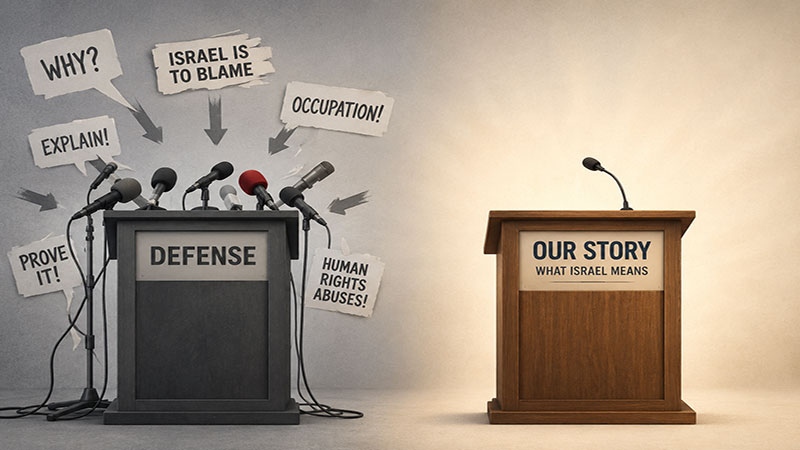
What we have built instead – with enormous effort and skill – is an entire apparatus dedicated to rebuttal. We track the news cycle so we can respond to it. We produce fact sheets to counter the last op-ed. We train students to survive the next hostile classroom encounter. We have gotten remarkably good at playing defense. And we have mistaken that skill for advocacy.
It isn't. It's damage control. And damage control, no matter how sophisticated, concedes the battlefield to our accusers before the conversation even starts.
Every time we open with a defense, we are implicitly accepting the premise that Israel is a defendant – that the burden of proof sits on our side of the table. The conversation is fundamentally about what Israel has done wrong and whether we can explain it away.
We are letting the wicked son write the agenda, and shift the discussion away from the one we really should be having. For the following reasons, like the leader of the Seder, we need to pivot – and shift to an affirmative and positive discussion about what Israel is and means.
1. Nobody has ever been moved to love something by a well-sourced rebuttal. Our advocacy for Israel should be grounded in, and seek to inspire, love and passion.
2. We need to train our own young people to see Zionism as an inheritance to be understood rather than a position to be defended. Somewhere between the hasbara trainings and the rapid-response memos, we stopped telling anyone – including ourselves – what Israel actually means to us. We have armed our children with talking points, when what they really need are convictions, and to understand why Israel matters to them personally.
3. We need to set the terms of our discussion, and stop letting our adversaries dictate it for us. Defense is exhausting – it is reactive by nature and never ends, because the attacks never end. An affirmative case is invigorating, and does not need to be remade every time someone posts something new.
None of this is to say facts don't matter, or that mischaracterizations should go uncorrected. They should be corrected. But correction is not a strategy, and we should recognize the risks in being locked in a responsive posture, and ensure we do not lose control of a conversation that we should be leading.
Here again, the Haggadah is instructive. It does not ask the leader of the Seder to ignore the wicked son. It asks him or her to answer differently – to refuse the frame, not the conversation.
This is not a call to disengage, to stop showing up, to stop caring what's said about Israel in the public square. It's a call to show up differently: leading with what we believe, not merely rebutting what others claim.
What would that actually look like? Less time spent perfecting the response to the last accusation, more time spent articulating – out loud, specifically, without hedging – what Zionism means to us and why. Fewer fact sheets engineered for the next debate, more stories told on our own initiative, in our own language, before anyone asks us to justify anything. Advocacy that begins with "here is what this means to me" rather than "here is why that's wrong."
It requires something harder than research or messaging discipline: it requires us to actually do the internal work of knowing, plainly, what we believe and why – the same internal work the Haggadah demands of the leader of the Seder before he or she can answer at all. You cannot go on offense with a case you haven't made to yourself first.
The wicked son is not going away. He shows up every year, and these days he shows up on op-ed pages and campus quads and social media threads far more often than he ever does at a Seder table.
That's fine. Let him ask his question. But let our strategy be to answer on our own terms – in the affirmative and with greater conviction – and in so doing, reclaim the conversation.