 October 16, 2026
Categories: Headline / Perspectives
Road Trip Retrospective


When is the right time to have The Talk?
As we packed our bags, getting ready for our trip to Alabama, the question swirled through my mind.
I remembered, so clearly, speaking to my children during the summer of 2020 about Black Lives Matter – regardless of how one feels about the demonstrations that summer – and how some parents of color have conversations with their children about what to expect when they engage with society at large.
And now, here I was, wondering what we might expect as we prepared to head into the heart of Dixie.
It was the summer after 10/7 and the world was on its head. Right was wrong; victims were perpetrators. And I was left to contemplate whether I’d made a very stupid decision in going on this road trip.
Briefly, I considered the old standby: Make sure we dress as inconspicuously as possible and cover or remove anything that could be seen as outwardly Jewish.
But I remembered the promise I’d made almost 30 years before, that I’d never take off my kippah out of fear or discomfort, and I had to nix the idea of concealing our identity. I couldn’t make part of The Talk about hiding who we are.
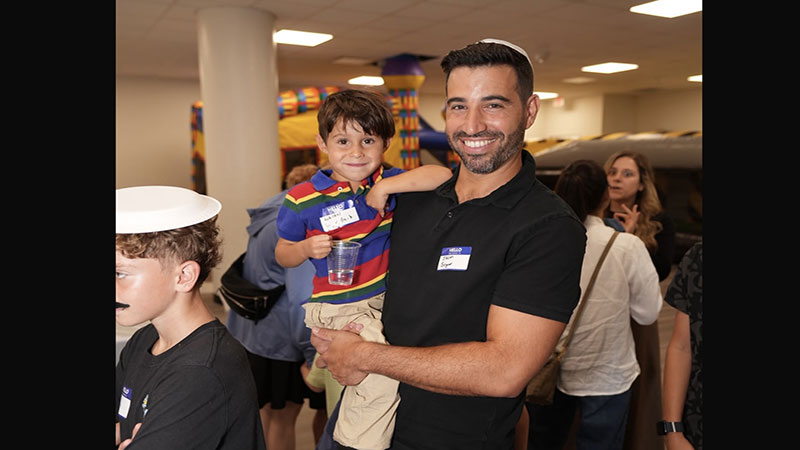
In the end, we went as we are: A modern Orthodox Jewish family just wanting to see America, build memories, and have fun.
* * * * *
Our trips began small about nine years ago as a response to something one of my older children said. The exact content of that exchange is irrelevant right now, and it’s not part of my story to tell, but it motivated me to grab my 8-year-old and my 7-year-old, toss them in the car, and head off towards the East End of Long Island. We spent three days exploring Montauk, the Gold Coast, the Long Island Sound, and the Riverhead Aquarium.
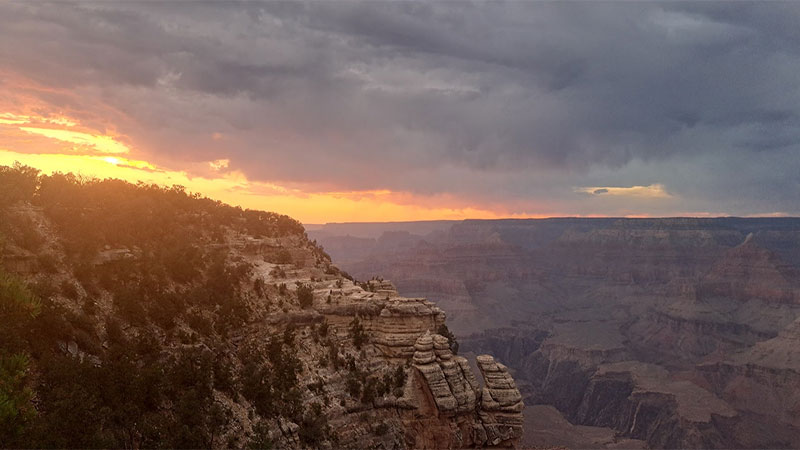
That trip spawned other adventures, each one more daring than the first: Rhode Island and Massachusetts; Maine; Vermont and New Hampshire; Upstate New York; Cape May, New Jersey; Virginia and North Carolina; Tennessee; South Carolina and Georgia; Alabama, Louisiana, and Florida; and then, our grand excursion, our cross-country trek to California, cutting through Ohio, Kentucky, Kansas, Colorado, Arizona, Nevada, and then through Utah, Wyoming, South Dakota, and Iowa on our way back to our home on Long Island.
This is to say we’ve seen a lot.
We always travel in our vehicle, a simple SUV. We’ve felt the texture of the road beneath us, the twists and turns of the routes we’ve taken, the blazing sun shining through the windshield and windows as we raced across the landscape.
And we have met a lot of people.
So perhaps there’s a bitter irony that today Jewish families across this country are forced to have our own version of The Talk with our kids, where we have to warn them about what it’s like to be Jewish on a college campus or in a secular office space.
Where we have to give our children advice about what to do when confronted by good old-fashioned Jew-hatred, blood libels, and casual antisemitism masquerading as anti-Zionism.
And it seems so bizarre that we’ve been reduced, in many ways, to clichés and catchphrases: If you see something, say something; trust your gut; better safe than sorry.
Yet, here we are, in 2026.
* * * * *
In some ways, it’s really surprising that the only two disquieting encounters we have had on our trips occurred before 10/7, one on our pass-through of Connecticut on our way to Massachusetts and the other during our second visit to North Carolina.
I actually don’t remember precisely where we were or what we were doing in Connecticut, but I clearly remember walking as a family to our car after a long day. As we crossed a main roadway into a park-like area and continued the trek to the parking lot where our car awaited our return, a motorist on the roadway slowed to a crawl and screamed loudly, “FREE PALESTINE!”
I had an instant to respond – or not. What could I say back? Should I say anything back? My family was with me: Do I ignore it and engender probing questions from my kids? Do I respond and possibly provoke a confrontation with a person who could get violent?
All these thoughts took about three seconds to race through my mind.
I turned around, raised my arm and waved, and cheerfully called back, “LOVE YOU TOO!”
To this day I have no idea if I made the right decision.
But the look on his face, the slack-jawed, open-mouthed stare, as he tried to figure me and my response out, tends to make me think I did. He was thoroughly confused: Was I mocking him? Showing him solidarity?
His window to continue the exchange closed as traffic built behind him, and he had no choice but to drive off. We got back to the car, slightly rattled, but grateful that a disturbing interaction was all we’d had to deal with.

Our encounter in North Carolina was one based in literal ignorance. It was so bizarre, it might actually be labeled as funny. A cashier in a souvenir shop asked if I was Jewish. After I said yes, she asked to see what was beneath my kippah and expressed surprise that I allowed my wife to go shopping in public. Two astonishing misconceptions in one short exchange. And yet, there was clearly no hatred behind them – only curiosity – so we classified that encounter differently from the one in Connecticut.
* * * * *
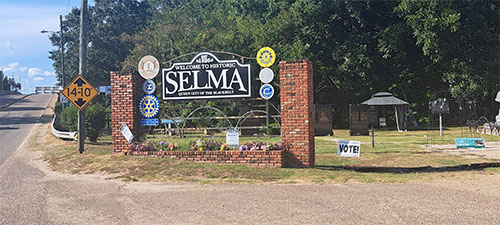
For the most part, though, across the vast majority of our trips through a good chunk of this country – and we’ve driven to some real out-of-the-way places: Foley and Selma, Alabama; Harpers Ferry, West Virginia; Wamego, Kansas – our encounters with perfect strangers have been wholesome and kind.
And maybe it was just fitting – I don’t know, karma, Divine intervention – that the summer after we went to Alabama and spent time exploring Selma, Montgomery, and Birmingham, the summer after I had The Talk with my children, the summer after my fears and trepidation were dispelled by the Southern heat and Southern hospitality, we met a young Black couple from Alabama who, like us, were visiting Mount Rushmore and who, like us, were trying to visit every state. We commiserated over the joys of road trips with children, compared notes on the number of states we’d been to (them, 46; us, 32 at the time), talked some more, and then parted ways.
It was such a human moment. And all our trips have been replete with simple, human moments.
There was the random woman who came up to me in a grocery store in North Carolina and furtively asked, “Are you Jewish?” When I gave my assent, she proclaimed her support for the Jewish people and the State of Israel. There was the very kind Indian family who managed a hotel on one of our excursions – a hotel whose amenities were the least Sabbath-friendly I’d ever seen; even the coffee dispensers were completely electric. But they acted with consideration and kindness and bent over backwards to make sure we wouldn’t violate Shabbos. There was the gentleman in West Virginia who, like the woman from North Carolina, asked if I was Jewish, and like her, lamented the state of world affairs with me. There was the Black woman who tsked and said, “I don’t understand why people hate your people so much” and the stranger on the street in our own community on Long Island who asked, “Is ‘Shalom’ how you say hello?” and then proceeded to offer us a “Shalom!” with a smile.
The positive encounters we have had far outnumber the negative ones. And although things sometimes look bleak, our travels across this great, vast country have given me more hope and inspiration than I would have believed possible.
Antisemitism is real, and it must be confronted. But we must also remember that there are many more people out there who are fundamentally good.
It is 2026, not 1936. History may rhyme – but we can change the meter and the rhyme scheme.