 November 13, 2026
Categories: Headline / Perspectives
Not Every Critic Deserves a Visa
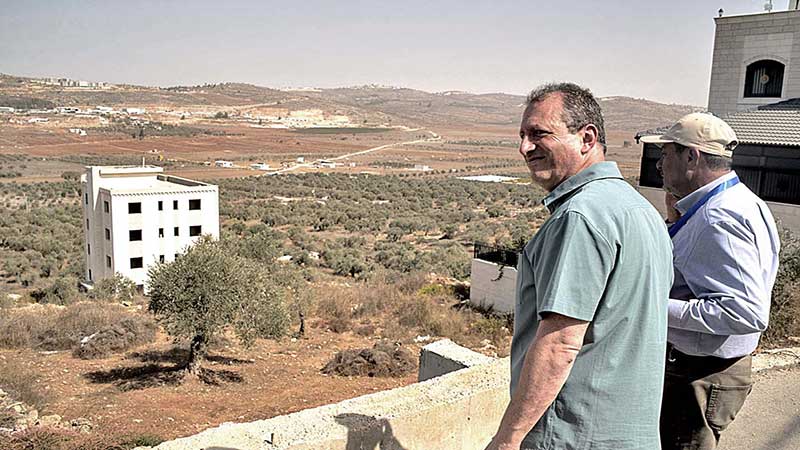


It barely made the news, and I’m sure most people reading this don’t even know it occurred. Last week, France barred Yossi Dagan, head of the Samaria Regional Council, from entering the country because of his role in establishing settlements and his advocacy for Jewish communities in areas from which Israel withdrew in 2005. Dagan himself was evicted from his home by Israeli soldiers in 2005 and advocated, and successfully returned, to rebuild his town. Israeli authorities answered the next day by denying entry to Jean-Luc Mélenchon and Mathilde Panot, two French politicians whose public statements on Israel have included accusations that Israeli officials characterize as blood libels.
Every sovereign state retains the authority to decide who may cross its borders, and that authority flows from the elementary duty of a government to shield its territory and its people from individuals it judges likely to produce disorder or lasting harm. Governments exercise this power daily through visa rules, watch lists, and border decisions that rarely attract attention until a high-profile case arises.
Countries invoke this power on concrete grounds. One argument in favor of selective bans holds that a government may refuse entry to people whose arrival would heighten domestic tensions or embolden groups that have already carried out attacks against local residents, particularly when the visitors have previously endorsed such violence or refused to condemn it. Another argument observes that a state may decline to host individuals who arrive with the announced purpose of manufacturing hostile coverage that weakens its security position or its standing with allies, since the obligation to maintain open borders does not extend to providing a platform for predetermined campaigns against the host country itself.
These considerations appear in ordinary practice when nations limit entry for those linked to organized crime, extremist networks, or efforts to stage provocations that later circulate as evidence of official misconduct.
Arguments against routine bans also carry force in ordinary relations between states. One holds that excluding elected officials can convert ordinary policy disagreements into personal disputes that later complicate practical cooperation on intelligence sharing, trade, or joint military exercises among countries that otherwise maintain close ties. Another notes that selective exclusions risk appearing arbitrary when a government continues to admit other visitors who express equally sharp criticism, thereby inviting the charge that decisions rest on political convenience rather than any consistent standard applied to all comers. Diplomatic custom often favors allowing entry and then restricting activities inside the country, yet that approach fails when visitors design their programs precisely to generate conflict at the border or in sensitive areas.
Israel has applied these considerations unevenly in recent years and has repeatedly allowed entry to American politicians whose itineraries concentrated almost entirely on gathering material that casts Israeli actions in the most negative light available. Representative Ro Khanna traveled to the region and declined repeated offers from Israeli officials to meet families of hostages still held in Gaza or survivors of the October 7 massacre, electing instead a schedule built around visits to Palestinian communities in Judea and Samaria. During that visit, his group was briefly stopped by local residents near a village in the southern hills, after which Khanna described the delay as a detention by armed settlers supported by soldiers, an account Israeli sources contested and that immediately generated headlines critical of Israeli policy. The episode supplied the material he sought, and the refusal to engage Israeli victims beforehand made the outcome predictable.
Former Representative Cori Bush and New York politician Brad Lander have joined comparable organized trips that emphasize Palestinian accounts of hardship while omitting any sustained engagement with Israeli victims of terror or with the security conditions that shape decisions on the ground. Bush has described settlers as invaders and arranged further visits under arrangements that treat Israeli authorities as obstacles rather than hosts, while Lander’s participation in olive-harvest programs produced claims of detention that Israeli officials labeled as staged provocations.
These repeated patterns leave Israel exposed to visitors who treat the country primarily as a setting for conclusions already reached before departure rather than as a place where competing claims can be weighed. The families still waiting for relatives held in tunnels, and the communities that absorbed the full force of the October 7 attacks, encounter tangible effects when foreign officials arrive, set aside their accounts, and return home with footage shaped for audiences already disposed to regard Israel as the single aggressor.
Sovereignty includes the ordinary right to refuse entry to those whose stated purpose is to produce such outcomes, and Israel can apply that standard without abandoning its readiness to host critics who arrive prepared to examine more than one side of the record. Israel should therefore block people who come solely to make the country look bad and who demonstrate no interest in acting as honest observers of the events they claim to document. No one has a right to visit Israel; it is a privilege that should not be granted to those looking to besmirch Israel’s good name.