 October 9, 2026
 Categories: Headline / Halacha & Hashkafa / Torah
A Home That Guards and Glows


Editor’s note: In last week’s Jewish Press, we accidentally published the wrong week’s column of Psychology in the Daf. We apologize to our readers and to Rabbi Simcha Feuerman. The correct column, entitled “Woe to the Neighbor: How Far the Shared Wall Must Go,” can be found on our website, www.JewishPress.com.
Chulin – Daf 135
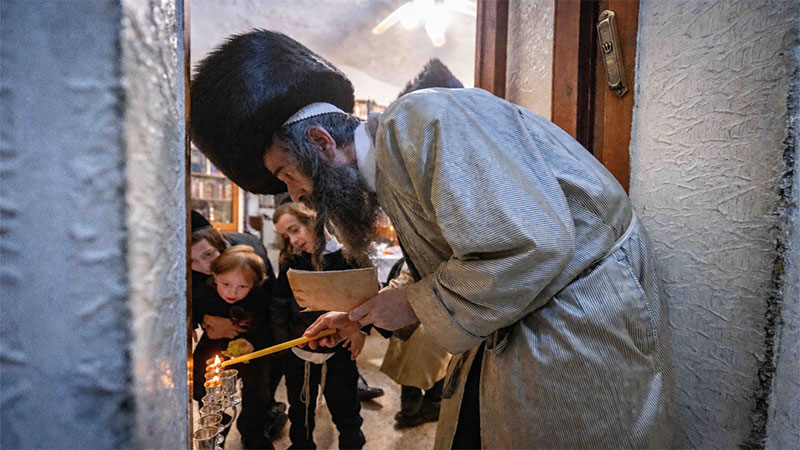
Our Gemara at the end of amud beis, heading into the next daf, speaks of the requirement that the mezuzah be placed on the right side of the doorway when facing it from the outside. Shem MiShmuel (Miketz 5) makes a brilliant distinction. The Chanukah menorah is placed on the left side – or, as he says, on the right side when facing the exit. Why? It has to do with the function of the mitzvah. The function of the mezuzah is to protect the inside from any noxious forces, physical or spiritual, that may come from the outside world. The home is to be kept sacred, and the right side mystically represents powerful and G-dly forces. However, the function of the menorah is to publicize the miracle (Shabbos 23b) – in other words, to broadcast a spiritual power outward into the world. So here, the menorah is on the right side when viewed from the point of egress.
A Jewish home is both a stronghold that protects its occupants and a source that broadcasts its spiritual energies outward. So it is, and so it shall be.
The One Who Falls: Destiny and Fences
Daf 136
Our Gemara on amud aleph discusses the mitzvah of building a maakeh, a protective fence around a roof to prevent someone from accidentally falling. The relevant verses are found in Devarim (22:8): “When you build a new house, you shall make a fence for your roof, so that you do not bring blood-guilt on your house if the one who falls shall fall from it.”
The Hebrew phrase is interesting because it implies that the person who could fall from the roof, we are commanded to protect is somehow “one who falls” – that is, someone destined to fall.
Our Sages picked up on this nuance and commented in Shabbos (32a): “In a similar vein, Rav Yitzchak son of Rav Yehuda said: A person should always pray that he will not become ill, and if he becomes ill, they say to him: Bring proof of your virtue and exempt yourself. It is preferable for a person not to be forced to prove that he merits staying alive, as he might not be able to prove it. Mar Ukva said: What is the verse that alludes to this? As it says: ‘When you build a new house, then you shall make a fence for your roof, that you bring not blood upon your house, if the one who falls falls mimenu [from it, or from him]’ (Devarim 22:8).’ He explains: Mimenu – from him proof must be brought. When one falls from his previous situation, it is his own responsibility to prove his innocence and emerge unharmed.”
“The school of Rabbi Yishmael taught: What is the meaning of the phrase ‘if the one who falls falls from it’? This person was destined to fall from that roof from the six days of Creation; it was ingrained into nature. Although he did not yet fall, the verse calls him ‘one who falls.’ Nevertheless, the owner of the house is indicted for this, as merit is engendered by means of the innocent and guilt by means of the guilty.”
The Gemara is grappling with the tension between predestination and human intervention. While much ink has been spilled on the philosophical and theological paradoxes of a predestined future, the Torah clearly takes the approach that, whether we understand it or not, both can be true. (See the famous discussion between the Rambam and Raavad, Laws of Teshuvah 5:5. The Shalah also offers an original and fascinating approach to this paradox; see Toldos Adam, Beis HaBechirah.) Suffice it to say that on a practical level, we believe that although there is a fate that is likely to some degree, it can still be averted through merit and/or preventive action. We are not allowed to behave with fatalism but rather must always strive to prevent harm through both actions and prayer in order to merit safety and success.
I will offer an original peshat on the phrase “the one who falls.” One would think that those who are suicidal will find a way to carry through with their intentions. For example, if there were a bridge with no guardrail, and statistically X number of people jumped off it each year, if you put up a guardrail and there were another bridge three miles away, the same approximate number would still commit suicide. They would simply find the next bridge. Yet study after study has proved this not to be the case.
This is known in the clinical literature as reducing the availability of means. Its effect was demonstrated during the period when England switched from coal to gas heating. Until the 1960s, domestic utility gas (coal gas) in the United Kingdom contained high levels of toxic carbon monoxide. It accounted for roughly 40% of all suicides in England and Wales in 1963. When the country switched to a less lethal form of gas, annual suicides in England and Wales dropped significantly, even though there are, of course, other ways to kill oneself. The same has been noted in numerous studies in which railings were built along a bridge. Even if other local bridges do not have railings, the suicides go down.
With these findings in mind, I believe the Torah presaged this counterintuitive psychological trend. “The one who falls” could be referring to someone with suicidal intent. The Torah is saying: Even though people might have the intention to do themselves harm, you are commanded to make a fence, and it will have an impact.
Sheepish Holy Words
Daf 137
Our Gemara on amud beis notes that there are linguistic differences between Biblical Hebrew and Rabbinic Hebrew: “When Isi bar Hini ascended from Babylonia to Eretz Yisrael, Rabbi Yochanan found him teaching the Mishnah to his son. Isi taught that the obligation of the first sheared wool applies only in the case of sheep [rechelim], the masculine plural form of rachel, meaning a sheep. Rabbi Yochanan said to Isi: You should teach him using the term rechelos, the feminine plural form. Isi said to him in reply: I teach the Mishna in accordance with that which is written: ‘Two hundred rechelim’ (Bereishis 32:15). Rabbi Yochanan said to Isi: The language of the Torah is distinct and the language of the Sages is distinct – i.e., these are like two separate languages, and the Sages do not always use the same forms that appear in the Bible. In this case, they use rechelos rather than rechelim.”
The idea that Rabbinic Hebrew and Biblical Hebrew are different could just mean that language usage shifts over time, as the Ran in Nedarim (2a) says: Language is merely based on agreement about terms. However, it also could have theological overtones. The Torah is Divine and each word must have its own reason; there can be no synonyms, as the Malbim asserts in his introduction to his commentary, found at the beginning of Yeshayahu. Additionally, the Sages may deliberately choose to use a different word in order to emphasize an idea. For example, the Gemara (Kiddushin 2b) states that the Sages changed the word for marriage from “acquire a wife” (kinyan) to “sanctify [or dedicate] a wife” (kiddushin). I heard from Rav Avigdor Miller, zt”l, that the Rabbis wanted to stress a sense of holiness in marriage and not have it compared to a mere transaction.
Gan Na’ul, in his introduction, makes an observation about the accuracy of Biblical Hebrew compared to Rabbinic Hebrew, which can sometimes be based on usage and vernacular. He notes that in the Torah, the sun is described as coming or going – “U’va hashemesh” (Bereishis 28:11) – but never as setting (shekiah). Shekiah is a rabbinic term. This is because “setting” is inaccurate. The sun never actually sets; the earth simply orbits around it. But relative to the person, it can be seen as coming or going.
He further suggests that even though Rambam and Ramban famously debated the reason why Hebrew is called lashon kodesh, the holy tongue (Moreh Nevuchim III:8 and Ramban on Shemos 30:13), there is another reason: “Kodesh” also means to specify, which is why it is also used to connote sanctification, but not exclusivity. After all, prostitutes are called kedeshah or kadesh because they are set aside for that particular activity – and of course, not because they are holy. The actual word kadesh means “set aside” (see Rashi on Devarim 23:18.) Therefore, Hebrew is lashon kodesh because its words are specific in their meaning and have no synonyms.