 October 16, 2026
 Categories: Interviews and Profiles
A Seat at the Table with Mitchell Silk
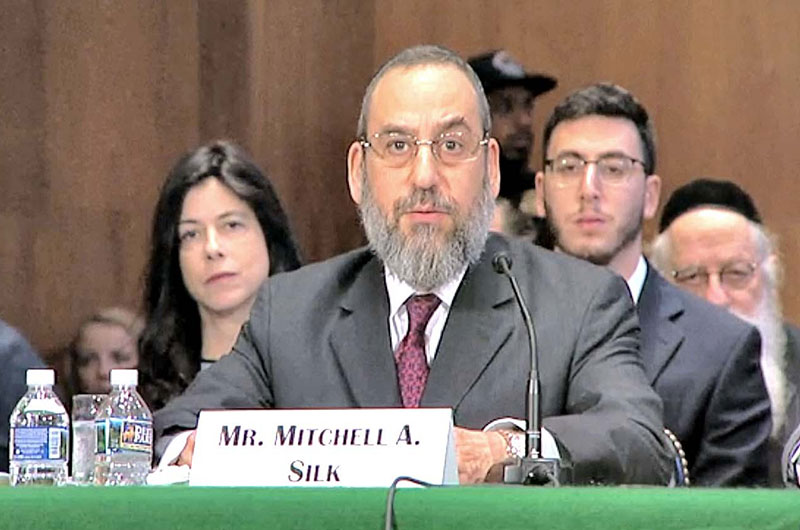


Mitchell A. (Moishe) Silk is a former assistant secretary for International Markets at the U.S. Department of the Treasury and the first chasidic Jew to hold a senior position in a U.S. presidential administration. A graduate of Georgetown University and the University of Maryland School of Law, Silk is fluent in Mandarin and Cantonese, and actively engages in pro bono work within the Jewish community. He currently serves as group general counsel of Waterton Global Resources and the Cedarfield Group.
Silk recently published a book about his experience, A Seat at the Table: An Inside Account of Trump’s Economic Revolution. The Jewish Press sat down with him for an interview to discuss his amazing career and the lessons he wants to share with the Jewish community.
The Jewish Press: Why did you call your book A Seat at the Table? And how did you get a seat at the table as Assistant Secretary for International Markets at the United States Department of the Treasury and the first chasidic Jew to be confirmed by the Senate for a senior federal role?
Mitchell Silk: Firstly, I wanted to use this book as a vehicle to communicate how President Trump has ensured that the U.S. has a seat at the table in matters that are important to the country, and how he has done that by putting America’s interests first. That is not to say that the President has looked at America’s interests to the detriment of other countries. Rather, this book takes a look at how Trump has conducted America’s affairs, particularly foreign affairs, in a way that puts our interests first.
Secondly, I want readers to know that they can have a seat at the table too as it relates to policy and events that have an impact on them. It is important for members of our community to participate in public policy. Vote – but this is not enough.
We need more people involved in communal battles on a volunteer basis, particularly on the pro bono level. Every lawyer has to do 50 hours of pro bono work. Look at all the Jewish lawyers out there, both religious and non-religious. There are thousands. Multiply that by 50 hours – that’s a lot of pro bono support. And this can be expanded to other fields such as accounting and social work. We need more participation from the people who are in a position to provide it who are not presently doing so. I find that people always go to the busiest person because they get the job done. This is not a reason for others to not chip in.
Thirdly, I want A Seat at the Table to serve as a vehicle for showing how I furthered the country’s interests and our community’s interests, which led me to living a more fulfilling life. I demonstrate this through the Four P’s, as referenced in my book. Perseverance: It takes a lot of hard work. Divine Providence: how hashgacha pratis factored into my growth and successes. Personal touch: how I used bonding with people and the best sides of our culture, such as having my counterparts in government over for meals and doing kind things for others. This has assisted in succeeding more than the formal one-on-one bilateral meetings I might have in my office or overseas. Progress over perfection: [This] means that while we have to aim for perfection, we can settle for progress.

As we saw from the recent mayoral election in New York City, it’s important to get out the vote, to have representation.
Absolutely. That point is all the more important post-election; I feel things are going to get more challenging. I oversee the United Talmudical Academy/Satmar School system. On the issue of substantial equivalency, we had some bumps in the road but secured a victory with the most recent decision in September before the Albany Supreme Court. However, I am concerned with the new mayor. I have been working on the corporate restructuring of UTA for over 10 years – I feel like I’m giving back to 50,000 kids by demonstrating to the government that the school system is in compliance. There are a lot of battles: special education, equivalency, discrimination… These battles will be harder to fight under the new mayor.
A lot of issues that our community faces receive pushback due to politics. You have the extreme left and the extreme right, with the Jews caught in the middle of political forces. It’s in this vacuum that we find fighting for our children’s educational needs so challenging. I am concerned, though, that these are going to be all the more challenging with this new mayor.
What was the most satisfying pro bono matter you’ve worked on?
Each case has provided me the utmost satisfaction as a lawyer and helped me satisfy a piece of [my] existential purpose – [to] help others. When I left Treasury and returned to Agudath Israel as chairman emeritus – I was chairman of the Pro Bono Legal Services Network at Agudah before joining the federal government, but left that position when I was confirmed – I encouraged other lawyers to get involved because we should all do pro bono work.
I was mainly involved in child cases. This usually involved children who were caught in custody battles. There was one case that spanned over four years. There were dwelling and educational issues. We succeeded in moving the child to a warm, caring, and Jewish environment (after he was in foster care). He is now a fine yeshiva bachur who is getting married soon.
A mother was pregnant when she and the unborn child were killed in a hit-and-run. The grandparents took the surviving two little girls to Switzerland for vacation. Their father came to me when the grandparents would not return the two children. We succeeded in getting them back under the Hague Convention after a lengthy legal battle in two countries.
How did you end up finding the Jewish community in Kaifeng, the capital of China during the Song dynasty, specifically its shul?
It was a dream of mine for many years to understand the very rich history of the Jews of China. Dara Horn wrote a best-selling book, People Love Dead Jews, in which she writes about a number of ancient Chinese Jewish communities, Harbin amongst them. Kaifeng was the oldest one. Shanghai had a historical Jewish community as well. During World War II, the Mir Yeshiva came through; you also have Iraqi traders as well (the Kadouri and Sassoon investors) who came through thereafter.
When I was in college, I took a course on the interactions between the West and China. I had received a government fellowship to study and teach in China in 1986. At the top of my bucket list was to visit Kaifeng. My friends and I took an overnight train to spend two days there.
There were five major periods, [and] one of them was trade via the Silk Road. Iraqi Jews came through and set up a community. This demonstrated how China was able to absorb whole cultures; over time, this community blended into Chinese society and intermarried. To illustrate, when I was in Kaifeng, I met the granddaughter (who was not halachically Jewish) of the last surviving Jew of that community. She wasn’t too interested in discussing the community, though. My theory was that we had arrived shortly before Rosh Hashanah and that she was upset we had not brought her a honey cake!
As a foreigner, I had to register with the State travel agency. I presumed, rather naively, that they would know where the remnants of the Kaifeng Jewish community were. We found the shul, which still had Hebrew inscriptions on it, but was turned into a Chinese government factory. There is also a Jewish cemetery, which we did not make it to. In the 1980s, the Chinese government was very much anti-religion. We didn’t get anywhere with the communist government’s travel agency.
Was it easy for you to live as a religious Jew while working overseas?
In Hong Kong, it was fairly easy to be a religious Jew. When my wife Yocheved and I arrived as a young married couple in 1992, with our two oldest children, there were three shuls (as the joke goes). You would go to one shul, [another] one was an option, and one you would certainly not go to. Essentially, there were three Orthodox minyanim. We were also joined by members of other communities. All in all, there was a smattering of shuls, restaurants and groceries. Talk about a smallish out of town community! You could also get cheap help, which made childcare and kitchen help easier. We hosted a lot of guests each week. We made it work. As my wife says, “Shabbos waits for no man.” And as it says in the Gemara, “A person’s wife is his home.” (Yevamos 62b). This holds true in Hong Kong or Borough Park – I couldn’t have done it without her. We had a good 15 years there.
Did the various battles you fought prepare you for Covid-19 and the passage of the Coronavirus Aid, Relief, and Economic Security (CARES) Act, which provided emergency assistance and health care response for individuals, families, and businesses affected by the pandemic?
Yes. I was confronted with two challenges during Covid. The first was personal: I could not go to shul; children could not go to school. My wife and three children (who were still at home) were living at home in Brooklyn. I would come home from Treasury [in Washington] for Shabbos. Due to the fact that there was no in-person schooling, my wife and kids joined me in D.C. for quite a few months. My kids went on Zoom. My wife ensured the kids did their work and also engaged in outdoor activities. Nothing could have prepared us for what we faced – it was a matter of how we approached it.
Explain how the principle of “The greater the darkness, the brighter the light that follows it” materialized itself in your life?
During Covid, [I faced] one of the greatest challenges of my career, which was keeping the airlines running. This was a $94 billion program under the CARES Act. We had to ensure airlines could meet 70% payroll. We also structured loans to the airlines to help them meet their needs. There was nothing to prepare us for this. Treasury required us to get the funds out the door within the first 10 days of the program.
It’s a big piece of hashgacha pratis that I had the experience to bring light into the darkness. My law firm work helped my work on funding the airlines in a way. While I was an associate, I engaged in credit documentation and created a form to help me churn out documentation quickly. This was extraordinarily helpful with the CARES Act. In Hong Kong, I helped restructure a billion-dollar enterprise. The pressure was immense; the volume of the work was crazy. We also had to restructure the company by a deadline to the satisfaction of the creditors. This also included refinancing. If we missed the December 31, 2001 deadline, the government would have pulled support for the project and all would be for naught. The shockwaves from the default of this company would have been felt throughout China and the Asian market.
The lead negotiator for China even called you “Comrade Su,” a title reserved for members of the Communist Party, as opposed to Mr. Silk.
He associated me with one of his buddies! This goes to show you how effective this approach is – the “personal touch.”
How did you apply the lessons you learned from your Zaidy to trade negotiations?
Zaidy Friend was only 5’2”, but to me he was the tallest man in the world. He had suffered from malnutrition as a young man in Eastern Europe. He stood for justice. Zaidy Friend would not back down. He didn’t have an Ivy League degree (not that this is so prestigious today), let alone a formal education, other than his yeshiva studies. Zaidy Friend had principles and knew how to apply them to each circumstance. How do you explain how a short guy with no political connections or secular education was able to lead an effort to build the Jane Adams Homes, the first government-subsidized public housing project that didn’t just benefit Eastern European Jews, but all immigrants in Chicago?
I am able to recognize a set of circumstances that needs solving and I try to fix it. This is the best lesson I learned from Zaidy Friend (without speaking to him about it). He was a hard worker. His house wasn’t filled with sefarim simply because the money wasn’t there. Yet he could pull up pesukim and Gemaras from the top of his head like there was no tomorrow. He quoted Tehillim. Zaidy Friend was an extraordinary old-timer.

When you were interviewed by David Malpass for Treasury, you brought along shmurah matzah and Israeli red wine – tell us about that.
This goes to personal touch. The interview was held a few days before Pesach. I had done my homework and learned that David and his wife Adele hosted hundreds of extended family members for Passover sedarim, a tradition that has continued for over a hundred years. David and Adele were touched by my gift. It was an attempt at kiruv, kindness, and relationship-building.
How do you negotiate with a political leader whether it’s a Trump or a Mamdani? Historically, we’ve had our friends but also our enemies in charge of the government. How do you speak to both?
You have to find commonality. You have to advocate firmly and zealously. The issues confronting us today and the environment are the base. The backdrop is complex; we need to advocate.
A key challenge for our community is finding more people in various fields who are willing to chip in. If more attorneys and others would step up, they would end up leading a much more fulfilling life. Countless hours can lead to countless lives being saved.
However, we can all give back. Don’t listen to me. Take to heart the words of Rav Moshe Feinstein, zt”l: You are required to give maaser (1/10) of your time as well. [Even Ha’ezer, Chelek 7, Siman 26]. Volunteer in whatever field you are in for the greater good of the community.
Can you share a thought from the Kedushas Levi for Chanukah to leave our readers with?
The Kedushas Levi teaches that the miracle of Chanukah was not only the victory over our enemies, but the revelation that even a single Jewish light can push away immense darkness. The Greeks sought to erase our Torah and identity, yet the small flame that endured showed that the Jewish soul carries a Divine strength that no power can extinguish. In moments of hostility or uncertainty, such as those confronting Jews globally, and particularly New York City, Chanukah reminds us that the Jewish response is to increase our light – with more Torah, more connection, and more courage – because when the world grows darker, the Jew grows brighter.
If readers from any background or experience want to share in this mission, they can reach out to Agudath Israel of America at agudah.org/agudah-legal.