October 2, 2026
 Categories: Halacha & Hashkafa / Headline
A Simple Shalom: Discovering Jewish Brotherhood in Everyday Encounters
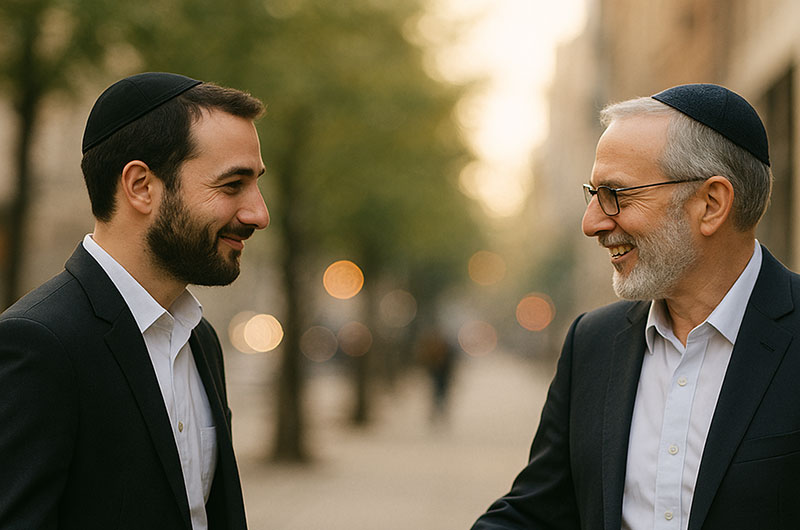


Two Jews pass each other at the airport – one returning from a business trip, the other heading to Israel. Their eyes meet briefly, then drift away. No smile, no nod, no “Shalom.” They could have been strangers. But are they?
The Torah insists otherwise. We are not strangers – we are siblings.
Our tradition commands us not only to believe in unity, but to live it in how we see, greet, and care for one another. Yet in the modern Jewish world, even as antisemitism surges and haters of Israel celebrate our struggles, many Jews still pass one another wordlessly on the street, in airports, and even in shul. We can mobilize instantly in a crisis – yet in ordinary life, we look past each other. If ever there were a time to greet one another as family, it is now.
The Torah doesn’t merely encourage kindness – it commands us to act toward every Jew as toward a brother or sister. Here are just a few of the many commandments that reveal the Torah’s vision of how Jews should see and treat one another:
“Ve’ahavta l’re’acha kamocha” — “Love your fellow as yourself.” (Vayikra 19:18)
“Lo tashich l’achicha” — “Do not charge your brother interest.” (Devarim 23:20)
“Lo teilech rachim b’amecha” — “Do not speak gossip among your people.” (Vayikra 19:16)
“Pato’ach tiftaḥ et yadecha lo” — “You shall surely open your hand to him.” (Devarim 15:8)
“V’chai achicha imach” — “Let your brother live with you.” (Vayikra 25:36)
These mitzvot are not natural human impulses. It is not natural to love another person – especially one outside your family – as you love yourself. It is not natural to forgo interest when lending money, particularly when the lender sacrifices potential income or when the borrower has means but prefers to use yours. And it is certainly not natural to restrain a negative comment after being insulted or wronged. Yet the Torah calls us to rise above what is natural – to live as family. Just as one instinctively loves a biological brother, would never charge interest to a parent, or speak ill of a sister, so too must we relate to every Jew: not as an acquaintance or neighbor, but as kin.
Pirkei Avot (4:15) teaches: “Be first to greet every person.” Greeting others is not mere courtesy – it is a mitzvah, and perhaps the simplest, most fundamental expression of kinship that the Torah requires.
When We Pass Each Other Like Strangers
It is painful to acknowledge how often we fall short. At Jewish events, on city streets, in synagogues, we pass one another without even a nod. The Torah’s vision of Am Echad – one people – too often feels like a catchphrase instead of a reality.Even in places with large Jewish populations or gatherings – perhaps especially there – we may feel that a polite greeting is unnecessary, or even awkward. But what message do we send when we avert our eyes from one another? That our fellow Jew is unworthy of acknowledgement? That we are too busy to notice? When Jews behave as strangers, we weaken the very sense of family that the Torah commands us to preserve.
And in an age of rampant antisemitism – when Jewish people are vilified, targeted, and mocked – this silence becomes even harder to justify. When the world scorns us, unity should come naturally. When others cheer our tragedies or attack our homeland, we instinctively draw closer. But, we often reserve our solidarity for moments of crisis. When tragedy strikes, we rush to help the sick, comfort the bereaved, and raise needed funds. But day to day, how many silent emergencies pass us by – the loneliness, financial strain, heartbreak, or quiet despair that could be softened by a warm “Shalom Aleichem”? Unity is tested not just in moments of collective grief, but in moments of ordinary life.
Even our daily prayer underscores this truth. When we daven with a minyan, we merit extra divine favor. But is that because ten individuals happen to occupy the same room? Or because Hashem delights when His children gather as one family – aware of each other, caring for one another, standing as a true community before Him?
A Call to Action: Start with Hello
It starts simply: say hello. Acknowledge one another. Look a fellow Jew in the eye and say “Shalom Aleichem,” “Good morning,” or “How are you?” If not out of politeness, then because the Torah demands it. Our communities – across all spectrums of observance – need to model this more intentionally. Rabbanim, educators, and community leaders can remind us that greeting others is a daily mitzvah. Parents can teach their children to say hello proudly, to every Jew, everywhere. Imagine what it would mean if our schools, yeshivot, and shuls treated every greeting as a small act of ahavat Yisrael.We often say Kol Yisrael Areivim Zeh Bazeh – all Jews are responsible for one another. But we cannot uplift someone we refuse to see. So the next time you pass another Jew – in the airport, at the mall, on the street, or in shul – remember that this is not a stranger. This is your brother, your sister, your family. Say hello. Smile. Nod. Offer warmth.
If we can unite in tragedy, surely we can unite in daily kindness. If we can rush to help one another in emergencies, surely we can acknowledge each other in ordinary moments.
Think about this: if you had the power to uplift a lonely person or someone in pain, would you use it? A warm greeting and a genuine smile can be transformative, adding light to another’s life and touching the heart. Imagine the power of thousands of small lights illuminated every day – in airports, grocery stores, shul’s, and school parking lots – just from Jews greeting one another with a simple smile, nod, hello or Shalom Aleichem.