 September 25, 2026
 Categories: Headline / Perspectives / Op-Eds
A Tale of Two Popes
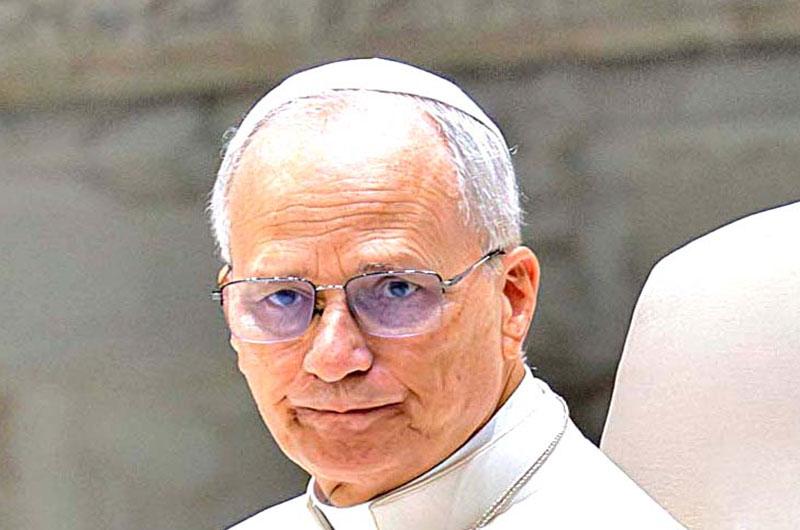


There is something deeply unsettling, and ultimately infuriating, about the spectacle of moral authority shrinking at precisely the moment it is most needed. A comparison between Pope Leo XIV and Pope Pius XII is not a comfortable one, nor should it be, because it forces a confrontation with a recurring failure at the highest level of the Catholic Church: the tendency, in moments of acute moral crisis, to retreat into abstractions about peace while the world demands clarity about evil. Pius XII is remembered, fairly or not, as the pope who spoke too softly during the Holocaust, but Leo XIV risks being remembered as the pope who speaks loudly, but in the wrong direction, flattening moral distinctions in the name of universal peace and, in doing so, undermining the very principles the Church itself developed to navigate a violent world.
To understand the force of this comparison, one must begin with Pius XII and the 1933 Reich Concordat, one of the most controversial agreements ever entered into by the Vatican. As Secretary of State under Pope Pius XI, Pacelli was the chief architect of this treaty with Nazi Germany. On paper, the Concordat was a defensive maneuver, designed to protect the rights of the Catholic Church in a rapidly changing and increasingly hostile political environment as it guaranteed certain freedoms: the operation of Catholic schools, the autonomy of Church institutions, and the protection of clergy. But these guarantees came at a steep and, in retrospect, devastating price: the Church agreed to withdraw from political life, effectively dissolving Catholic political organizations, most notably the Center Party, which had been one of the few structured forces capable of resisting Adolf Hitler’s consolidation of power.
This was not merely a bureaucratic adjustment, but a seismic shift; by removing itself from the political arena, the Church ceded ground at a critical moment. The Nazi regime, still in its early phase, gained a form of international legitimacy through the Concordat, while internal opposition weakened. Pacelli and the Vatican may have believed they were securing the Church’s survival, but the effect was to facilitate the regime’s entrenchment; it was a gamble rooted in caution, and it failed in ways that history has not forgotten and must never forget.
As pope, Pius XII continued to operate within this cautious framework. When World War II erupted and reports of systematic persecution and mass murder began to reach the outside world, he chose a path of diplomatic restraint. His public statements were carefully worded, often couched in generalities that condemned suffering without naming perpetrators. Even as the machinery of genocide became unmistakably clear, he refrained from directly denouncing Hitler or the Nazi regime in the explicit terms that many believed the moment demanded. His defenders argue that this caution saved lives, that more forceful statements might have provoked even greater brutality against Catholics and Jews alike. And, indeed, there is some evidence to support the claim that the Vatican engaged in quiet efforts to assist victims, sheltering Jews in Church institutions and facilitating escapes.
Yet the criticism remains, and it is not easily dismissed. The pope, uniquely positioned as a global moral voice, did not use that voice with the clarity and force that the horror of the Holocaust seemed to require, and at a time when evil was not subtle but systematic, not hidden but industrial, the language of diplomacy represents a bitter failure. While Pius XII did not bless Hitler, did not endorse his crimes, did not declare that resistance was immoral, he also did not stand before the world and say, plainly and unmistakably, that what was happening was evil beyond compromise and that it must be opposed with every available means.
That distinction between failing to condemn evil forcefully and actively blurring the moral legitimacy of opposing it is what brings the comparison to Leo XIV into such sharp relief. For all his caution, Pius XII never suggested that it was wrong to fight Nazi Germany; rather, he operated within a long-standing Catholic moral framework that recognized the tragic necessity of war under certain conditions. That framework, developed by Augustine of Hippo and refined by Thomas Aquinas, is known as the “Just War Theory,” which does not glorify violence; it constrains it. It insists that war must be a last resort, waged by legitimate authority, for a just cause, with proportional means, and with the protection of civilian life as a central concern, but it also recognizes a hard truth: that in a world where aggression exists, the failure to resist it can be a moral failure in itself.
Leo XIV’s rhetoric, particularly in response to the current conflict involving Iran, appears to move beyond this tradition in ways that are not merely debatable but deeply troubling. His repeated insistence that war is a “madness” to be rejected, his calls for immediate negotiation regardless of context, and, most strikingly, his assertion that “G-d does not bless any conflict,” collectively suggest a worldview in which the use of force is not simply regrettable but fundamentally illegitimate. This is not the cautious diplomacy of Pius XII; it suggests something far more sweeping, far more absolute, and far more dangerous.
Because if “G-d does not bless any conflict,” then what becomes of the moral responsibility to defend the innocent? What becomes of the obligation to stop an aggressor who is inflicting what the Church itself has described as “grave, certain, and lasting damage”? The Just War tradition does not exist to justify violence; it exists to navigate the tragic reality that sometimes violence is the only means of preventing greater evil. By appearing to reject this framework, Leo XIV collapses the distinction between aggressor and defender, between those who initiate violence and those who seek to stop it.
Nowhere is this more consequential than in the context of Iran. For more than four decades, the Islamic Republic has been associated with acts of terrorism, support for militant proxies, and a sustained hostility toward its regional adversaries, and its pursuit of advanced military capabilities, including nuclear technology, has raised the stakes to a level that cannot be dismissed with inane platitudes about dialogue. The idea that such a regime can be reliably restrained through negotiation alone is not a neutral position; it is dangerous foolishness.
This is where the argument advanced by President Trump particularly resonates, whether or not one agrees with all its implications. The claim, while stark, is inarguably correct: the alternative to confronting Iran decisively is not peace, but a world in which an aggressive regime holds the threat of nuclear devastation as leverage. In that world, diplomacy does not eliminate conflict; it freezes it under conditions of permanent coercion. To reject the possibility of force in such a scenario is not to choose peace, but to accept a different and potentially more catastrophic form of instability.
Leo XIV’s position, as articulated in his public statements, seems rooted in a kind of liberal universalism, the belief that all conflicts, regardless of their nature, can ultimately be resolved through dialogue and mutual understanding. While it is an appealing vision, one that reflects a genuine desire to transcend the cycles of violence that have scarred human history, it is also a vision that is blind to actors who do not share its premises, who view negotiation not as a path to peace but as a tactic to stall, consolidate power, and advance strategic objectives.
The frustration, and indeed the anger, that this provokes is not simply political; it is moral. It arises from the sense that a leader entrusted with profound moral authority is failing to grapple with the realities of a world in which evil is not always susceptible to persuasion. It is one thing for Leo to call for peace; it is quite another to do so in a way that appears to deny the legitimacy of defending oneself against those who would do harm.
This frustration is compounded by what many perceive as a troubling inconsistency in Leo XIV’s public interventions. He has been outspoken in criticizing policies aimed at confronting Iran, yet far less visible in responding to other instances of violence, particularly those involving Christian communities. The reported massacres of Christians in Nigeria over Easter, in which armed attackers targeted villages and churches, killing men, women, and children, stand as a grim example. Whether due to diplomatic caution, informational uncertainty, or other factors, the relative silence, or at least the lack of sustained, high-profile condemnation, must not go unnoticed.
The contrast is jarring. On one hand, sweeping denunciations of war and sharp criticism of policies aimed at countering a perceived global threat while, on the other, a more muted response to the immediate and brutal slaughter of vulnerable communities. This is not merely a matter of public relations; it speaks to the priorities and emphases of an allegedly moral leader. When abstract principles receive more vocal attention than concrete atrocities, the result can feel detached, even indifferent, regardless of the underlying intentions.
In this sense, the comparison with Pius XII comes full circle. Pius failed, in the eyes of many, by failing to speak forcefully against a manifest evil. Leo fails even the most basic moral test by speaking in a way that obscures the necessity of confronting evil when it cannot be reasoned with. One erred on the side of silence; the other, much worse, errs on the side of moral absolutism that leaves no room for the tragic but sometimes necessary use of force.
The Catholic Church’s Just War tradition was not developed lightly, as it emerged from centuries of reflection on the tension between the call to love one’s enemies (except Jews who refuse to convert; another discussion for another day) and the duty to protect the innocent. By setting aside this tradition – or, at least, reinterpreting it in a way that drains it of practical significance – Leo XIV is not merely offering a new perspective; he is challenging a foundational element of Catholic moral teaching.
And that is why the stakes of this debate are so high. This is not merely a theological disagreement about policy or rhetoric; rather, it is a question about the role of moral leadership in a world where the line between peace and coercion, between restraint and capitulation, is often perilously thin. If the Church cannot articulate a framework that distinguishes between unjust aggression and justified defense, then it risks becoming a voice that offers little guidance in the face of real-world crises.
At the end of the day, the anger that animates this critique is not rooted in hostility to the Church or to the ideal of peace, but it is rooted in the conviction that peace, to be meaningful, must be grounded in justice, which sometimes requires the willingness to confront, rather than accommodate, those who threaten it. Pius XII’s legacy reminds us of the cost of failing to speak clearly against evil, but Leo’s current posture represents the failure to recognize the means by which evil must sometimes be opposed.