 October 9, 2026
 Categories: Torah
Ad D’(lo) Yada: Facing Our World


No matter how you approach it, one specific Talmudic mandate about Purim remains remarkably strange.
Rava said: On Purim, a person is obligated to become intoxicated to the point of “ad d’lo yada” – where the distinction between “Cursed be Haman” and “Blessed be Mordechai” can no longer be perceived.
Much has been written about the practical application of this directive. Various potential paths have been suggested towards its safe fulfillment. Warnings have been issued concerning the damage that can be caused when it is followed too literally and assiduously.
But I would like to raise a more basic question. How could this mandate be issued in the first place?
Fundamentally, Judaism is a reality-based religion. We are enjoined to find G-d in our own lives and world, with our feet firmly planted on the ground. While the consumption of alcoholic beverages is certainly permitted in Jewish law, inebriation is hardly seen as a goal. The entire idea of escape, particularly through the use of external substances, is antithetical to normative Jewish thought.
How, then, could Rava mandate that, on Purim, an individual should reach a point where the distinction between an enemy and an ally is indiscernible – so intoxicated that the difference between villain and hero in the Purim story disappears in a haze?
Before we proceed, it should be noted that, on a practical level, much halachic discussion surrounds Rava’s mandate. Basing his position on numerous earlier sources, for example, Rav Moshe Isserles (the Rema) rules that the obligation can be fulfilled by drinking slightly more than usual and falling asleep. In this way, the difference between Haman and Mordechai will cognitively disappear. Certainly, the dangerous excesses that mark the efforts of many to fulfill Rava’s instruction would not be sanctioned by Jewish law.
And yet, the questions remain. Why does Rava fashion his ruling as he does? What meaningful goal will be achieved through this obligatory escape from reality?
The answer lies, I believe, in Purim’s unique place in Jewish history.
The Babylonian Exile has come to an end.
Permission has been granted for a “return to Zion.”
Very few Jews, however, take advantage of this welcome edict. The vast majority, comfortable with their lives, opt to remain in Babylon.
The exile of force has become an exile of choice.
And at this point, Hashem decides to show the Babylonian Jews the true import of their choice. He launches a series of events that will clearly reveal the nature of the world in which they have chosen to live.
It will be a world of v’nahafoch hu – of instantaneous change; a world in which your circumstances can, and will, change at a moment’s notice. You can feast at the banquet of a Persian king; an instant later, confront the threat of total annihilation; an instant later, rise to defeat your enemies in battle. You will stand on shifting sands, never knowing what tomorrow will bring.
It will be a world of hester panim – Hashem’s hiddenness. You will no longer be able to benefit from the words of prophets. G-d will be silent and, at times, even seem absent. You will experience travail without explanation. It will be your task to discern G-d’s hand in your lives and in the world around you.
It will be a world in which you will be controlled by the whims of others. Subject to the erratic behavior of foreign despots and populations, your fate will be determined by their mood each day. Your lives will be their playthings.
Above all, it will be a world that will claim as its first victim – the truth.
Right and wrong will become so intertwined that each will no longer be discernible. Verbal attacks, outright lies, each more preposterous than the last, will be hurled in your direction and accepted as truths by those around you. Villains will be fashioned as heroes; heroes will be denigrated and denounced. A lonely battle for the truth will fill your days, as you struggle to maintain your footing in surroundings that will become increasingly bizarre.
Of all the warnings conveyed by the Festival of Purim, it is the last which marks ground zero in our struggle for survival in an alien world. Perhaps that’s why Rava insists that we must reach the point on Purim where we can no longer discern Haman from Mordechai.
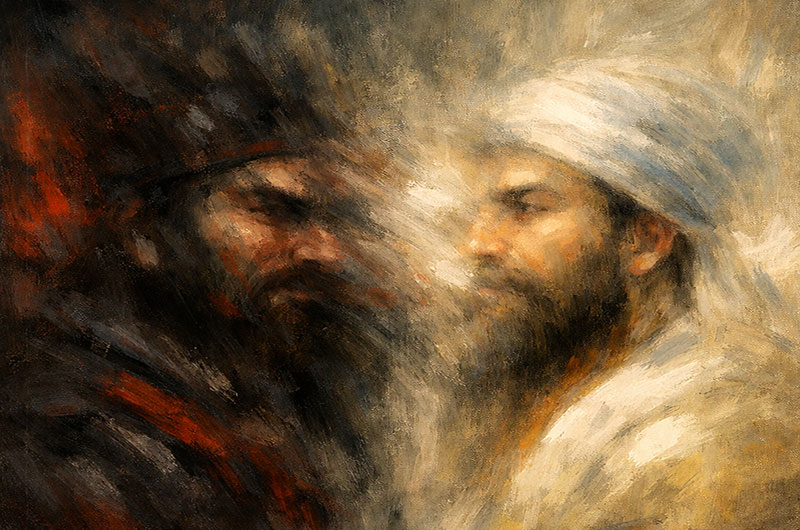
To defeat our enemies, we first must understand the nature and depth of their attack. For one day, Rava maintains, we must enter the absurdity of lies that surround us – if only to fully see them for what they are. We must enter the world of ad d’lo yada, where truth is abandoned; where right becomes wrong and wrong becomes right; where terrorists are seen as victims and victims as colonizers; where Haman and Mordechai are indistinguishable.
And then, armed with new understanding, we will be better able to struggle to change that world… From a world of ad d’lo yada to a world of ad d’yada, a world in which truth reigns supreme.