 October 16, 2026
 Categories: Community / Headline / Jewish Community / Albany Beat
Albany Beat - July 17, 2026


New Measures to Address Gun Violence in N.Y.
The past several weeks have been particularly busy in government and politics. Two examples: June saw the celebration of Dairy Month and Gun Violence Awareness Month, even though state residents are well aware that gun violence is on the rise in the state.
Dairy Month was celebrated by turning the marble center court of the Legislative Office Building, known as the Well, into a mini-farm. Assembly Agriculture Chairwoman Donna Lupardo (D - Binghamton, Broome County) is retiring from office this year, so another upstate Democrat will have to take over the reins of shepherding through animal legislation. Senator Michelle Hinchey (D - Saugerties, Ulster County) is the chair of the Senate Agriculture Committee. Hinchey is Jewish, and there was kosher food with O-U and Kof-K hechshers given away at this event.
Animals, from goats to owls, were on display, and in a rare show of bipartisanship, Republicans and Democrats posed for pictures with the animals. Elephants and donkeys – symbols for Republicans and Democrats, respectively – were not part of the menagerie on display. On the floor of both houses, legislation was passed boosting the state’s agriculture industry, New York’s number one industry and the third nationwide. New York farms are dwindling, however. Alternative sources of energy are cropping up instead, in the form of wind farms and solar farms.
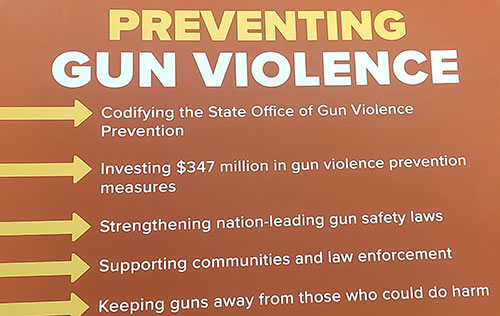
Gun Violence Awareness Month was likely the most vocal, heartbreaking, gut-wrenching, passionate, and emotional for those impacted by the loss of loved ones at the hands of deadly firearms. During the waning days of the legislative session, gun violence victims and survivors, mainly from advocacy groups based in Brooklyn, Manhattan, and the Bronx, as well as a couple of groups from Buffalo and Albany, came together to rally, hold a news conference, and meet with agency representatives at a roundtable discussion, including relevant officials from the Office of Children and Family Services, Division of Criminal Justice Services, Office of Victim Services, Office of Mental Health, Office of Community Safety, New York State Office of Gun Violence Prevention, and the New York State Police.
This is clearly a complicated problem to solve. The stories told were horrific and heartbreaking. Over a two-hour period, the agency leaders listened, took notes, and offered a few insights as to what they could do. The group of state lawmakers was led by Assemblywoman Monique Chandler-Waterman (D - East Flatbush, Brooklyn). Prior to her foray into politics, in 2008 she founded East Flatbush Village to provide support to low-income and underserved communities; the group was one of the participants at the day-long event.
During the waning days of the legislative session, on June 2, both houses of the state legislature passed “Francesco’s Law,” named for a bullied teenager who tragically took his own life, which establishes violations for the failure to safely store rifles, shotguns, and other weapons in the presence of a minor or a prohibited person, and requires the Office of Gun Violence Prevention to collect and analyze statistical and other information and data with respect to injuries or deaths of minors resulting from failure to safely store a firearm, rifle, or shotgun. The measure was sponsored by freshman Jewish Senator Erik Bottcher (D - Manhattan’s West Side, including Greenwich Village) and Khaleel Anderson (D - Far Rockaway, Queens).
Born in London on January 28, 2004, Francesco “Cochran” moved to Southampton, Suffolk County, when he was one year old, with his two mothers and older brother. His mother reports that Francesco was passionate about architecture, especially the design of cities and their infrastructure. His true love was sailing, which he excelled at due to his vice-like grip and rather long arms. Francesco loved music and showed a talent for the violin as a young boy. He got accepted into the Metropolitan Youth Orchestra, performing with them twice at Carnegie Hall and once at Lincoln Center.
As a teenager, Francesco became the subject of vicious and personal rumors and ridicule. Before his quick spiral downwards, he was a happy star student with everything to look forward to in the world. But the spiteful lies began. One night, he was unable to take any more and had an uncharacteristic night of recklessness. Although he had not set out to, Francesco ended his life on a moonlit beach in Southampton. Francesco died on October 21, 2021 at the age of 17.
“Firearms need to be locked up. If a person is in crisis and they have access to an unsecured firearm, it’s extremely dangerous. If a firearm is locked up when its owner is not using it, it is exponentially less likely to kill or injure someone,” Bottcher told The Jewish Press. “Firearms should be safely stored when their owners are not using them. If parents don’t think their kids know where their guns are, they’re kidding themselves.”
Besides Francesco’s Law, other anti-gun legislation passed this session included the Survivors First Act, a ban on a Glock switch and 3-D printed guns.
Bottcher shared that as a teenager suffering from loneliness and depression, he himself tried to commit suicide by overdosing on pills.
“I grew up in the Adirondacks in a town outside of Lake Placid, New York, called Wilmington, population 950. When I reached about adolescence, I struggled as the only gay person that I knew and the feeling of aloneness overcame me, the depression. I made the decision that I didn't want to live anymore. I tried taking my life on four or five occasions. I actually made a milkshake in the kitchen with my family all around me. The milkshake contained several bottles of sleeping pills,” Bottcher told The Jewish Press. “My mother entered my bedroom at around eight o’clock to check to see if I was okay. When she came in, she found that I was unresponsive. And I was rushed to the hospital where my stomach was pumped and I was involuntarily taken to a hospital called Four Winds Medical Center in nearby Saratoga Springs. I was 15 years old. I spent a month in the mental health hospital.
“A gun is 90 percent effective in suicide attempts. Pills are rather ineffective. The importance of making sure that people in moments of crisis can’t access firearms is of paramount importance.”
Lawmakers Weigh In on the Tallis Bag with Gun Pouch
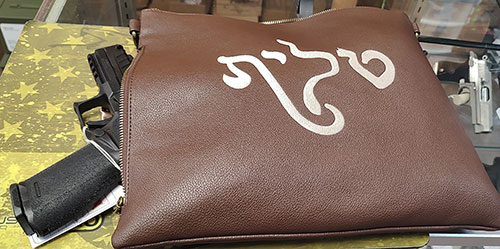
The Coral Springs, Florida-based CC Tallis, LLC is marketing a tallis bag with a zippered side pocket to carry a concealed weapon while davening. There is no lock for the zipper and a gun (pictured) fits neatly into the pouch. This is a way for congregants to get past shul security personnel who often wait at the entrance of a congregation checking for such weapons.
Reactions about the tallis bag were wide-ranging.
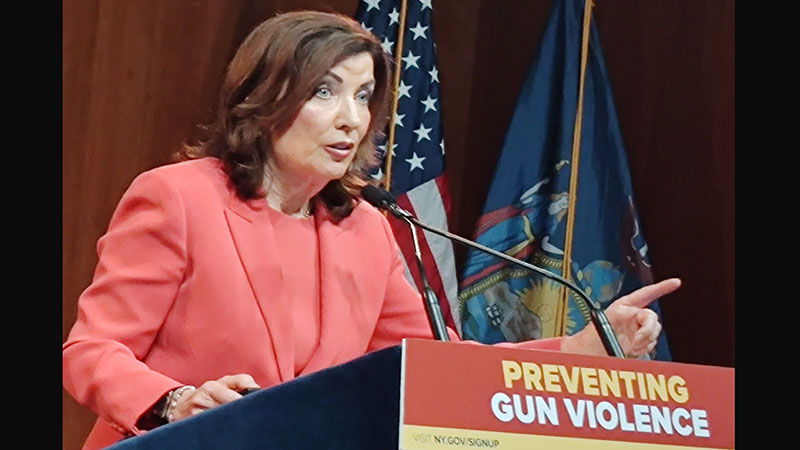
“My first reaction is you can also have a shooter hiding weapons very easily walking into a synagogue, which should give even more concern,” Governor Kathy Hochul told The Jewish Press.
“My job is to focus on public safety. We have spent a record amount of money to provide for secure grants for synagogues and yeshivas that are vulnerable. I don’t want to encourage anyone to break the law themselves and be subjected to prosecution by breaking laws.
“The Jewish community feels under siege, and there have been far too many instances [of violence].”
Hochul’s gubernatorial opponent has a slightly different take on the tallis bag with a pouch to hold a gun.
“I’m always happy when Jews protect themselves. If that’s what is necessary to protect the Jewish people, then that’s what we have to do,” GOP gubernatorial hopeful and Nassau County Executive Bruce Blakeman told The Jewish Press. “They should always keep the weapon on them. That’s the law.”
An anti-gun advocacy group also weighed in on the matter.
“Jewish communities absolutely need protection, but carrying hidden loaded guns will lead to horrific tragedies, not personal or community safety,” said Rebecca Fischer, executive director of New Yorkers Against Gun Violence, in a carefully crafted prepared statement. “Many Jewish Americans, like many Americans of other communities and faiths, are justifiably afraid of discrimination and violence right now. However, carrying hidden, loaded guns is extremely dangerous and far more likely to lead to more violence and death, not safety.”
The New York equivalent of the NRA offered an opposing view. “If you’re going to carry a concealed carry firearm, you carry it on your person. If you can’t carry it on your person something like that [the tallis bag] is fine,” Tom King, executive director of the New York State Rifle and Pistol Association, told The Jewish Press. “I’m an advocate for people in churches, synagogues, and schools to be armed because it’s the only way to stop a bad guy with a gun. It has to be done safely and you have to be very well-trained in order to do that. It’s OK to own a gun. It’s OK to have a gun for protection. If you’re going to carry it to a synagogue, a church, a school, where there would be other people who may be involved and could get hurt, training is of utmost importance.”
The state’s chief legal eagle remained neutral when asked about the tallis bag. “We cannot carry guns in the State of New York. This is not a right-to-carry state,” Attorney General Tish James told The Jewish Press. “I’m not going to opine as to whether or not it is a good idea – it’s just a state of affairs.”
One longtime Bronx Assemblyman found the tallis bag off-putting. “I don’t think it’s a good idea to have concealed weapons in a house of worship,” Assemblyman Jeffrey Dinowitz (D - Riverdale, The Bronx) told The Jewish Press. “It would never have occurred to me that that’s what [the side pocket pouch] was for because I don’t think like that in the first place. A synagogue is a place for peace.”
One member from the Republican side of the aisle is a gun-carrying Assemblyman who admits to having his firearm with him while in the legislative chamber.
“I have two guns. One is a service weapon, a 9mm Glock, and the second weapon I have is a .38 Smith & Wesson revolver. Sometimes I carry one of them with me in the Capitol,” Assemblyman Michael Reilly (R - Eltingville, Staten Island) told The Jewish Press. Reilly is a retired lieutenant with the New York Police Department, and he explains that as a former police officer, he is exempt from the restrictions against being allowed to carry a weapon into public buildings. “No one is going to look at that bag as being threatening because it is supposed to be for prayer, but if you’re using it and not a member of the congregation that would be a red flag for me.”
Reilly is also concerned about violating a person’s civil rights. “We come across a challenging situation where someone has a religious item with them and they may be hiding a weapon. It becomes the issue of do we infringe on their religious freedom by questioning what’s in the [tallis] bag? That’s something that brings us down a slippery slope,” he said. “You have to be careful with kids around. The gun is supposed to be secured at all times.”
Next week I will take a look at the winners and losers of the June primary election, how one particular Jewish patriot financed the Revolutionary War and then died broke at age 44, as well as a new Torah in a famous small upstate New York town. Can you find the Star of David on the one-dollar bill? You’ll read about it in next week’s Albany Beat column.