 October 16, 2026
 Categories: Features / Jewish Community
Antisemitism the Focus at this Year’s Jewish Legislators’ Breakfast
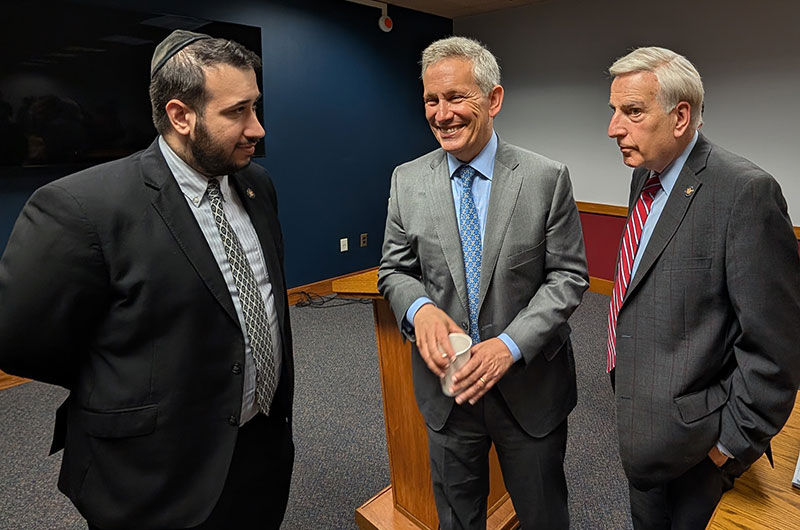


Throughout the legislative session in Albany between January and June, lawmakers often take time out of their busy schedules to attend events celebrating their own and their constituents’ ethnic, national, and religious backgrounds.
This year, celebrations included the Italian-American Day fundraiser for student scholarships at the Italian Community Center in Troy, Panamanian Day at the Legislative Office Building in Albany, the annual SOMOS conference to focus on issues important to the Hispanic community held in San Juan, Puerto Rico, the New York State Black, Puerto Rican, Hispanic & Asian Legislative Caucus’s annual Valentine’s weekend soirée in February, the Peace Islands Institute New York Ramadan Iftar dinner, and the American-Irish Legislators Society’s mid-March event at the Albany Hibernian Hall.
There are only two Jewish-oriented events during the legislative session. One is a celebration of the Lubavitcher Rebbe’s birthday where shmurah matzah is handed out to all attendees, Jewish and non-Jewish, by Rabbi Velvel Butman, executive director of the Chabad Lubavitch of Westchester County. A second event takes place in May, for Jewish-American Heritage Month. The National Association of Jewish Legislators (NAJL) – New York, chaired by Assemblyman Charles Lavine (Glen Cove, Nassau County) and Assemblyman David Weprin (D - Hollis, Queens), who is co-president of the National Association of Jewish Legislators, hosts a legislative breakfast.
Nine of the 23 Jewish members of the Assembly showed up at this year’s NAJL breakfast, along with four non-Jewish members. From the Senate, the turnout was worse. Of the five Jewish Senators, only one, Sam Sutton (D - Midwood, Brooklyn), attended this year’s breakfast.
This year’s event featured prominent attorney Henry “Hank” Greenberg as keynote speaker. His remarks focused on “The State of Global Antisemitism.” Greenberg, 64, an Albany-area resident and a shareholder at Greenberg Traurig, LLP, is an experienced trial and appellate lawyer. He served as president of the New York State Bar Association, former counsel to the New York State Attorney General, counsel to the Lieutenant Governor of New York State, Assistant United States Attorney for the Northern District of New York, and law clerk to then-Associate Judge (later Chief Judge) Judith Kaye of the New York Court of Appeals, according to his biography on the Greenberg Traurig website.
Greenberg cited several examples of global antisemitism, including an explosion at a Jewish school in Amsterdam and an attack against Israeli soccer fans in Amsterdam in which they were ambushed, chased, and beaten by organized mobs; explosions in synagogues in Belgium; gunfire at two Toronto synagogues in March of this year; the Yom Kippur massacre in Manchester, England, and the recent stabbing of two Jews in a Jewish neighborhood in North London; and the Bondi Beach attack in Sydney, Australia on Chanukah, in which 15 Jews were gunned down and many more shot and injured, including a Holocaust survivor.
Turning to this country, Greenberg said, “The U.S. is experiencing unprecedented levels [of antisemitism]. This is the most concentrated – not hyperbole – concentrated, lethal surge in Jew-hating since the Holocaust. It comes from the far left, from the far right, it comes from the middle. It is everything, everywhere, all at once.” He warned that antisemitism has “become mundane for most of America. What would have made headlines in the past, today goes unnoticed.”
“When antisemitism becomes normalized and unchecked, it poses a lethal threat,” he continued. “We are at risk of being like frogs in boiling water. The temperature keeps rising. The water begins to bubble. People don’t notice it’s happening, and then all of a sudden, it’s too late.”
Greenberg spoke passionately about the situation Jews are facing in America today, sometimes sounding frustrated by the predicament.
“How is it possible that when we’re living in a world where you need police protection to observe your faith, for Yom Kippur, for Rosh Hashanah, for any of the holy days, that’s not a scandal? Why is that not the top of the fold of The New York Times? It is as if we are walking on broken glass. And I think you know what that metaphor alludes to. How does this happen in a state where there are 1.7 million Jewish residents?” he asked, referring to New York, of course.
In his view, antisemitism “come[s] to the fore where intolerance is widespread, conspiratorial thinking is prevalent, and the value of pluralism is challenged.” He called the fight against antisemitism the fight “for the soul of America.”
“We will persevere. We will confront antisemitism with clarity and courage. We will call out those who would deny us our rights. We are here now and forever. We will endure. Am Yisrael Chai!” Greenberg concluded.
Assemblywoman Deborah Glick (D - Greenwich Village, Manhattan), who is retiring from the lower house this year, asked Greenberg about combating authoritarianism. “We are facing a lot of authoritarianism in America. What do we do about an administration that, on the one hand, seems to be supportive of Israel, but on the other hand embraces conspiracy theories that ultimately hurt us?” she asked.
To which Greenberg replied that education is part of the answer. “No one has suffered more from authoritarianism than the Jewish people. What I would say is, the basic civics education of America needs to be taught and retaught – not just in schools, by the way. The constitutional illiteracy that now exists in America is a lethal threat to democracy… People don’t understand the separation of powers,” he said.
Assemblyman Aron Wieder (D - Monsey, Rockland County) did not ask a question but read his prepared comments: “We are strongest when we stand together as one people, as Jews. We have a responsibility to stand with one another and defend one another. Too often we see Jews allowing themselves to be used as token Jews, to legitimize hatred against their own people, believing that appeasing those who hate us will somehow keep them safe or accepted. History has already judged that illusion. The cemeteries of Europe are filled with Jews who thought distancing themselves from their people would save them. It did not. Our responsibility is not to seek approval from those who despise us. You will never get it. [It is] to stand with our own people with clarity, dignity and courage. The real question is: If Jews will not stand up for one another, who will?”
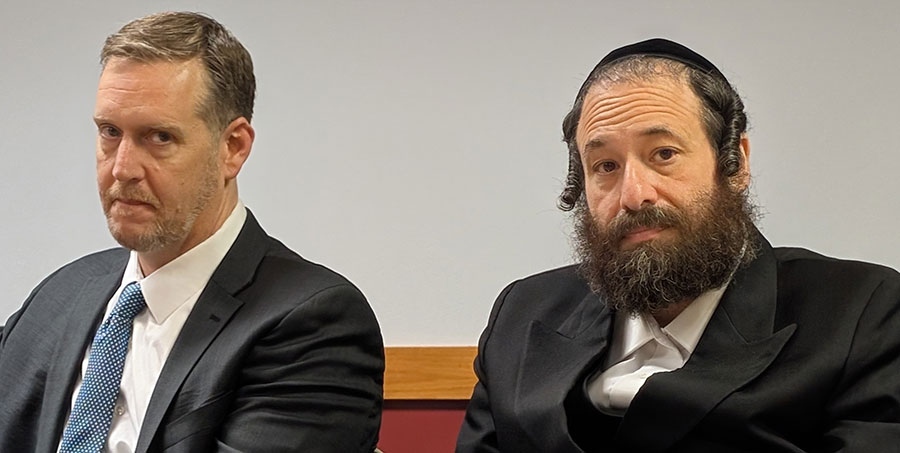
Ed Braunstein, 45 (D - Bay Terrace, Queens), a Catholic, wanted Greenberg’s thoughts about social media’s contribution to the rise of antisemitism.
“How much do you attribute the rise of antisemitism to social media – people with the algorithm and people getting reinforced information that kind of validates their viewpoint? That has to be part of what we’re seeing,” Braunstein remarked.
“It is a force multiplier of the absolute worst,” Greenberg agreed. “Social media has become a blight on our culture in a myriad of different ways because what you’ll see is hundreds, if not thousands, of posts spewing the most venomous antisemitism you could imagine. I’m not just talking about Zionism [and] Israel. I’m talking about the most grotesque posts calling for violence and attacking Jews… We live in these spheres where increasingly people are getting their news from the social media outlets of their desire, with algorithms to just feed what they want. If you just have a little bit of hate, all of a sudden, your post will start to get flooded with a lot of hate. It is a huge contributor.”
Twenty-eight of the 213 members of the Legislature in both houses are Jewish, translating to 7.6 percent. Thirty-two members of the state Legislature represent a significant number of Jewish constituents, translating to 6.6 percent in both houses.