 October 23, 2026
 Categories: In Print / Halacha & Hashkafa
Building The World Within


Zevachim - Daf 54
Our Gemara on amud beis describes Dovid HaMelech and Shmuel’s process for determining the proper area to build the Temple:
Rava taught: What is the meaning of that which is written concerning David: “And he and Samuel went and dwelt in Naioth. And it was told to Saul, saying: ‘Behold, David is at Naioth [beNayot] in Ramah’” (I Samuel 19:18–19)? But what does Naioth have to do with Ramah? They are in two distinct places. Rather, this means that they were sitting in Ramah and were involved in discussing the beauty [benoyo] of the world, i.e., the Temple.Does the search for the Temple’s location end with King David, or does every generation search for a place to bring the Shechinah? What is the meaning of the Temple as the “beauty of the world”?
Nefesh HaChaim (Gate 1:4, hagah) explains the symbolic structure of the Temple and the order of the universe. The various structures, rooms, and compartments represent and channel different dimensions of reality and celestial worlds. The building of the Temple was considered equal to the creation of the world (Midrash Tanchuma, beginning of Pekudei). It is no coincidence that Betzalel, the builder of the Mishkan, was endowed with mystical wisdom to manipulate Divine names and letters to create worlds, as described in Berachos 55a.
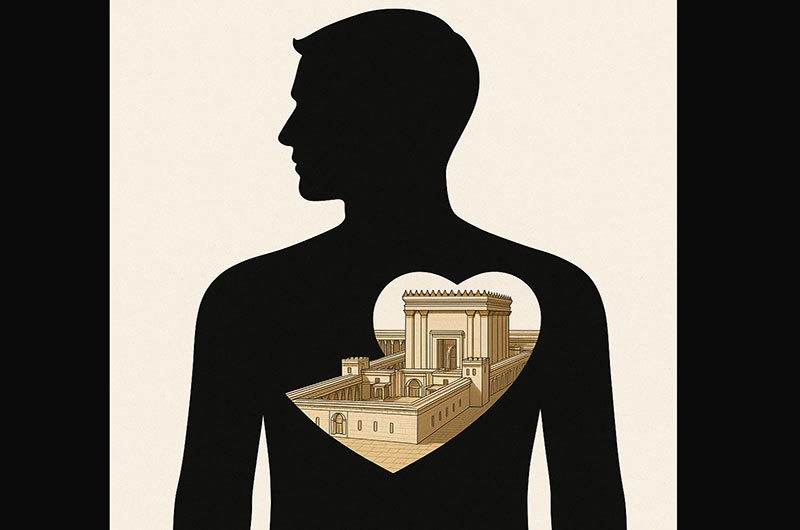
Nefesh HaChaim goes further to declare that even the human body is its own version of the Temple, and also a universe. The verse states (Shemos 25:8): “And you shall make for Me a sanctuary and I shall dwell in their midst.” The verse says “their,” not “its,” implying that the Shechinah will dwell in each person of Israel if they sanctify themselves like a Temple. This is what is meant by the Talmudic adage: “The deeds of the righteous are greater than the creation of heaven and earth” (Kesuvos 5a).
When the verse says about the Mishkan (Shemos 25:9), “And so you shall do,” and the Gemara (Sanhedrin 16b) infers “so you shall do for the generations,” it means that we all can create a dwelling place for the Shechinah within ourselves. While we pray and wait for the restoration of the Beis HaMikdash, we have plenty of work to do within ourselves to bring about internal redemption.
The Day After Thanksgiving
Daf 55Our Gemara on amud aleph discusses the rule of the Thanksgiving offering: It can only be eaten on the day and subsequent evening of its offering. A Thanksgiving sacrifice is brought in response to an event where a person was in mortal danger and was saved. This one-day time window is different from other Shelamim, which allow an additional day.
The Abravanel (Tzav) explains that since the owner has only one day to eat all that meat, he will invite others to join, which will help publicize and celebrate his thanksgiving event, such as if his life was miraculously saved.
Sefer Daf al Daf quotes the Imrei Emes, who offers a thought-provoking answer. Really, miracles happen every day; therefore, if we celebrate this particular miracle for more than one day, it encroaches on recognition of other miracles that belong to the next day. Symbolically, if we extend this Thanksgiving offering to the next day, it diminishes the recognition that truly every day is miraculous.
Occasionally we experience events so out of the ordinary that we find them miraculous because we are not used to this manifestation, even though existence itself is a miracle and, even within our own bodies, we find miracles and wonders. We use those moments of inspiration to heighten our recognition of the wonders of the world and G-d’s providence – but not because miracles don’t happen all the time.
The Gemara (Succah 29a) states: “When the sun is eclipsed, it is a bad omen for the entire world. To what is this matter comparable? To a king who prepared a feast for his servants and placed a lantern before them to illuminate the hall. He became angry and said: ‘Take the lantern from before them and seat them in darkness.’”
How can we make sense of this when we know an eclipse is an astronomical event, predictable and not reactionary? Thales predicted a solar eclipse in 585 BCE, and the rabbis may have known this as well – they were aware of Halley’s Comet (Horiyos 10a).
The Gemara (Horiyos 12a) describes anointing new kings by a spring so that their kingdom will continue like the flowing water. The Meiri explains these symbolic acts are not magic tricks but rather arouse awareness and encourage more fervent prayer. Similarly, we can consider the eclipse not as a divinely timed punishment, but a natural event that induces awe, reminding us to improve – because without G-d’s Providence, we can suffer everything, including the loss of the Sun itself.
A so-called overt miracle simply arouses us momentarily, but in truth, it is no more miraculous than everyday life. Just as we celebrate anniversaries or birthdays to focus on love and recognition for someone we always love, miracles remind us to focus on the Divine wonders we live with constantly.
It’s All About the Base
Daf 56Our Gemara on amud beis discusses the laws of the firstborn offering, the animal tithe offering, and the Paschal offering: “Their slaughter is anywhere in the Temple courtyard, and their blood requires one placement, provided that the priest places it so that the blood goes on the base of the altar.”
These offerings do not require sprinkling the blood on the altar’s corners, likely because they are not for explicit sins. Yet there is one minimum requirement – that the blood reaches the base of the altar.
Rav Kook (Olas Re’iyah, Eizehu Mekoman 45) brings a deep explanation. The three sacrifices represent three domains by which holiness spreads into life. The firstborn offering represents holiness inherent in nature itself – sanctified from birth. The tithing offering represents acquired possessions and wealth, which can also be imbued with holiness. Finally, the Paschal sacrifice, brought by the community, represents holiness manifesting within society.
As the Mishna states, “The slaughter can be anywhere in the courtyard, so long as the blood is all poured to the foundation of the altar.” Poetically, this implies that diverse spheres can channel holiness in their own way, so long as they ultimately return to the same base.
In each aspect of life – natural, personal, and communal – sparks of holiness can be revealed. The success lies in keeping the ultimate goal of unity and Divine service rooted at the base of the altar.
Procrastination Nation
Daf 57Our Gemara on amud beis discusses one of the Rabbis’ interesting practices regarding mitzvos whose deadline was the end of the night. The Paschal offering must be consumed by midnight, though technically it can be eaten all night (according to Rabbi Akiva). Similarly, Berachos (2a) explains that one has the entire evening to recite Shema, but the Rabbis required it by midnight. The reason offered is that by making an earlier deadline, a person is less likely to delay, fall asleep, or forget.
Logic operates one way, and “psycho-logic” another. Logically, giving people more time to accomplish a mitzvah should increase observance, not decrease it. Yet human nature works differently: The more time we have, the more comfortable we feel to postpone, and we often slip into a pattern of avoidance and non-action. On the other hand, if we have a shorter timeframe – which raises the pressure – it becomes harder to avoid, and we enter behaviors of immediacy and accomplishment. In this case, less is truly more.
It is a painful but universal truth that scarcity tends to breed appreciation. The less time we have, the more we accomplish; the more time we have, the greater the tendency to accomplish less. The brevity of life is painful, yet it is our very fragility and mortality that elicit appreciation and enjoyment in life. The Gemara (Sotah 46b) tells an aggadah about a legendary city called Luz where the Angel of Death had no jurisdiction. Yet it was observed that when an elder eventually grew disgusted with life, he would commit passive suicide by walking outside the gates and letting the Angel of Death reach him. The longer the people lived, the more bored they became.
I don’t believe that this discussion about deadlines and procrastination finds itself on the first page of the Talmud by accident. The rabbis were winking at the student who had just begun his journey in Shas: “Don’t think you have all the time in the world. Don’t procrastinate – start working on your studies right now.”