October 2, 2026
 Categories: Features
Charitable Appeals Gone Amok
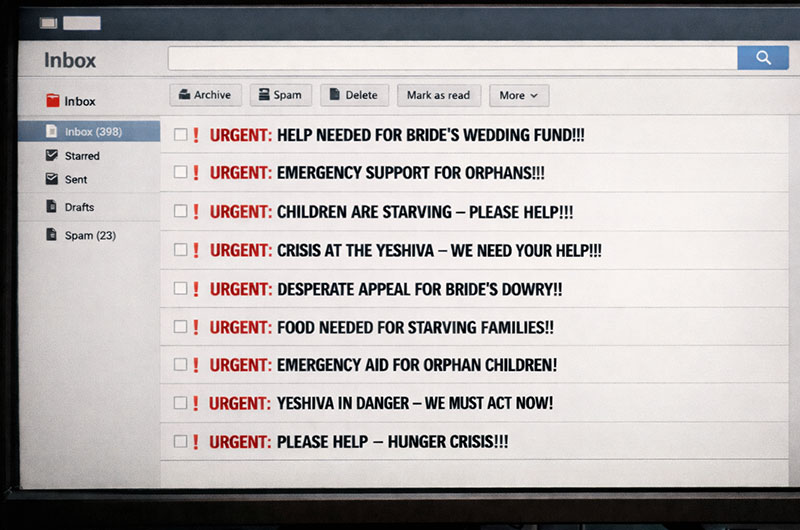


You might call me Ebenezer Scrooge (apologies to Charles Dickens and Herman Melville).
But I’m not really a tightwad. My wife and I contribute several thousand dollars a year to charity, even though my having to give up my part-time tutoring job to care for her leaves our household budget running a deficit of hundreds of dollars a month. (Whether we come close to meeting the requirement of tithing depends on what we’re taking 10% of – pretax income, after-tax income, income net of Medicare premiums...) No, my problem isn’t with giving – it’s with the increasingly aggressive ways in which many charities do fundraising.
In the good old days, soliciting for charity was simple: The organization sent an envelope containing a cover letter, a form for the donor’s name, address, phone number, and amount donated, and a return envelope – occasionally a business-reply one from the larger organizations, meaning postage is not required. (Email address was subsequently added.) In recent years, however, the process has become more complicated. Since I don’t have the chronological order for the changes, I’ll discuss them in order of increasing complexity.
One simple change was that many charities started printing only their street or mailing address on the initial envelope, omitting the name of the organization, and some omit the return address altogether, presumably to compel the recipient to open the envelope rather than discard it right away if not interested in contributing. In addition, the cover letter is now frequently accompanied by a full-color page or brochure promoting the organization’s mission, often including “celebrity” endorsements (including rabbinical certifications when appropriate).
Another practice that has come into vogue is printing a row of checkboxes with suggested amounts on the return form, and a circle around the second or third from the left with the text “This much would be a great help,” which might be considered a form of shaming. At least it is for me, since although the secular charities usually start the checkboxes around $10-$15, the Jewish ones, except for a few that start at $18, begin at $36 or $54 or even $100 or more.
Saddest of all is the one I have started receiving monthly stating the number of orphans in Israel to be married during that month (81 in Teves, 99 in Shvat), with the statement that whoever gives 10 shekels (modified to $10) to each orphan “…will enjoy abundant parnassah and a wondrous increase in income beyond the natural, and he’ll experience success in all he does…” At such times, I regret not having pursued money as single-mindedly as many of my fellow Jews. At the same time, I’m uncomfortable with the resemblance of this practice to the medieval Church’s sale of indulgences, that is, a guarantee that for a donation of a specified amount, the donor would earn a reduction in the number of years his or her soul would have to spend in purgatory after death.
The big change, however, has been the increasing inclusion of “free” gifts presumably aimed at guilting the recipient into contributing. It started slowly with items such as address labels and notepads, then escalated to calendars and greeting cards, and has now gone as far as items of clothing – T-shirts, socks, or gloves – and even kitchen towels. One organization that provides employment for people with disabilities went so far as to send numerous items with a statement for $26.95, as if I had ordered everything. As I have done with “gifts,” I sent back what I could and paid for the rest; in this case, I was stuck with buying a spiral-bound calendar the size of a memo pad for $11.95. I do make an exception by contributing to yeshivas and Jewish day schools that send softcover books on Judaic subjects that I’m invariably interested in reading.
Let me reiterate that my objection is not to giving charity but to the practices that are being employed to encourage it, some of which involve an element of coercion. Nevertheless, the foregoing examples of 501(c)(3) organizations for which contributions are tax-deductible pale in comparison to the tactics used by 501(c)(4) organizations, particularly the political ones, for whom contributions are not tax-deductible. In fact, charity fundraisers could take lessons from the political fundraisers. Case in point: For the last two years, going back well before the 2024 elections, my email and text message inboxes have been jammed (or should I say stuffed?) with appeals from candidates all across the nation, party organizations, and political interest groups soliciting contributions. For those old enough to remember the TV series The Jeffersons, I can relate to George Jefferson, grumpy though he was, becoming annoyed at Ralph the doorman who, whenever he did anything for George, however minor, then held out his hand with the palm up, expecting a tip.
While I have on occasion replied that my circumstances don’t allow sending more than token campaign contributions (I avoid mentioning that I prefer to donate to organizations serving the hungry, patients with serious illnesses, the disabled, and refugees from war), it hasn’t made much of an impression. Even cutting off texts by typing “Stop” in the reply box has left me open to intemperate replies such as “You’ll be very sorry that you’ve been ignoring us,” which almost sounds as if it had been written by a mafia boss. Another egregious offense is the insinuation that in order to receive the Trump administration’s proposed tariff rebate, I need to confirm my acceptance and send a contribution. Excuse me, I’m not aware of any governmental enactment that sets political conditions for receiving government benefits, with the exception of totalitarian nations.
In any event, I keep stopping texts and unsubscribing from emails, and the politicians keep sending them. Apparently, the political class has an inexhaustible supply of telephone numbers for sending texts and addresses for sending emails.
I see the whole matter as irrelevant. It is my expectation, based on the results of special elections, that the Democrats have convinced a majority of Americans that the economy isn’t as strong as their own circumstances would suggest (I suppose they will next accuse the Bureau of Labor Statistics of lying about job growth, unemployment, and inflation) and that it is cruel to enforce the immigration laws at the expense of our undocumented neighbors (so they want to abolish ICE, I assume so as to reopen the borders to millions of future Democratic voters). The end result is likely to be a landslide victory for the Left in the 2026 midterms, followed by increasing pressure on Jews to move to Israel. Middle-class retirees like my wife and me who are unlikely to be able to afford the astronomical housing prices in Eretz Yisrael, which will probably continue rising as more Jews from the U.S., Europe, and Australia make aliyah, will thus be left behind like Dora Bloch in the rescue at Entebbe. I have written to both American and Israeli Jews whose standing is greater than mine to ask what is being done about making housing more affordable in the Holy Land, without receiving any answer. I guess I’m just not prestigious enough to merit a reply. C’est la vie.