 November 13, 2026
Categories: Headline / Halacha & Hashkafa / Torah
Consumed by Guilt: Retroactive Refunds for Forbidden Meat


Bechoros – Daf 37
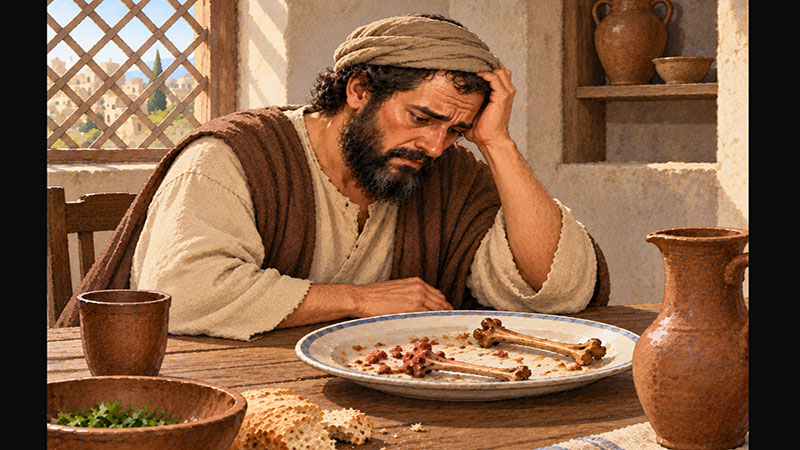
Our Gemara on amud aleph discusses a situation where someone sold a forbidden food and the buyer consumed it. Is the buyer to be refunded because he was sold a product he never would have wanted, or do we say that since he consumed it, in the end he received the benefit?
“In the case of one who slaughters a firstborn animal and sells its meat, and it was discovered that he did not initially show it to one of the Sages, the halacha is that it was actually prohibited to derive any benefit from the meat. In that case, what the buyers ate, they ate, and the Sages penalized the seller in that he must return the money to them, which they paid for the meat that they ate. And with regard to that which they did not eat, that meat must be buried, and he must return the money that they paid for the meat that they did not eat.
“And likewise, in the case of one who slaughters a cow and sells it, and it was discovered that it is a treifa, what the buyers ate, they ate, and what they did not eat, they must return the meat to the seller, who may sell it to a gentile or feed it to the dogs, and he must return the money to the buyers.”
In actuality, if the meat was consumed, the seller should not have to refund him, since the buyer received a benefit and cannot return the food. But the Rabbis penalized the seller and made him pay anyhow so as to discourage such trickery (see Rashi ibid.).
This is in regard to food items that are Biblically prohibited; however, Rambam (Laws of Sales 16:14) and Shulchan Aruch (C.M. 234:3) rule as follows in regard to items that are forbidden only due to rabbinic law: If the items are still in existence, then they are returned, and the seller must refund the buyer because the purchase was made under false premises. If the items were consumed, since the buyer did receive the nutritional benefits and pleasure of eating, there is no refund.
The question, ultimately, is what is the difference between something prohibited under rabbinic law and something prohibited under Torah law? The Sm”a (ibid. 4) offers two explanations:
1. Since the prohibition is only rabbinic, the Rabbis did not treat it as severely and therefore did not find a need to impose an extra-legal financial penalty.
2. In the case where the buyer consumed something that was forbidden according to Torah law, the pain of having violated those laws, even inadvertently and without his knowledge, significantly detracts from the enjoyment to the extent that he could ask for a refund. In contrast, he does not feel the same distress for violating a rabbinic law inadvertently.
This is an interesting psychological answer: It is assumed that if a typical Jew violated a Torah law, even by accident, this significantly ruins the pleasure to the extent that he could demand a refund from the seller. Yet we still have a question: Why would he not feel the same way about violating a rabbinic law?
The Nesivos Mishpat (ibid. 3) answers that there is a fundamental difference between rabbinic law and Torah law. When a Torah law is violated due to lack of knowledge, there is still a requirement to make penance and atonement. On the other hand, when a rabbinic law is violated, even due to lack of knowledge, no atonement is required. This fundamental difference is why the buyer who consumed the food does not feel the same anguish, and therefore enjoys that rabbinically forbidden food to the extent that he cannot ask for a refund.
Still, we might ask, why is it that no forgiveness is required for an inadvertent violation of a rabbinic prohibition? Shu”t Toras Chesed (O.C. 31) explains that when it comes to Torah prohibitions, the object itself has a forbidden aura – something intrinsically toxic about it. And therefore, the violation requires a purification ritual, even if it was committed unintentionally. However, something that is forbidden due to rabbinic law is not intrinsically prohibited. Rather, a person is obligated to obey the rabbis and not violate their ordinances. The object itself has no intrinsic toxicity, spiritual or otherwise. Consequently, if there was a violation with no intent to disregard rabbinic law, then ipso facto there is no need for atonement.
One final question: Even if we were to argue that your average Jew would find violating a Torah law so disturbing that he could not enjoy the food, why would this apply retroactively? That is to say, at the time he ate the food, he did not know that there was any violation. If so, the pleasure was complete with no diminishment. It is only after he finds out that he ate something that was forbidden that he retroactively experiences anguish. Yet how does that detract from the pleasure he already experienced? The simple answer might be that it’s not so much that it detracts from his pleasure in the past, but since he experiences an equal or greater distress and needs to seek atonement, the purchase experience as a whole had no value, and therefore he is entitled to a refund.
I believe that there is a deeper answer that has psychological implications. Much of what we feel happy or sad about is often experienced in retrospect. That is to say, if we are currently preoccupied with a particular disappointment or pain related to a past event, even if the past event was experienced happily at the time it occurred, it becomes colored in our memory and the experience gets destroyed. I find this particularly true in relationships, and I call it “telescoping.” If someone is feeling good about another person, his memories of the past and expectations for the future “telescope” in positive ways, coloring the experiences. On the other hand, unfortunately, if he is in a pained state in his relationship with that individual, his recollections of the past and expectations for the future become colored negatively in light of his current feelings. While this is subjective and not rational, in the world of emotions it is still valid. And if I’m correct in my understanding of this peshat, we see the Torah’s keen understanding of, and respect for, human nature and subjective emotional states.
Ben Bias: When a Sage Can’t Rule on His Own Firstborn
Daf 38
Our Gemara on amud beis relates a story about a great Torah scholar who would not allow himself to rule on a blemish of his own firstborn animal. This follows the halachic ruling that when it comes to certain matters, the Rabbis added an extra degree of caution and concern that the financial stakes would bias the ruling. The Mishna (Nega’im 2:5) states that the Rabbis did not allow a rabbi to rule on personal matters in three areas: firstborn blemishes, tzora’as, and annulling his vows.

It is interesting that this restriction does not apply everywhere. And the majority of poskim allow rabbis to rule on personal matters, such as his wife’s niddah status (Shach on Y.D. 188:7).
Rav Elyashiv (He’aros al Shas, Bechoros) adds an interesting exception. Even regarding blemishes for a firstborn, the sage may rule on it, provided that the consumption is limited only to him.
Something to contemplate is what, ultimately, is the difference. If the Rabbis consider the financial loss of a firstborn and perhaps the subtlety of ruling on a blemish to be subject to personal bias, why would it make a difference if the scholar in question limits the consumption only to himself personally? Bias is still bias. If anything, he might be more likely to take the risk solely for himself than to impose it on other people.
And here we see a powerful psychological point. Even though the rabbis of the Mishna had concerns about financial bias, even regarding a great sage, those concerns are limited to outsiders looking in. Meaning to say, others could and should doubt the possibility of personal bias to the extent that even a great sage loses credibility regarding a ruling that he has a personal investment in. Yet that is only regarding his credibility toward other people. He is allowed to believe in himself and trust himself. The Rabbis, though greatly concerned with the possibility of bias, did not see it within their ability to be so bold as to directly insinuate that a sage cannot trust himself in relation to himself. That is a step too far and no one can tell another person what his motives are and what he is truly feeling.