 October 9, 2026
 Categories: Halacha & Hashkafa / Torah
Daf Yomi



What About the Blood?
“They Were Not Really Babylonians…”
(Menachos 100a)
Tstrong Yom Kippur he-goat – sa’ir shel Yom Ha’Kippurim – was a communal Chattas brought on Yom Kippur as atostrongment. Its meat had to be eaten by the Kohanim within one day and night of its offering. Since it is forbidden to eat and cook on Yom Kippur, the Kohanim would have to wait until the conclusion of Yom Kippur to cook its meat and eat it. They had to conclude eating it by dawn.
A Friday Yom Kippur
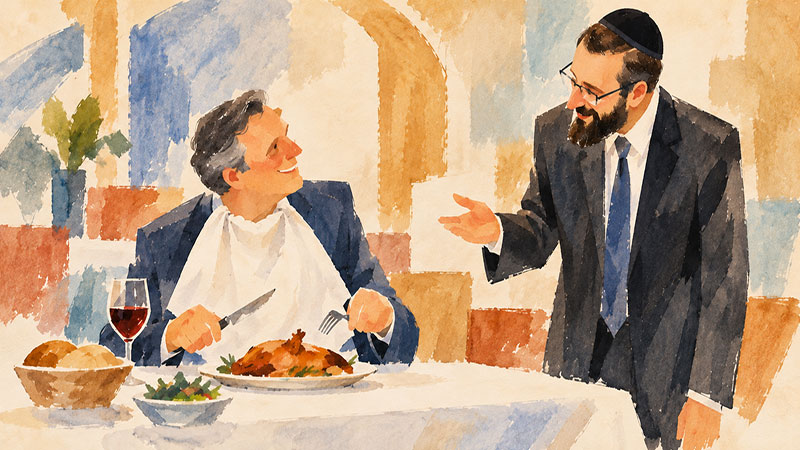
Before the set calendar of Hillel, when the New Moon was sanctified based on the testimony of witnesses, Yom Kippur would at times fall on Friday. This presented a problem: what to do with the Yom Kippur he-goat, as it could not be cooked on either day – neither on Yom Kippur and nor on the Shabbos that immediately followed. R. Yose explains in the Mishna (99b) that there was in fact no problem because the Babylonians (Kohanim of Babylonian descent) used to eat the korban raw as they were not very particular. Rashi (100a s.v ‘u’mitoch she’son’in…’) explains that eating raw meat is gluttonous behavior.Takes Offense
Rabbi Yehuda, who was of Babylonian descent, took offense at this statement maligning his ancestors as gluttons. The Gemara (100a) responds that they were not really Babylonians but Alexandrians, but since there was ongoing enmity between the Bnei Eretz Yisrael and the Bnei Bavel, the objectionable behavior of the Alexandrians was attributed to the Babylonians. Tosafos (s.v ‘she’son’in…’) find it difficult that these Jews are viewed as gluttons for eating the korban in its raw state. Were they not engaged in a mitzvah? Was there any other way for them to avoid the sacrifice becoming nosar (leftover)? Tosafos explain that the derision was not for what would transpire with the sacrifice on the unusual occurrence of a Friday Yom Kippur, but rather that they were in the habit of eating raw meat all year long.Rinsing And Salting
The Torah (Vayikra 3:17) states: “Vechol dam lo sochelu” – and all blood you shall not eat. The Mechaber (Yoreh De’ah 69:1), based on this injunction, rules that one must first rinse and then salt meat in order to rid it of its blood. This is the halacha for meat that is to be cooked, but what about raw meat? The Mechaber (supra 67:2) rules, based on Tosafos (Chullin 14a s.v “ve’nasbin”), that one may eat raw meat merely by rinsing it, without salting it, provided any veins with blood have been removed. According to this view, blood that remains in its original place, inside the animal’s organs, is permitted for consumption. Rambam (Hilchos Ma’achalos Asuros chap. 6:12) disagrees with Tosafos and rules that even as regards raw meat, one must first salt it before eating it.Biblical or Rabbinical
Shibolei Ha’Leket (Hilchos Issur v’Heter siman 12), citing Rabbeinu Avigdor HaKohen, adduces proof to Tosafos’s position from our Mishna, which says that the Babylonians (Kohanim) ate the meat of the sa’ir on Motza’ei Yom Kippur, which was Shabbos. He reasons that since heavily salting raw meat [sufficient to draw out the blood] on Shabbos is forbidden, evidently the Kohanim ate the raw meat in an unsalted state. Tosafos Yom Tov, in defense of Rambam (based on the view cited by Tosafos, Shabbos 75b (s.v “ein ibud b’ochlin”), offers that the Biblical requirement of salting applies only to dressing the hide but not to the edible meat, with regard to which it is only a rabbinic law and as such, when the need arose, could be overridden in the Temple.