 October 16, 2026
 Categories: In Print / Halacha & Hashkafa
Does G-d Refuse Repair Attempts?


Sanhedrin 112
Our Gemara on amud beis discusses the concept that “[t]he offering of the wicked is an abomination” (Proverbs 21:27). Although this verse comes from Mishlei, it appears to express an idea that is more than just rabbinic – it seems to be de’Oraysa, a Torah principle. This is evident in its application to explain why the designated sacrifices of a person from an Ir haNidachas, a condemned idolatrous city, must be destroyed and cannot be accepted on the altar.
At first glance, we might conclude that although G-d welcomes repentance, He has no interest in the sacrifices of a non-repentant sinner. Theologically, this seems reasonable – why should G-d accept an offering from someone who is otherwise rebelling against Him?
Yet something about this conclusion feels unsettling. While we might say that G-d is well within His “rights” to reject such a sacrifice, it seems, in some way, ungracious. The renowned marriage researcher John Gottman identified the acceptance of repair attempts as a critical stabilizer in marriages. Repair attempts are broader than apologies; they encompass any effort toward positive connection. In his studies, he found that the downfall of many relationships was due not to a lack of attempts to reconnect, but rather to the refusal of one spouse to accept the other’s repair attempt.
For example, after a terrible fight in which hurtful words were exchanged, one spouse might make a small bid for reconciliation – a smile, a joke, or an offer to help with something. The other spouse, still nursing wounds and unresolved resentment, might feel an overwhelming urge to reject or ignore the gesture out of spite. While the hurt is understandable, Gottman found that successful marriages had mechanisms for accepting repair attempts, whereas deteriorating marriages did not.
This brings us back to our question: If the acceptance of repair attempts is so crucial in human relationships, why does G-d refuse to accept a sacrifice from a sinner who has not yet repented?
However, upon deeper examination, this principle is neither absolute nor sweeping. While G-d does not accept an Olah sacrifice from an unrepentant sinner (Zevachim 7b), there are other sacrifices that He does accept, and the distinctions are worth exploring. The Rambam (Hilchos Shegagos 3:7) codifies it as follows:
- The sacrifice of an unrepentant, habitual idolator or one who desecrates Shabbos publicly is not accepted.
- A habitual, unrepentant sinner of a particular sort may not bring a Chattas sacrifice for a shogeg (unintentional) violation of that specific sin. For example, if a person habitually eats chelev (forbidden animal fat), he cannot bring a Chattas if, on one occasion, he mistakenly thought it was shuman (permitted fat). Since he would have eaten it regardless, his act does not qualify as the kind of unintentional sin for which a Chattas atones.
- However, he is still permitted – and even obligated – to bring a chattas for other sins.
Similarly, the habitual sinner’s Chattas is rejected for that particular sin because he cannot genuinely claim it was unintentional. Yet for other transgressions – ones he generally avoids—he is still eligible to bring a Chattas.
A beautiful expression of this idea can be found in the laws of Birchas Kohanim. Even a Kohein who is a habitual, unrepentant sinner is still obligated to recite the priestly blessings (Shulchan Aruch, OC 128:39), except in cases of idolatry or murder, where a specific scriptural disqualification applies. The Rambam (Hilchos Nesias Kapayim 15:6-7) poignantly comments:
He should not be prevented from [reciting the priestly blessings] because [doing so] is a positive mitzvah incumbent on each priest who is fit to recite them. We do not tell a wicked person: “Increase your wickedness by failing to perform mitzvos.” …Do not wonder, “What good will come from the blessing of this simple person?” for the reception of the blessings is not dependent on the priests, but on the Holy One, blessed be He, as [Numbers 6:27] states: “And they shall set My name upon the children of Israel, and I shall bless them.” The priests perform the mitzvah with which they were commanded, and G-d, in His mercies, will bless Israel as He desires.
This paints a picture of a G-d who does accept repair attempts. Only an offering that is ludicrously insincere or paradoxical is rejected.
However, one matter remains unresolved: Why does G-d reject the Olah sacrifice of a habitual sinner (Zevachim 7b)? To answer this, let us turn to Rashi’s precise wording, which anticipates this concern:
The Olah sacrifice … serves as a form of appeasement gift – like a person who has wronged the king and is seeking a rapprochement through advocates. When he comes to appear before the king, he brings a gift.
Rashi emphasizes that the Olah sacrifice is not merely a voluntary offering but a final stage in a process. A rapprochement gift is meaningful only after an apology or act of repentance; otherwise, it is empty ritual.
Returning to the relationship metaphor, people often bring gifts as “make-up presents,” but such gestures are usually better received after an apology, rather than as a substitute for one. Notably, Zevachim (ibid.) makes no mention of a Shelamim sacrifice being rejected (see Shiurei Rav Aharon Lichtenstein, Zevachim 6a). This suggests that G-d does accept repair attempts and bids for connection even when explicit apologies are absent – so long as they are not insincere apologies or misused rituals.
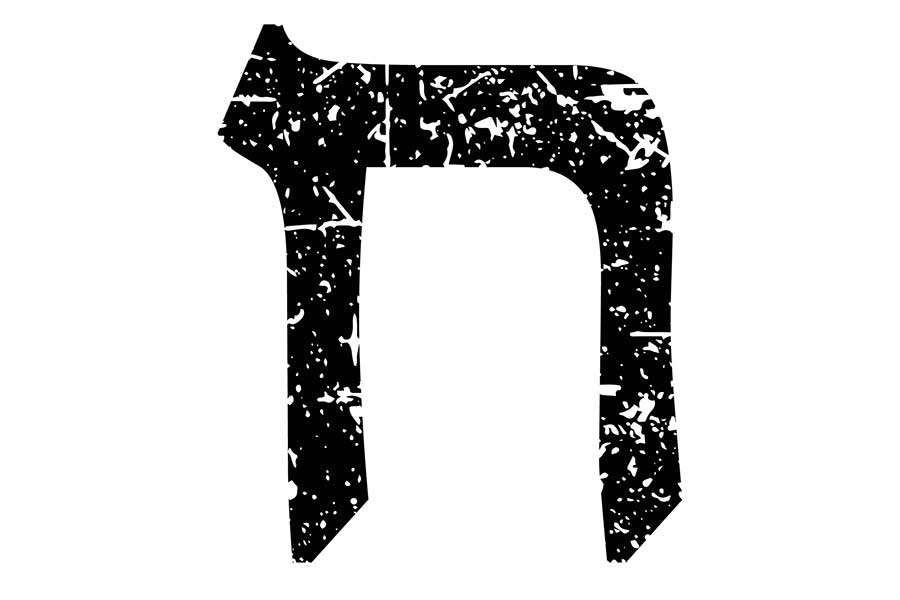
When The Ches Points Upwards
Sanhedrin 113Our Gemara on amud aleph relates an insolent remark from King Achav to Eliyahu, which instigated a drought as punishment. Achav dismissed the idea that the founder of Jericho’s sons had died due to Yehoshua’s curse upon anyone who attempted to rebuild the city. He mocked:
Moshe’s curse – that the rains would cease if we served other gods – did not come true. Why should Yehoshua’s? I have erected idols in every furrow of the fields, and the rains are so strong that we cannot even travel to the pagan temple to worship!Sefer Daf Al Daf notes an interesting nuance in the shape of the Hebrew letter ches in Torah script. In Sephardic tradition, the ches has a flat roof, while in Ashkenazic script, it has a pointed roof. The Gemara (Menachos 29a) explains that the pointed roof alludes to G-d: “The Holy One, Blessed be He, lives [chai] in the heights of the universe.” The Hebrew word chai (life) begins with the letter ches. Furthermore, there is one verse in the Torah where even Sephardim write a ches with a pointed roof – Devarim 11:17, which describes G-d’s wrath. This is the very verse Achav referenced. The Beis Yosef (Orach Chaim 36) cites this as a tradition. Sefer Daf Al Daf suggests that this pointed ches directly addresses Achav’s challenge, serving as a reminder that G-d is, above all, inscrutable, and that – despite appearances – the prophecies and curses will ultimately come true.
A core component of the Torah is the principle of reward and punishment. As Achav himself quoted, we are promised sustenance and success if we uphold the covenant, and economic and national ruin if we reject it. Yet G-d’s timing and ways are unfathomable. There is no full understanding of why some wicked people prosper for a long time while calamities befall the relatively innocent. As Tehillim (92:7-8) states: “A brutish man cannot know, a fool cannot understand this… Though the wicked sprout like grass, though all evildoers blossom, it is only that they may be destroyed forever.”
These kinds of questions often stem from an incorrect and overly simplistic understanding of reward and punishment in Jewish philosophy. A good introduction to this topic can be found in the Rambam’s introduction to Perek Chelek, as well as in his letter about astrology.
There are often zealots who publicly claim to know the cause of specific calamities, invariably attributing them to some sin or shortcoming. While solemn repentance and prayer in response to tragedies are fundamental Jewish responses, it is theologically naive and poorly timed to declare with certainty the Divine cause of a catastrophe.
Years ago, when a certain non-Orthodox congregation was attacked on the morning of a bris for the child of a homosexual couple, some suggested that the attack occurred because they were sinners. More recently, there were those who attributed the events of October 7 to the wanton nature of the rave that many victims had been attending. While that tragic day rightfully inspired teshuva and prayer, that is very different from smugly assuming we know why G-d allowed it to happen.
What would such people say to a victim of a child molester who knows that the perpetrator was allowed a successful life, enabling him to ruin the lives of dozens of children? If G-d found time to strike down a synagogue, why did He not instead direct His wrath toward such a person?
The Gemara (Berachos 5a) instructs that when a person experiences suffering, he should examine his actions to identify and correct any sins that may have brought it about. However, this is meant as a personal, introspective exercise – one of humility and self-reflection.
By contrast, Bava Metzia (58b) warns:
If torments afflict a person, if illnesses beset him, or if he buries his children, one may not speak to him as the friends of Iyov did, asserting that his sins brought about his fate.What did Iyov’s friends do wrong? Weren’t they simply following the teaching in Berachos (5a)? The answer is that while a person should engage in self-reflection, it is utterly inappropriate to say such things to someone who is suffering.