 October 9, 2026
 Categories: Halacha & Hashkafa / Torah
Eggsellent Behavior


Chulin – Daf 64
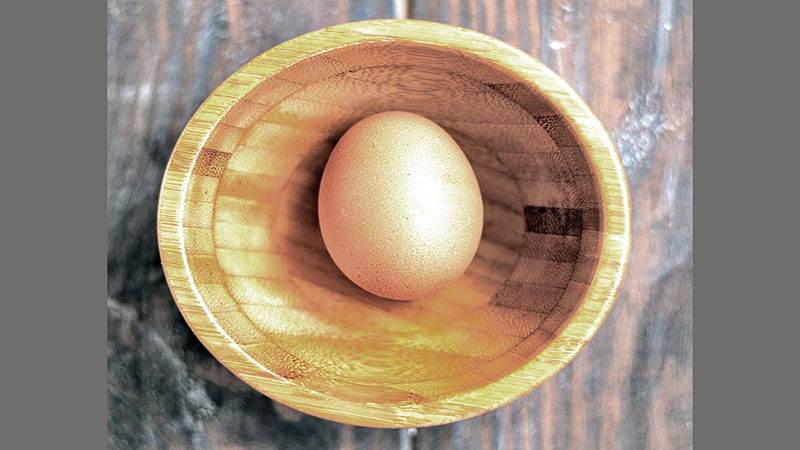
Our Gemara on amud aleph describes the features of eggs from kosher birds versus eggs from non-kosher birds: “Any egg that narrows at the top and is rounded, so that one of its ends is rounded (kad) and the other one of its ends is pointed (chad), is kosher. If both of its ends are rounded or both of its ends are pointed, they are non-kosher.”
Likkutei Halachos (Y.D., Laws of Eggs 2 and 4) discusses the secret meaning contained within these physical properties. Whenever there is a unification, there is a holiness, as it incorporates all and is therefore closer to G-d’s unity. The Jew unifies the Written Torah and the Oral Torah, making two modes of relating to law, thought, and practice into an integrated whole. The two sides of the kosher egg – the rounded (kad) and the pointed (chad) – are the combination of Written and Oral Torah. The Hebrew word for rounded is kad, which is spelled chaf dalet, numerically 24, the number of books in Tanach, the Written Torah. The Hebrew word for pointed is chad, which means sharp, and stands for the Oral Torah, which is built on the sharp analysis and legal distinctions of the Sages.
Furthermore, the two sides – sharpness and softness – represent a unification of two opposite but necessary features that it takes to fulfill the Torah: humility and brazenness. It takes humility to learn and be close to G-d, but brazenness to enact the will of G-d and intellectual guts to pursue the limits of human ability, and even transcend them.
From a psychological perspective, mental health is not about eliminating drives, but rather about healthy integration of various drives. The emotional and the intellectual, the aggressive and the peaceful, joy and seriousness, compassion and self-interest. One of the essential features of Torah observance and thought is the healthy integration and balance of the various drives and parts of human nature. (Rambam’s Shemoneh Perakim makes this point in an extended fashion.)
For example, the Jewish calendar is based on a combination of lunar and solar inputs; specifically, the months follow the Moon, but the seasons follow the Sun. Since 12 lunar months only add up to 354 days, that is approximately 11 days short of a solar year. The rabbis understood from the Biblical directive to guard the month of spring that they needed to add in a leap month (Adar II) approximately every three years (actually a cycle of seven out of every nineteen years) in order to ensure that Passover occurs in the spring. However, we must ask ourselves: What is this process supposed to teach us?
The three major world religions, Judaism, Christianity, and Islam, all view the calendar differently, and this may be a manifestation of a way of working with reality. Christianity exclusively follows a solar calendar, Islam exclusively follows a lunar calendar, in that its holidays are measured by lunar months alone, while Judaism follows a hybrid. We might say that the Christian world, which is in large part the Western world and a legacy from Greek Hellenism, follows the obvious and observed phenomena. The years and seasons are organized solely on the observed reality of the solar cycle. Islam bases its year solely on the Moon. The Moon is seen at night and waxes and wanes. We might say that the Sun stands for observed natural reality and the Moon stands for mystical, mysterious, and inner, subjective reality.
In terms of attitudes, the secular Western world relates to concrete practical concerns, and organizes itself based on those perceptions and needs. The Islamic world is the opposite. The subjective spiritual dimension is the organizing force, regardless of practical considerations. Jihad, suicide bombings, and cutting off the hand of the thief are all expressions of the spiritual reality dictating the external reality. (Notably, despite the literal reading in the Bible of “an eye for an eye,” the rabbis of the Talmud report a tradition that these draconian measures are not meant literally, but instead stress the importance of the fairest possible financial restitution. Jewish courts of law never practiced “an eye for an eye.”)
Judaism, by organizing itself based on a combination of the solar and lunar cycles, shows a balance between inner realities and outer realities. The spiritual dimension in our life is vital. There is a drive toward unio mystica – cleaving to and joining with G-d. There is a part of us that wants to run away from all the practical day-to-day problems and live on a mountaintop. Yet we cannot do that. We must live in this world, so long as the good Lord sees fit to keep us alive. We must plant, harvest, eat, live, and love among people.
The kosher egg is a physical manifestation of this important archetype of life. The non-kosher egg has either both rounded or both sharp sides, because it sits at the extremes and has not achieved successful balance or integration of human nature.
A Wing and a Prayer: Rav Pappah’s Harmonizing Legacy
Daf 65
Our Gemara on amud aleph has a ruling by Rav Pappa that integrates the opinion of two Sages regarding the wings of kosher grasshoppers: “Any grasshopper that has four legs and four wings and two additional jumping legs, and whose wings cover most of its body, is kosher. The Gemara asks: What is considered most of its body? Rav Yehuda said that Rav said: ‘Most of its length.’ And some say that he said: ‘Most of its circumference.’ Rav Pappa said: ‘Therefore, one must satisfy both versions of the statement. We require that the wings cover most of its length, and we also require that they cover most of its circumference.’”
Sefer Daf al Daf quotes Sefer Hadar Yitzchak that notes that Rav Pappa is in the habit of making such rulings in which he integrates two opinions and combines them halachically. There are indeed ten instances in the Talmud where he does so. (A few sources are Berachos 59a, regarding sighting a rainbow, ibid. 60b, regarding the closing of the Asher Yatzar blessing, and Shabbos 20a regarding the extent that a branch of wood needs to be lit prior to Shabbos.)
The liturgy of the Siyum, recited upon completion of a masechta of Gemara or a Seder of Mishna, includes a listing of the names of Rav Pappa’s ten learned sons (See Shulchan Aruch Y.D. 246; Rama and Shach.) Hadar Yitzchak points out that the Gemara (Shabbos 23b) states: “One who shows love for the Sages will merit children who become Sages.” Rav Pappa merited 10 sons who were Sages who correspond to these 10 instances where he harmonized the opinions of his colleagues, an expression of love.
Furthermore, the Maharshal (Yam Shel Shlomo, Bava Kama, end of chapter 7) cites a teshuvah of the Rama who had a tradition that Rav Pappa was a wealthy man and would make a festive meal to celebrate each time his sons completed a masechta. No doubt, this love for Torah and love for his sons must have been a contributing factor in their success. Which one, do you think, was primary? His love for Torah or his love for them and their achievements? Here is an interesting story from Berachos (45b):
“Three people who ate as one but did not conclude their meals together, one interrupts his meal in order to join the other two in a zimmun, but two do not interrupt their meal to join the other one in a zimmun. The Gemara challenges: And do two really not interrupt their meal to join the other one in a zimmun? Didn’t Rav Pappa interrupt his meal to enable Abba Mar, his son, to recite the zimmun blessing; and, in that case, it was Rav Pappa and one other person? The Gemara responds: The case of Rav Pappa is different, as he acted beyond the letter of the law (to honor him; see Rashi.)”
We can say that Rav Pappa’s honor for the Torah was at least matched by his love and honor for his sons. Either way, a pedagogical success story.
One last thought. Perhaps the constant effort to seek a path that harmonizes both opinions was its own merit and pedagogical influence. The desire to understand and integrate all opinions is an attitude that demonstrates respect in a practical way and also promotes intellectual development.
Fishing for Truth
Daf 66
Our Gemara on amud beis noted that though the signs of a kosher fish are fins and scales, in fact every fish that has scales also has fins. The Gemara then asks: If so, why did the Torah bother to mention both fins and scales? Why not just write that every kosher fish has scales, which would have been sufficient? The Gemara answers:
“It is written: ‘…To make Torah great and glorious’ (Isaiah 42:21). G-d consequently expanded some aspects of the Torah more than strictly necessary.”
The simple explanation is, as Tosafos states, that the Torah provided multiple sources, which implies that the Torah may sometimes provide an explanation that is not strictly necessary. This is apparently a rule, but there is no stated reason why. Presumably, the Torah is assuming that it may not always be easy or clear to deduce a matter, so the Divine wisdom and will deem certain seemingly superfluous indicators to be of value.
I will add that the idea of fins might have a lesson or truth locked inside that we are invited to look at, now that it, too, is a formal sign, even if not necessary because we can determine kashrus from scales alone. For example, the Shelah (Torah Sheb’ksav, Derech Chaim, Shemini 5) offers an explanation for why these species are not kosher. Most are familiar with the obvious concept that the non-kosher beasts and birds are predators, as opposed to the more passive kosher cattle and birds. The Shelah extends this idea to the fish and grasshoppers as well. The kosher grasshoppers hop on knee joints (Vayikra 11:21), which indicates that they are non-predators and are equipped to run away swiftly. The kosher fish have protective scales and fins to run away and guard against predators as well. The Shelah uses this as an indicator of the sensitivity of the Jewish soul. The mere consumption of a predatory animal can somehow increase a predatory behavior within the person who consumes it.
Mei Hashiloach (II, Shemini 7) sees a self-referential hint within the law itself. Scales represent the protective exterior of the fish, a defensive status quo. Fins represent the ability to ambulate and travel. The metaphoric scales of the Torah are the truths that are intrinsic and should be known. The fins are the ways to navigate the “sea of the Talmud” and know more. Though one could have known kosher fish from their scales, G-d also taught about fins because it still is a kosher sign and there is some Torah idea hidden within it that has now become easier to discover. G-d gave fins to navigate and find out even more, beyond the given and deductive truths.