 October 9, 2026
 Categories: Features / Jewish Community
Energy Crisis in New York State Reaches a Crossroads



New York state is in the midst of an energy crisis – and it is seen not only in skyrocketing gas prices at the pump but in just about every economic sector in the state. This situation is leading to a different affordability crisis than the one we keep hearing about.
With the summer months fast approaching, New York state could see brownouts or blackouts in crucial areas. There are businesses that cannot have one second of interruption in energy flow, or their experiments focused on leading-edge technology would be destroyed, costing many millions of dollars.
In April, energy industry experts gathered to discuss the pending crisis at the New York Energy Summit held in Albany at the Albany Capital Center. The Tulsa, Oklahoma-based Infocast, a Clarion Events company, ran the event. The two-day conference attracted hundreds of energy companies and consultants as well as business owners from across the country, who paid a high entrance fee to attend.
There is a whole new lexicon emerging which the public will need to adapt to. Government officials and industry insiders already know the industry terminology: energy storage facilities, interconnection reforms, battery storage facilities, SMRs (small modular reactors), and many versions of data centers.
The problem with New York’s energy supply is the aging facilities used for transporting electricity around the state.
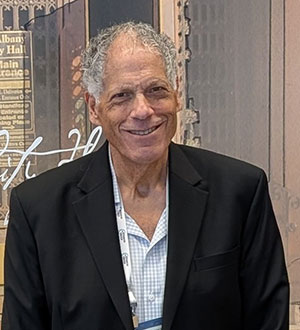
“New York’s transmission system is among the most overutilized in the country. Our transmission system was primarily designed in the 60s and 70s and primarily focused on large central station fossil and nuclear plants,” Mark Scher, president of Albany-based Applied High Voltage, told The Jewish Press. “Now we’re switching to a more decentralized generation with a lot of renewable plants. The transmission corridors are very much at or above rated capacity.”
The Big Apple is a big hoarder of New York’s power supply.
“A high percentage of the state’s power goes to New York City, and those are the corridors that are tremendously stretched. What we’re looking at is technical capabilities, to be able to get more power generation and capacity installed locally in the New York area – more technical solutions to be able to increase the grid capacity without physically building new lines,” he explained.
Governor Kathy Hochul has delayed her emissions-free target by ten years, from 2030 to 2040.
“Quite frankly, it’s an admirable goal,” Scher said. “But without the addition of nuclear facilities, it’s just not possible to go totally emissions-free. The advent of the new technology, which is smaller modules that can be built locally, is a technology derived from what the Navy uses to power nuclear aircraft carriers and nuclear submarines.” He explained that it’s not actually a new technology but a new application of a well-proven technology, “and it’s more cost-effective.”
Other attendees at the conference believe a return to nuclear energy should be part of the emissions-free future.
“There’s a lot of excitement around nuclear power,” Noah Ginsburg, executive director of the Queens-based New York Solar Energy Industry Association, a leading advocacy group, told The Jewish Press. “The Governor has expressed her support for tying nuclear energy to major economic development projects in central New York. That seems like something that’s moving forward.” But he said that he doesn’t believe that nuclear power is a low-cost source of electricity.
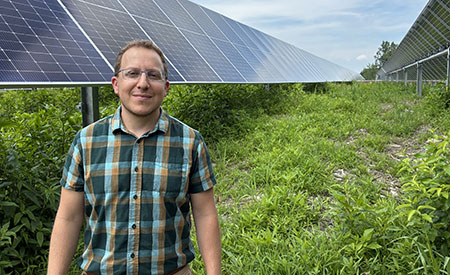
Ginsburg said he still is a proponent of solar.
“Solar is being paired with [lithium-ion] battery energy storage systems. You charge up your batteries when it’s nice and clean, and you dispatch when there’s high demand for electricity. It helps to keep rates lower,” he said. “More and more, we’re seeing solar grids with energy storage, and I think that’s a trend that’s going to continue, in part because of the federal government winding down support for solar but continuing support for energy storage. So solar works in New York but it works better in Arizona – you can generate more electricity from a solar panel in Arizona than you can in New York.”
Energy policy is part of ongoing budget talks that seem to be never-ending. The state budget was due to be in place by April 1. I suppose that was an April Fool’s joke on New Yorkers.
“When we think about what we can do that both supports progress towards New York’s clean energy goals and drives down electricity rates, the answer to that question is the Accelerate Solar for Affordable Power Act, or the ASAP Act,” Ginsburg said. That bill is part of the budget negotiations.
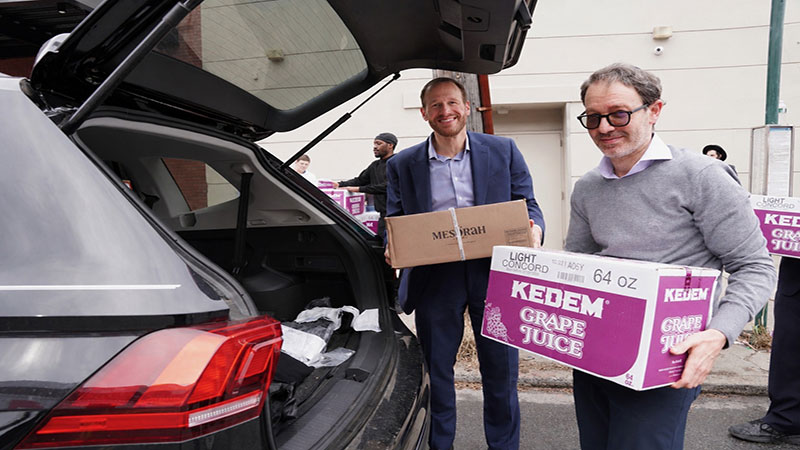
A father and son team from the Flatbush Orthodox Jewish community in Brooklyn attended the summit because their company caters to development of energy storage, primarily battery storage. They describe themselves as land developers in Texas and New York. The pair were among many who welcomed the opportunity to network with other leaders in the energy sector involved with battery storage facilities.
“New York City is obviously the most valuable market to do battery storage. Maybe [we’ll do] one in Sullivan County, some in Ulster, some up in Oneida, Oneonta, and the Binghamton area,” Stan Hillelsohn, a land developer and president of Marston Equities, told The Jewish Press. “Battery storage is a very small footprint. Our typical project is about half an acre. Every storage [structure] is not going to go and change the landscape of New York state by taking over a lot of farmland. It will probably take a small little corner right next to a substation that no one even realizes is there, and it just puts it there. You probably wouldn’t even realize…it was ever there. In New York City, you take a little parking lot and turn it into a battery storage facility, [it will] be a little more noticeable.”
As modern technology marches on, the battery storage facilities will not hold a massive number of lithium-ion batteries, like the ones you would see on television exploding on bicycles, in apartment houses, or in overhead airplane luggage compartments. There is a safer solution that companies lay out for local government officials when going through the permit process.
“Inside are just racks upon racks upon racks of batteries. There is a fence around it on a slab of concrete and that’s the whole thing,” Jay Hillelsohn, the owner’s son, told The Jewish Press.
“The batteries are usually the size of a laptop. Probably usually about 200 of them in each project that we’re working on, which would be equal to about five megawatts. Obviously, we need a forklift to put it on the truck and then it goes on the shelf. It’s all prefabricated. Picture the way a lot of upstate bungalow colonies have been built in prefabricated buildings. Same concept.
“There’s a company out of Pittsburgh called EOS Energy. And they build the batteries domestically. They make the batteries out of zinc carbide. They’re not made of lithium like your Tesla batteries. The great thing about this is that it’s non-flammable…Obviously, there could be a small electricity fire from servers but effectively, the actual material is non-flammable. It’s all domestically made, supporting American jobs.
“Our role is that they need to be sourced. It’s a real estate game. We are the developers. Effectively, [the company in] Pittsburgh is the supplier. They supply the actual battery, but [need] to put it somewhere. That’s where we come in,” Jay Hillelsohn explained.
The energy policy in New York state is turning out to be a three-pronged approach, according to one leading power sector consulting firm that attended the New York Energy Summit.
“There’s definitely a lot of interest in trying to figure out how to hit the balance between affordability, economic development, and meeting the needs at the moment in terms of getting more resources built. Depending on who you are listening to, some folks are still very interested in maintaining a commitment to the environmental and climate goals,” Seth Kaplan, vice-president of the Washington, D.C.-based Grid Strategies, LLC, told The Jewish Press. “And the technology that is kind of sitting on the shelf that can get built tomorrow…is wind and solar, particularly solar and storage, wind that has been going through the permitting process, and then coupling renewables with storage. That’s the low-cost resource that’s available right here and right now.”
Grid Strategies recently issued a report stating that preventing the nation’s coal plants from retiring over the next three years could cost consumers at least $3 billion per year.
“The Champlain to Hudson power line coming down from Quebec is about to go live. New York is continuing with the process of contracting for more wind and solar. Those projects are moving through the project pipeline. It’s a matter of diversifying, of not being overly dependent,” Kaplan concluded.
The conference itself was not without any hiccups. One of the methods of having a successful summit is to encourage positive media coverage. In this case the events company hired to run the New York Energy Summit decided to bar the media from covering the private event even though there were no signage explaining no media allowed. When this reporter contacted the marketing manager for permission to enter the event space, the following email message was received:
“Unfortunately, we aren’t able to provide a press pass at this time for NY Energy. Thanks for your interest – but you’ll need to sign up [and pay] if you’d like to participate this year.
Best regards,
JIMMY MA
Director of Marketing”
Stan Hillelsohn, the land developer, bemoaned that the price of signing up had cost multiple thousands of dollars, but came to Albany from the Flatbush section of Brooklyn anyway to network with other industry experts. He explained that the value of attending was important to him.
“It was a lot of money. When you have a conference like this, in the same room you have the people who are decision-makers. They have information about the products we’re looking to develop and they can help you with.”