 October 16, 2026
From the Mundane to the Sacred (Part VI)
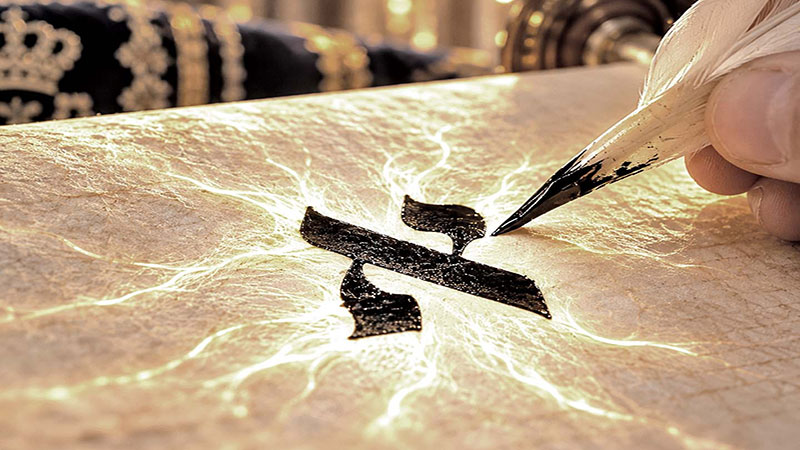


In the previous article, we discussed the ink of STaM and how ordinary black liquid becomes something entirely different once it forms the sacred words of Torah. But focusing only on the black letters gives an incomplete picture. A Sefer Torah, tefillin, or mezuzah is not simply writing placed on a neutral background. The white parchment surrounding the letters has a halachic and spiritual role of its own.
The Torah Written in Black and White
The Gemara in Menachos 29a teaches, “kol os she’ein gevil mukaf lah me’arba ruchoseha pesulah,” any letter that is not surrounded by parchment on all four sides is invalid. This requirement is known as mukaf gevil. Rashi explains the basic case as one letter becoming attached to another. Tosafos in Gittin 20b goes further in explaining why this requirement is unique to STaM. The Torah requires “u’kesavtam,” which Chazal understand as kesivah tamah, a complete or perfect writing. For STaM, a letter is not complete merely because the black strokes are recognizable. It must also exist as an independent letter, properly surrounded by the white parchment around it.
That distinction is striking. If two letters touch, they can remain perfectly readable and still be invalid. The problem is not simply that the reader can no longer tell them apart. The black form has lost its proper relationship to the gevil surrounding it. Halacha is therefore telling us that what appears to be empty space is not irrelevant. The white around the letter contributes to what makes the letter a complete halachic letter.
The discussion becomes even more interesting with the space inside certain letters. The Rishonim and later poskim discuss whether mukaf gevil also requires intact parchment within the hollow areas of letters such as a hei. The Bavli and Yerushalmi are understood differently on this point, and the Tur cites the Yerushalmi's stricter position requiring surrounding gevil even internally. Once again, halacha is paying attention not only to where the ink is, but also to where it is not.
This halachic idea fits remarkably well with a teaching I recently heard in the name of the Noam Elimelech. The klaf of a Sefer Torah possesses an extraordinary kedusha because it absorbs the kedusha of all the letters written upon it. He develops this idea and says the klaf has greater kedusha than any individual letter because all of the letters rest upon and sanctify it.
That idea changes the way we picture a Sefer Torah. We naturally think of the black letters as the sacred content and the parchment as merely the material holding them. But the klaf is not simply a shelf carrying something holy. Torah written upon it changes the status of the physical hide itself. The letters and parchment become parts of one sacred object.
Chazal give us an even more powerful image. The Yerushalmi in Shekalim describes the Torah given to Moshe as “white fire engraved with black fire.” The image is almost startling when looking at a Sefer Torah. The black is fire, but so is the white. The white is not described as nothingness. It is another dimension of Torah.
I saw this idea developed beautifully in a quotation from Rav Kook in Gold from the Land of Israel. Rav Kook connects the halacha of mukaf gevil with the image of black and white fire. He explains that we normally notice only the black letters because they contain the Torah we can read and understand. Yet the white parchment represents a higher, hidden dimension of Torah that cannot be expressed in ordinary letters. The black ink is the revealed Torah, while the white surrounding it points toward what remains beyond our ability to write.
There is a related idea that is widely quoted from the Zohar: The Torah contains 600,000 letters, corresponding to the 600,000 root souls of Israel. Later works famously connect this to the word Yisrael itself, reading it as an acronym for Yesh Shishim Ribo Otiyos LaTorah – there are 600,000 letters in the Torah. Yet an actual count of the letters in a standard Sefer Torah produces only about 304,805.
That discrepancy has produced many explanations. One beautiful approach is that we should not count only the visible black letters. The white spaces surrounding and defining them also participate in the written Torah. On this understanding, the Torah contains more than what the eye sees in ink alone.
All of this brings us back to the larger theme of this series. We began with something thoroughly physical: animal hide. It was processed into klaf, prepared lishmah, and made ready to receive Torah. Then ordinary ink was placed upon it in the form of sacred letters. At that moment, it would be easy to say that the holiness is entirely in the writing and that the parchment simply carries it. But the halachos of mukaf gevil, the image of white fire and black fire, and the later teachings about the sanctity of the gevil suggest something richer.
The Torah is not only in the letters; it is the spacing too.
The animal hide that began as the most mundane part of the process is no longer merely beneath the Torah. Once it becomes the gevil of a Sefer Torah, the physical material itself has been drawn into the kedusha of the words written upon it.