 October 16, 2026
 Categories: Featured / Headline / Names and Numen
G-d’s Gift
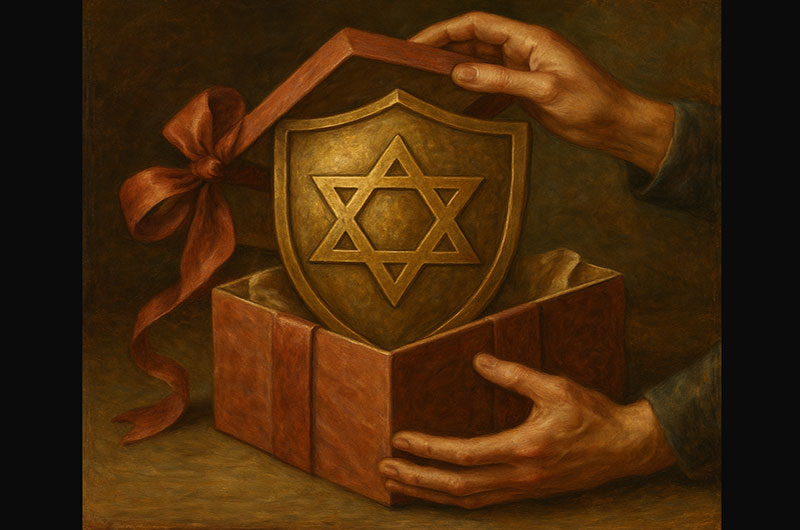


When we recall the story of Chanuka, we think not only of the Hasmoneans’ stunning victory over the Seleucid Greeks, but also of the special gift that followed: the miracle of the oil. In the newly rededicated Temple, a single sealed jar of pure olive oil was found, enough for just one day – yet it burned for eight. That miracle, as Rabbi Chaim Shmuelevitz (1902–1979) put it, was like a “Divine kiss” atop the military triumph, a sign of G-d’s closeness and love. And when we reflect on the greatest gifts G-d bestows, few compare to the blessing of children. This article explores Jewish names that capture precisely that idea: that a child is a gift from G-d.
First and foremost among the names we discuss is Matityahu (pronounced Matisyahu in Ashkenazic tradition). This was the name of the Hasmonean patriarch who inspired the revolt against Hellenism. The name itself is built from two parts: matit (related to “gift”) and yahu, a shortened form of G-d’s four-letter that uses three letters from His name. References to the name of G-d in a personal name are called theophoric elements. Although Matityahu lived in the Second Temple period, the name appears much earlier: several Levites in King David’s time bore it (I Chron. 15:18, 15:21, 25:3). A shortened variant, Matityah (dropping the final vav in the theophoric element), also appears in the Bible (Ezra 10:43, Neh. 8:4, etc.). These Hebrew names later evolved into the Latin Matthias, Spanish Mateo, and English Matthew (often shortened to Matt).
A closely related name is Matanyah, the original name of King Zedekiah, the last ruler of Judah. When Nebuchadnezzar placed him on the throne, he changed Matanyah’s name to Zedekiah (II Kgs. 24:17). Still, the name remained popular in the generations that followed, especially in Ezra’s time (Ezra 10:26–37, Neh. 12:8). An extended form, Matanyahu, appears even earlier, in the days of King David (I Chron. 25:4) and King Hezekiah (II Chron. 29:13). These names all combine matanah (“gift”) with part of G-d’s Four-Letter Name.
In recent times, a simpler form has emerged: Matan. At first glance, it seems like a shortened version of the names Matanyah/Matanyahu. But in the Bible, Matan appears only once, and not in a flattering context: he was the priest of Baal’s temple during Queen Athaliah’s reign, who was killed when Joash replaced her (II Kgs. 11:18). Because of this, Rabbi Chaim Kanievsky (1927–2021) discouraged parents from giving that name, and even suggested those already named Matan should change their name to Natan. Rabbi Ovadia Yosef (1920–2013) similarly advised altering Matan to Matanyah, restoring the theophoric reference to Hashem. Others, such as Rabbi Meir Mazuz (1945–2025), take a more lenient view, noting that naming conventions can shift over time. He maintains that even though at one time in history, the name Matan may have been considered improper, it later became acceptable. Interestingly, Josephus (Against Apion Book I §18) even reports that a Tyrian king named Matan lived around the same period, underscoring the name’s popularity among Baal-worshipping cultures. (I discuss all of this in my book G-d versus Gods: Judaism in the Age of Idolatry.)
Another Hasmonean name is Yonatan (Yonasan in Ashkenazic Hebrew, or Jonathan in English). After Judah Maccabee’s death, his brother Yonatan led the Jewish state for six or seven years (see Yosiphon Book I ch. 26; Radak to Zech. 11:14). The name combines yo (a shortened form of G-d’s Name) with natan (“gave”), making it thematically the mirror image of Matityahu.
The name itself is older: As you may have surmised, Yonatan itself is a Biblical name. Yonatan was the heroic son of King Saul and the loyal friend of David. Saul’s son is often called Yehonatan, using a longer theophoric prefix, and several other figures in the Bible bear that form as well. In fact, Saul’s son is more often called Yehonatan than he is called Yonatan. Appropriately, the Book of Maccabees records Matityahu giving a pep talk to his sons in which he compares Yonatan to the biblical Jonathan, famed for his victories against the Philistines.
This brings us to Natan (Nosson in Ashkenazic, Nathan in English), another biblical name borne by multiple figures, including the prophet who advised King David and Solomon. From this root we also get Netanel (Nesanel or Nathaniel), an ancient Biblical name dating back to the time of the Jews’ sojourn in the wilderness (Num. 1:8, 2:5, etc.) and still found in the early Second Temple era (Ezra 10:22). In the Mishnah, Talmud Bavli, and Talmud Yerushalmi, there are no sages named Rabbi Netanel, although the Mishnah (Avos 2:8) does mention a Tannaic sage named Rabbi Shimon ben Netanel. That said, Pirkei DeRabbi Eliezer (chs. 17; 25; and 48) does cite a sage named Rabbi Netanel, whom Rabbi David Luria (1798–1855) presumes was the father of the aforementioned Tannaic sage. In rabbinic times, Rabbi Shimon ben Netanel appears in Avot (2:8), and later sources also mention a Rabbi Netanel.
Either way, the name Netanel is comprised of natan (“giving”) and the theophoric el (one of the names of Hashem). An inverse formation appears in Elnatan, borne by several biblical figures. And other parallels — Netanyah and Netanyahu — combine natan with parts of the Tetragrammaton. These remain familiar today, with Netanya a city in modern Israel and Netanyahu being the surname of the longest-and current-serving Prime Minister of Israel.
Another “gift” name is Shai. Originally a nickname for Yishai or Yeshayahu, it eventually became independent, likely because of its positive meaning. In the Bible, shai (meaning “gift”) appears three times as a regular word (Isa. 18:7, Ps. 76:12, Ps. 68:30). Rabbi Avraham Bedersi HaPenini even noted that shai is yesh (“there is”) spelled backwards, suggesting a gift represents something substantial.
Not all “gift” names are Hebrew in origin. In rabbinic literature we encounter Todros who was a physician whose scientific statements are quoted in the Mishnah and Talmud, and Todos who was a leader of the Jewish community in Rome (Mishnah Bechoros 4:4, Tosefta Ohalos 4:2, Babylonian Talmud Brachos 19a, Pesachim 53a, Beiztah 23a, Sanhedrin 33a, among several others). Later rabbis with that name include Rabbeinu Todros (who wrote a set of Tosafos to Nazir), Rabbi Todros Abulafia (an important Kabbalist), Rabbi Todros Miller (from the Gateshead Seminary). These names also mean “gift from G-d” but are not of Hebrew origin, rather they come from Greek. Todos and Todros, are both Hebracized forms of the Greek name Theodoros (“gift of G-d”). That name was popular in Ancient Greece and continued to be popular under Christian influence.
The Greek connection runs deeper. When the Torah describes Jacob sending Esau a minchah (Gen. 32:14), Targum Pseudo-Jonathan translates it as doron — a Greek word for “gift.” Thus, names like Doron (common in modern Israel) actually have Greek roots. Theodoros combines theo- (“G-d,” as in the terms theophoric, theology, and theosophy) with doron (“gift”), mirroring Hebrew constructions like Yonatan (“G-d gave”) or Elnatan (“G-d gave”). The feminine Dorothy simply inverts the order, much like Matityahu, Matanyah, Netanyahu, or Netanel wherein the “gift” element precedes the theophoric element.
Theodore’s many variants include Ted, Teddy, and the Russian Feodor/Fyodor. Less obvious is Tudor, both a Welsh surname (famously borne by the English royal dynasty in the 1500s and 1600s) and a given name in Romanian (Tudor for men, Tudora for women), all ultimately related to Theodoros.
The cross-cultural interplay even appears in rabbinic history. Rabbi Nesanel Weil (1687–1769), the celebrated author of Korban Nesanel, had a son named Rabbi Yedidyah Teo Weil (1721–18050. It has been surmised that because his Hebrew name Yedidyah includes Hashem’s two-letter name, he was given the nickname Teo (which is related to the Greek word theo) so that people could refer to him without saying Hashem’s name in vain. In fact, the Noda BiYehudah (Kamma Yoreh Deah §76) addressed a responsum to “Rabbi Yedidyah who is nicknamed Teo Weil” about errors in writing G-d’s Name in a Torah scroll.