October 2, 2026
 Categories: In Print / Headline / Halacha & Hashkafa
Is It Proper to Attend a Rosh Hashana Davening in a Different Nusach From Your Own Just Because You Like the Service/Chazzan?
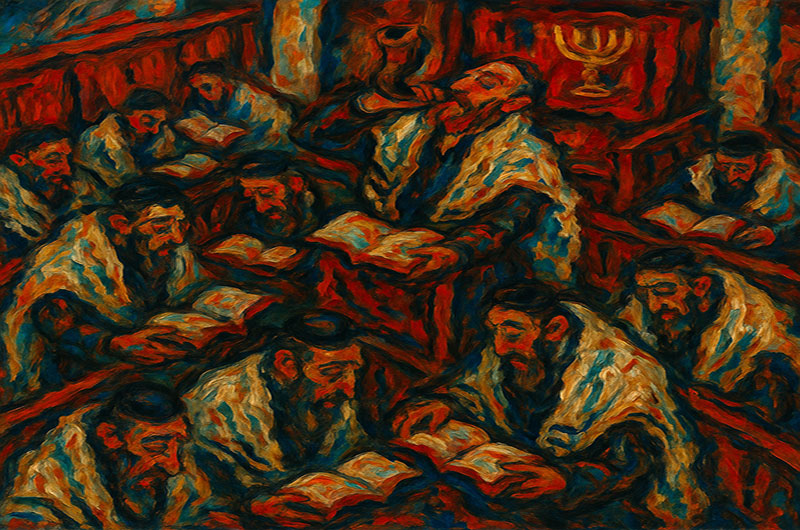


 Indeed, there are many people, especially yeshiva students whose family nusach is Sefard yet they learn in “Litvish” yeshivos where the nusach is Ashkenaz. Vice versa there are many families whose nusach differs somewhat from that of the synagogue where they daven. Indeed, a rabbi might find himself in the same predicament. What to do?
More important is how the tefillah experience moves them. Many join a particular synagogue because the tefillah there is serious, inspiring and friendly. The gaon Rav Moshe Feinstein, zt”l, posits (in Responsa Igros Moshe, Orach Chayyim vol. II: 23, 104) that when one joins a congregation whose nusach is different from his own, one is to follow the established nusach of the congregation as one prays out loud, to avoid causing confusion. However, regarding the silent Amidah, one is to follow his own nusach.
One of the gabbaim in my own synagogue grew up in Monsey and merited to daven in the synagogue of the gaon Rav Yaakov Kaminetzky, zt”l. Though Rav Kaminetzky’s personal nusach was Ashkenaz, he did exactly as Rav Feinstein’s ruling. My congregation follows nusach Sefard, yet my family nusach is Ashkenaz. I do as the two great geonim rule.
Interesting to note is that my seventh great-grandfather on my mother’s side of the family was Reb Meilech, zt”l (Rabbi Elimelech Weisblum of Lizensk), the Noam Elimelech (after his famous work). His father and forbears all davened Ashkenaz; it was his brother Reb Zishe of Hanipoli, zt”l, who introduced him to the Sefard nusach, which Reb Meilech became one of the earliest supporters to spread among Polish and Galician Jewry.
Rabbi Yaakov Klass, rav of Congregation K’hal Bnei Matisyahu, Flatbush, Brooklyn; is Torah Editor of The Jewish Press; he also serves as chairman of the Presidium of the Rabbinical Alliance of America. He can be contacted at yklass@jewishpress.com and Rabbi@igud.us.
* * * * *
 The question of whether one may attend a Rosh Hashana davening in a different nusach from his own simply because he prefers the service or the chazzan reflects the tension between maintaining family minhag and achieving personal kavanah. Chazal teach “al titosh Torat imecha” (Mishlei 1:8), that one should preserve ancestral custom, and the Magen Avraham (O.C. 68) cautions against straying from one’s family nusach.
At the same time, the Maharam Shick (Orach Chayyim #43) notes that although the Magen Avraham stresses fidelity to one’s tradition, there may be circumstances where one may switch from nusach Ashkenaz to nusach Sefard if it truly enables deeper kavanah.
Still, the strong preference is to remain with one’s family and communal minhag. This is not something to abandon lightly, and certainly not simply because one enjoys the style of a particular chazzan or the atmosphere of a different shul. However, if a person sincerely feels that his kavanah will be significantly compromised by remaining in his usual nusach, there may be room to join a different nusach for the sake of deeper concentration and connection.
This issue is even sharper on Rosh Hashana, when the differences between nusachot are more pronounced – particularly in the piyyutim and the order of the Amidah. Precisely on the Yamim Noraim, when our prayers carry such weight, one must carefully balance the power of continuity through communal minhag with the imperative of heartfelt kavanah. The guiding rule is that the default remains to stay with one’s minhag, but in cases of genuine spiritual need – not personal taste – there may be grounds to pray in a different nusach.
Rabbi Jonathan Muskat is the rabbi of the Young Israel of Oceanside, a rebbe at Shulamith High School, and a pastoral health care liaison at Mount Sinai South Nassau.
* * * * *
 There is certainly a value in preserving one’s family nusach, minhagim, and even niggunim. Those, too, are compelling aspects of the mesorah. Fidelity to the past is not only comforting, but familiarity with the davening also enhances the spiritual experience.
Yet, this should not be overstated, as the differences in nusachot on the Yamim Noraim are negligible. Some piyyutim are different, the Avodah in the Yom Kippur Mussaf is different, but most are the same.
As such, if one finds a particular davening uplifting or a chazzan inspiring, and such will deepen his tefillah and bring him or her closer to Hashem, it is a worthwhile endeavor. But this comes with a serious caveat.
There are many people who are drawn to a specific chazzan or to a davening that features extensive communal singing of favored tunes. Many deem that a profound spiritual experience and undoubtedly music has the capacity to touch the soul in ways that words alone often cannot. Nevertheless, we must distinguish between a spiritual experience in which the mind and soul are engaged and enriched – and what is often just an esthetic or sensual experience which does not. Music can touch the soul but sometimes it just arouses the senses in such a way that the participant misconstrues it as a spiritual experience, perhaps unaware of what a genuine spiritual experience is.
There is a difference between feeling good, even exhilarated – and feeling inspired, awe-struck, and acutely conscious of the holy, which is a completely different realm. We should be wary of “spectator tefillah” which one attends to watch and listen to a chazzan as if at a concert, as well as “participatory tefillah” where the focus is more on creating in the congregation an acoustic mood and upbeat ambience than on feeling contrite, humble, apprehensive of the Yom HaDin, and striving to reconnect with Hashem.
Whoever finds the right balance should go for it, regardless of nusach.
K’tiva va’chatima tova to all!
Rav Steven Pruzansky is Rabbi Emeritus of Congregation Bnai Yeshurun (Teaneck, NJ), Senior Research Associate at the Jerusalem Center for Applied Policy (JCAP.ngo), and author of “Repentance for Life” about the Yamim Noraim (Kodesh Press).