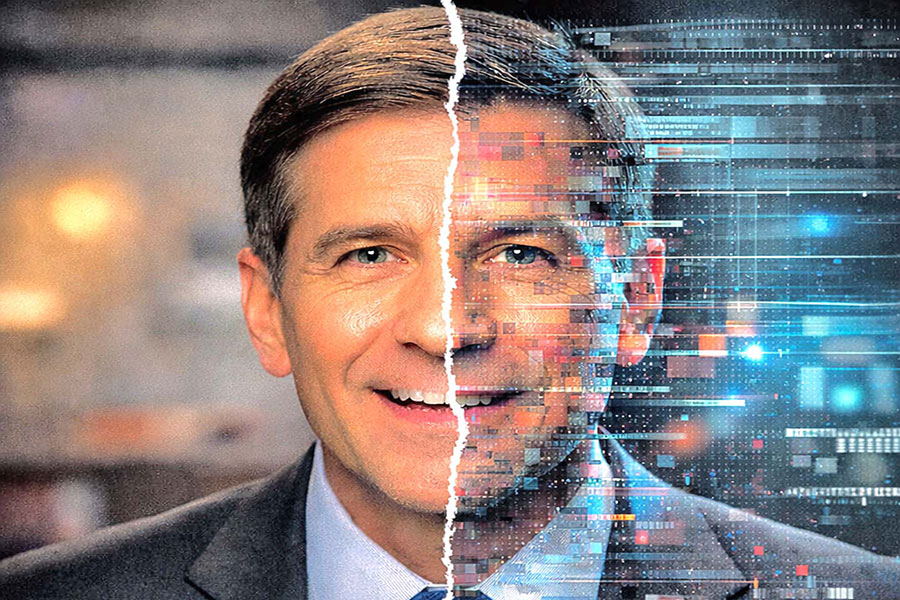
Photo Credit: ChatGPT


Those of us who are old enough may remember a commercial for a company that manufactured tapes for video and audio recording in which the voice of an operatic soprano is heard hitting a high note and shattering a drinking glass. And then the question is asked by the announcer: Is it live or is it Memorex?

Advertisement


A similar phenomenon is occurring today, but with potentially much more serious consequences. I first became interested in researching this topic when links to advertising material began showing up in email messages and publications (to which I had never subscribed). They tended to follow a common pattern: A celebrity spokesperson presents a video about an exciting new discovery of a cure or treatment for some unconquerable malady, usually found in an obscure plant or animal deep in the Third World. The video sponsors had acquired a limited supply of the wonder drug, which required expensive processing, but they were making it available to the public not for $249.95, not even $149.95, but $79.95 or even $69.95 a bottle. Of course, to be sure to have enough to complete the course of treatment, it was advisable to order a three- or six-pack while supplies lasted (especially as it might be months before an additional supply would become available).

Perhaps the most egregious of these marketing campaigns was a promotional video, hosted by Dr. Sanjay Gupta, for a supposed dementia treatment and potential cure based on a rare form of honey. One of the ads for it showed what purported to be an endorsement by Dr. Ben Carson, former Secretary of Health and Human Services, using his face and voice to convey the message. Dr. Carson says he never made such a recording. So does Dr. Gupta. In other words, this endorsement was a fake – produced by AI. Such videos, which mimic real people, are called deepfakes, and are becoming increasingly common in advertising, in writing for publication, and even in political campaigns. The website usefulai.com lists eight deepfake detectors for videos, each with its own strengths and limitations:

  • Deepware has a direct social media scanning link and the facial manipulation detection, but its inability to analyze voice deepfakes might require a second program;
  • Sensity is speedy and accurate and is able to detect multiple types of manipulations across video, audio, and images in one platform;
  • Tru Media uses multiple detection techniques to achieve great accuracy and render a quick response;
  • DuckDuckGoose has an activation map that pinpoints which parts of the video triggered the fake detection alert;
  • DeepBrain takes longer than some others but delivers depth of analysis and accuracy;
  • DeepFakeDetector operates across multiple AI platforms and is highly accurate;
  • WeVerify DeepfakeDetector can check multiple files simultaneously and catches subtle facial inconsistencies that other detectors miss;
  • Sentinel also catches facial inconsistencies that other detectors miss.
For what it’s worth, there are people who are honest about the use of AI. For example, I recently saw an ad for Baerskin hoodies, which ended with a message displayed across the screen – for a long enough time for people to actually read it – saying “this video was produced with AI.”

Besides the problem of fake videos, there are other potential hazards associated with AI. One of them is the possibility of students using it essentially to do their homework for them. Consider a student who has to write an essay of 500 to 1,000 words on a particular topic and really doesn’t feel like doing the research or the writing and editing required to put it together, but simply takes the criteria – length, subject matter, point of view, and so on – and plugs it into say, ChatGPT, whereupon the program then runs through and digests thousands of possible references, puts together a composition, and presents it as submission-ready homework.

This is not idle speculation. A Fox News report on the recent international conference of educators hosted by Melania Trump at the State Department expressed the same concern. And education activist Corey DeAngelis actually envisioned students becoming zombies at their computers.

A big part of the problem here is that it’s very difficult to tell what’s real and what’s AI, given that the program does tend to produce grammatically correct sentences and paragraph structure. There are certain telltale characteristics. For example, typically, in the last sentence of an essay, the program separates evidence and conclusion with a dash; this is a hallmark of AI. However, there are more sophisticated detectors of AI-generated reports. The best known, Grammarly, doubles as both an AI detector and a writing coach, using AI to help the user write better for work, school, articles, reports, and proposals, and offers spelling, grammar, and even plagiarism checking. This leads to the question of whether Grammarly can detect Grammarly-generated writing.

In an October 2025 article on Originality.ai, its founder, Jonathan Gillham, wrote that using Grammarly for spelling or grammatical errors has minimal impact on AI content detectors, but using Grammarly’s rewrite and rephrase features can lead to content getting flagged as AI-generated. “Wherever possible, always strive to be transparent and open about the tools you use for creating content, and save original versions for clarity if required,” he advised.

He also recommended doing the following to avoid false positives: “Focus on writing unique, original content. Use AI writing and editing tools sparingly (avoid Grammarly’s Rephrase, Rewrite, and Use Our Best Version features). When you scan your copy with the Originality.ai AI detector, include the entire version (instead of a single paragraph). Monitor the AI score of your content by using the Originality.ai ‘Watch a Writer Write’ Google Chrome Extension.”

It’s not only students who might abuse AI software. What if professional writers decide that it’s easier for them simply to have the computer write their articles or essays for them? Maybe someday they’ll even be able to write a full book that way. I’m not aware yet of the capability of AI to generate mathematical equations, physics papers, and so on, but it’s probably only a matter of time before that comes along too.

The biggest fear, however, is that unlike previous automation, which eliminated blue-collar jobs, AI will eliminate white-collar jobs. Thus, it would appear that the more artificial intelligence takes over, the less natural intelligence there will be. After all, polls indicate that in November a majority of Americans will vote for a political party whose major policy positions 70-80% of them disagree with. Talk about cognitive dissonance!


Share this article on WhatsApp:
Advertisement

SHARE
Previous articlePrecedence
Next articleSefira: Our Passion for Torah
Richard Kronenfeld, a Brooklyn native now living in Phoenix, holds a Ph.D. in Physics from Stanford and has taught mathematics and physics at the secondary and college level. He self-identifies as a Religious Zionist.