 September 25, 2026
 Categories: In Print / Headline / Front Page
Is Mamdani’s Victory – And NYC’s Deterioration – Assured?
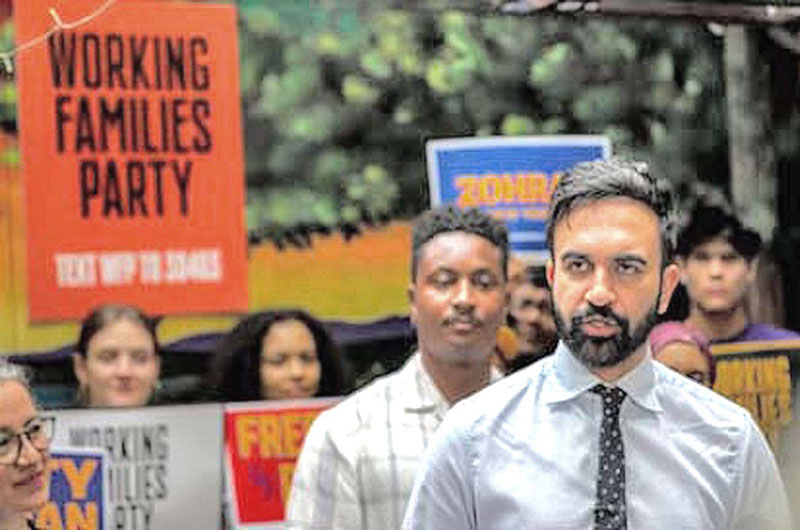


When asked what can be done to stop the election of New York City Democratic mayoral nominee Zohran Mamdani this November, a longtime political operative and former political director for a New York State elected official, who asked to remain anonymous, gave The Jewish Press this direct answer: “Nothing.”
Mamdani, a self-described Democratic Socialist who has represented the 36th District in the New York State Assembly since 2021, emerged from relative obscurity into the national spotlight this year, defeating former New York governor Andrew Cuomo and a slew of other candidates in the Democratic mayoral primary in June. His success, while touting policies such as freezing rent, creating city-owned grocery stores, and making childcare free, is alarming to many.
Beyond his economic platform, however, of particular concern for many Jewish New Yorkers has been Mamdani’s outspoken anti-Israel stance. The assemblyman has accused Israel of committing genocide and refused to condemn the phrase “Globalize the intifada.” Mamdani has also pledged to arrest Israeli Prime Minister Benjamin Netanyahu should he come to New York City under his mayoralty.
“This is not someone running for Secretary of State. This is someone that’s supposed to be dealing with garbage and potholes and street lights and education budgets,” the political operative told us. “Yet, now we see that Israel has become [his] focus.”
Mamdani’s campaign website touts endorsements from progressive, anti-Israel Jewish groups such as Jews For Racial & Economic Justice (JFREJ) and Jewish Voice for Peace (JVP). Over Rosh Hashanah, Mamdani visited Kolot Chayeinu, an unaffiliated Jewish congregation in Brooklyn known for championing progressive, including pro-Palestinian, causes.
Mamdani’s primary win has alarmed many in part because it was also unexpected, with nearly every major poll predicting a Cuomo victory in the weeks leading up to the primary. Under the city’s ranked choice voting system, Mamdani received 56.4% of the vote after two rounds of vote tallying, compared to Cuomo’s 43.6%. Incumbent Mayor Eric Adams, who chose to run as an independent in April after dropping out of the Democratic primary, dropped out of the mayoral race entirely earlier this week.
For New York City Councilmember Inna Vernikov, a Jewish Republican who represents the 48th District in Brooklyn, a combination of voter behavior and the selection of primary candidates brought about this outcome. In addition to low voter turnout, she said, the Democratic Socialists of America (DSA), of which Mamdani is a member, “focused on activating the transplant yuppie class who hate Israel and are generally communism-loving progressives.” She added, “Mamdani has been able to tap into a voter demographic that’s never been activated before – the young, disenfranchised voters, many of whom have been indoctrinated on college campuses and brainwashed by left-wing media.”
The choice of candidates voters encountered when filling out their ballots was also part of the problem, according to the operative. “The Democratic primary was so fluid,” he said. As the incumbent mayor, Adams was expected to be a strong candidate despite recent scandals, the operative said. When Adams decided to run as an independent, Cuomo became the mainstream candidate. “I mean, the guy has scandals on every front – sexual scandals, financial scandals, corruption scandals, all the Covid stuff, especially regarding the Jewish community,” he said. “So here you [had] a situation where now suddenly there’s no Democratic front-runner.”
Mamdani exploited this void, according to the operative. “And what are people told? At least in the Orthodox community, we’ve got to vote for Cuomo because we’ve got to stop Mamdani,” he said. “That’s not a very motivating factor when you think about it. You tell people, ‘Vote for this guy because the other guy is worse.’” He noted that while Orthodox Jews voted in substantial numbers, many other groups did not.
As Vernikov put it, “If there was a serious moderate Democratic candidate in the primary with their finger on the pulse of the issues that are affecting New Yorkers and a decent campaign – then we might be seeing a very different election.”
Meanwhile, while many were not motivated to vote for Cuomo, Mamdani “had a strong base on two demographics,” the operative said. The first was white progressives, including college students with anti-Israel views. The second is a growing Muslim population. (If elected, Mamdani would become the first Muslim mayor of New York City.) “It’s almost accidental,” he explained. “Had Eric Adams said from day one he wouldn’t run, or had the Democratic Party put up somebody that’s not recycled with a lot of scandals…there might have been a different Democratic nominee – a more classical nominee, maybe a liberal but a classic Democrat that might not be necessarily Zionist but neutral, at the minimum, towards Israel.”
According to a recent New York Times/Siena College poll of 1,284 registered voters, 39% said they felt Mamdani “has best addressed the Israeli-Palestinian conflict” in his campaign, and 41% of those polled in the survey said they would vote for Mamdani if the election were held today. Cuomo received 26% support, Adams 11%, and Curtis Sliwa, the Republican nominee, 14%.
“There are some New Yorkers who are undoubtedly attracted to other parts of his campaign messaging and perhaps even his personality. I don’t believe everyone who supports him is an antisemite,” said Yeger. “But it does seem that every antisemite supports him.” He added that many Democratic party leaders “have either ignored or excused his antisemitism.”
According to the political operative, Mamdani reflects “a general shift in the Democratic Party” in which elected officials feel pressured to support him after “seeing this is where the numbers are, this is where the party’s at, this is where the voters are at, especially the younger voters.” He added, “More and more candidates are coming out calling Israel a genocide state and all these other things… So that is a monumental shift. And [Mamdani has] given them that type of boost.”
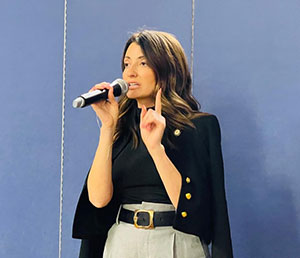
Vernikov said that to defeat Mamdani in November, everyone must support a single candidate who is most likely to defeat him, and also “spread the word about where these radical socialist policies inevitably lead – to communism.” An immigrant from the former Soviet Union, Vernikov said she has “a firsthand understanding that his ideas will lead us to dangerous places – the elimination of the free market, merit, and healthy competition, and usher in bread lines, destitution, and zero opportunity.”
Speaking to The Jewish Press a few days before Adams dropped out of the race, the political operative noted that candidates dropping out now does little because the ballots have already been printed. “The physical ballot was printed a few weeks ago, but by law, the ballot was already set by July,” he explained. “So, all this notion about this guy dropping out, or that guy dropping out, to encourage other people to vote – it’s rearranging chairs on the Titanic.” He added, “Republicans are going to go into the ballot box… and they’ll see the Republican and they’ll vote for him. Even if Sliwa were to drop out, they’ll still vote for him, likewise for the other candidates.”
Despite grim predictions, Jewish organizations and institutions across New York City have made major efforts to get out the vote for the election in November. Jewish Voters Unite (JVU), which aims to involve Jewish communities in the political process, has partnered with organizations to register new voters in neighborhoods across the city. Agudath Israel, in partnership with the Yeshiva and Seminary Coalition for Bnei Chul, is working to facilitate absentee voting for New York City residents studying in Israel.
Some have gone further, with Magen David Yeshivah, a Sephardic school in Brooklyn, requiring parents of students to provide proof of voter registration. Congregation Shaare Zion in Brooklyn, the largest Syrian shul in New York City, did the same for those seeking to purchase seats for Rosh Hashanah and Yom Kippur davening. In a joint letter published in late August, more than 50 Sephardic-Syrian rabbis in New York and New Jersey urged community members to register to vote. “The upcoming elections will have real and lasting impact on the safety of our neighborhoods, the strength of our institutions, and the ability of our children to grow up proudly and freely as Jews,” the letter said. “To sit this out is to abdicate our communal responsibility. This is not optional. It is a mitzvah.”
Though many of these voter registration efforts are driven by nonprofits who cannot openly endorse or denounce any candidate, JVU’s social media emphasized that “antisemitism is on the ballot” and Agudath Israel’s website warned that the election “will shape our yeshivos, shuls, and community life for decades.”
If Mamdani wins, Yeger encourages New Yorkers to pull their children out of New York City public schools, or, if they can, to consider leaving the city altogether. He said this warning isn’t limited to Jews. “There are many other reasons that he is dangerous to New York City as a whole – his positions on criminal justice, which boil down to a fancy version of no one should ever be prosecuted for anything, will put every New Yorker in danger,” said Yeger. “His spending plans are unsustainable. His taxation plans are ridiculous and unachievable.”
On the issue of public safety, Mamdani’s platform includes creating a “Department of Community Safety,” which will invest in “mental health services” and other programs aimed at lowering crime. According to Mamdani’s website, “Police have a critical role to play. But right now, we’re relying on them to deal with the failures of our social safety net – which prevents them from doing their actual jobs.” This progressive approach has drawn blowback from Republicans and Democrats alike.
“He is simply not ready to be mayor, and I hope people recognize that,” said Yeger.
For Vernikov, a Mamdani victory would mean that Jewish life in New York City becomes more dangerous. “I can’t imagine a world where Zohran would hold antisemites on our streets and college campuses accountable for violence and intimidation,” she said. His win would lead to “an exacerbation of what we are currently experiencing: more crime and violence on our streets, antisemitism, coupled with more financial insecurity, and sky-high prices.” Vernikov fears the City Council would push through Mamdani’s socialist agenda, which would significantly harm the middle class. “At that point, the city we love so much will collapse,” she said.
The political operative has a slightly more moderate view. On one hand, he thinks an “already unmotivated” NYPD will “have even slower response times, have even a weaker response to real criminal acts and real pro-terror marches,” and that more people will leave New York City. Still, he does not think his worst-case scenarios of “almost total anarchy” will come to pass. “The way I see it is that he’s going to win with less than 50% of the vote, most likely,” he said, meaning that the other candidates combined will garner more than half of the votes. “[This] would in essence show that he doesn’t have a mandate. If he doesn’t have a mandate, he might be a little bit more classical, in a sense, as a Democrat.”
Mamdani has already walked back some of the things he has said about the NYPD in the past, according to the operative. “He’s going to be fighting in Albany because they’re going to be deciding how much taxes he can raise. He’ll be fighting Donald Trump in D.C. He’ll be fighting some certain police unions and other unions. Not everybody’s going to be on board with everything,” he said. In 2020, Mamdani called to defund the police, a stance he has since walked back. “On a certain level, he’ll have to moderate,” the operative added. “It’s just the way it is by nature in politics.”
Vernikov thinks that if Mamdani wins, the rest of New York State and the country will see the negative results of his mayoralty and will vote against similar politicians in the future. So, despite negative forecasts, she, and others, see reason for hope.
“In Williamsburg and Boro Park, they’re building more shuls. No one’s saying, ‘Oh, you know what, we’re going to wait this out for four years,’” the operative noted.
“I am filled with hope to see the bold Jewish figures who have arisen despite great danger and opposition to serve as voices for our people,” said Vernikov. “We are resilient and we will overcome, as we always have.”
Mamdani’s campaign did not respond to The Jewish Press’s request for comment.