 October 9, 2026
 Categories: Halacha & Hashkafa / Torah
It’s All Greek to Me – But Still Holy


Menachos - Daf 74
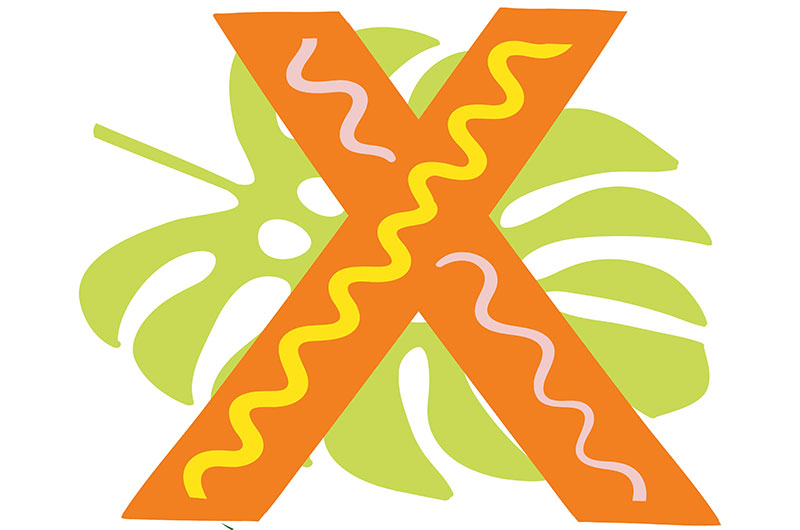
Our Gemara on amud beis discusses how the wafer Mincha offerings were smeared with oil: “The oil is smeared in a shape similar to the Greek letter Chi.”
There is some debate amongst the commentaries about what this letter was and what shape it was. Opinions include:
- The letter “X” (Rambam, Klei Mikdash 1:9) · The Hebrew letter Tes (Rashi, Menachos 75a) · Gimmel, Nun, or Chaf (Tosafos, ibid.) · Chaf (Rashi, Horiyos 12a), which could be a Delta (a triangle) or a reverse Chaf Sofis, which is a Gamma (Hon Ashir Mishna Menachos 6:3 and Sefer Daf al Daf).
Breaking Bread (and the Self)
Daf 75 Our Gemara on amud beis describes the process by which the Mincha offering was broken into pieces, as per the verse in Vayikra (2:6), “pasos osah pittim” – break it into pieces. The Mishna adds that the pieces were a k’zayis (volume of an olive). The process of breaking the Mincha into pieces, like other sacrificial rituals we have discussed throughout Zevachim and Menachos, can be seen symbolically. In a broad sense, breaking a whole into parts, which are fully or partially offered on the altar or eaten, represents the process of self-analysis and self-confrontation – facing one’s deficits but also one’s strengths, and refining them so that what needs to be sacrificed and directly dedicated to G-d is done so, and what needs to be co-opted into continued human process and sustenance is also appropriately assigned. There is a famous saying of the Kotzker: “There is nothing more whole than a broken heart.” Degel Machane Ephraim (Vayikra 13) expands on this idea from two opposite perspectives, ultimately unifying them. A k’zayis often represents a minimum amount of food to be considered halachically substantial for forbidden foods, as well as mitzvos of consumption (Makkos 16b, Mishna Challah 1:2). Therefore, by extension, a k’zayis represents a unit of life force, and since G-d is the source of all life, each k’zayis can represent a unit of godly emanation. According to Degel Machane Ephraim, breaking the Mincha into k’zayis pieces represents a mindful process of discerning the godly life force in the material world. I believe he is referring to different drives and personality traits that we, who are made in G-d’s image, tap into and utilize. However, Degel Machane Ephraim also reads it from the opposite direction. “Pasos osah pittim” can also come from the Aramaic root “Y-F-S,” meaning to spread (see Onkelos on Devarim 12:20). This is symbolic of an expansive, inspired state of mind where the person is experiencing the totality of G-d, and so his comprehension of everything as unified is represented in the breaking of the pieces, which are then unified in an offering. The process of finding G-d in our lives can be both general and particular. Our inspiration might come from seeing one piece or aspect in our lives, or from an overwhelming intuitive sense of presence.Hotel Universe: Five-Star Stewardship
Daf 76 Our Gemara on amud beis mentions an oft-quoted rabbinic principle: “The Torah is careful to spare the money of the Jewish people.” Why is such a principle operative? On a simple level, we can say it is a function of humility. G-d provides for a minimum of structure and commitment in our relationship to Him and leaves it to us to voluntarily add more tribute. Additionally, it might be related to the principle we discussed in our discussion of Menachos 72 that we do not rely on miracles. The Torah expects us to live naturally in most situations, and therefore the amount required to serve G-d should not be extraordinary or require extensive sacrifice. The Baal Shem Tov (Vayechi 5) offers a mystical interpretation. Everything comes from G-d and must serve a godly purpose. If an object comes into your possession, there are holy sparks that must be liberated by your using them in service of G-d. This liberation may be personal to your soul, which needs to be the conduit. An object changes ownership when the person has utilized every aspect that travels through his conduit. If it comes into another person’s possession, it is because it now requires a new process of redemption through that person’s conduit. Nothing is to be wasted, and each possession is precious, but not in a hoarding, miserly way. It is precious because it is there in form and function to serve G-d as the possessor sees fit, as he knows his best conduit. G-d models this approach by being mindful of the financial burden on us. This humble and practical attitude toward everything that we possess is actually not possession but rather stewardship. This is the Torah version of conservatism, not a fake, woke form of “Let’s hug animals and worry more about an exotic fish than the almost one million annual abortions in the United States.” This is living in the world as a welcome and beloved guest of G-d. He wants us to live and enjoy His blessings and accommodations in “Hotel Universe,” while also being a considerate and respectful guest when on the premises.Grasping Straws or Holding Ground: How Much Is Enough?
Daf 77 Our Gemara on amud beis discusses possible Scriptural sources for the percentage given as terumah (generally for the Kohanim) from the loaves of the thanksgiving offering. In one part of the discussion, there is a suggestion to learn from the terumah that was taken from the spoils of the war against Midyan. In Bamidbar (31:28-30), there were two terumos. Those who went to war kept half the spoils, and from that half had to give 1/500 as terumah. Those who did not fight split the other half of the spoils and gave 1/50. Therefore, when the Gemara suggests that we can learn the percentage of terumah required for the thanksgiving loaves from the Midyan spoils, it could mean 1/50 or 1/500. Rashi on our Gemara says 1/50. Interestingly, Rashi Kesav Yad says 1/500. Either way, we must understand the rationale for choosing one derivation over the other. Sefer Daf al Daf brings down a fascinating discussion: Generally, when faced with a choice to derive a higher or lower amount from a Scriptural source, the Rabbis apply the principle of “If you (attempt to) grasp a large amount, you (might) retain nothing, while if you grasp a small amount, you will retain it.” (See Yoma 80a as an example.) If we apply this principle here, at face value Rashi Kesav Yad is correct, since 1/500 is smaller than 1/50. Yet it depends on how you understand the root reason for the principle. Thus far, we are looking at it as choosing the smaller number in any sense, even literally. However, if the principle is to choose the most conservative option, then although often a smaller number is the conservative number, this is not always true. In the example of a possible Biblical requirement to dedicate a portion of terumah, the conservative option is to give more (1/50) so as to fulfill the requirement beyond doubt. This might be the rationale for our version of Rashi, which says 1/50. There is another profound idea here. The Rabbis applied an adage to dictate a Torah idea. I believe this is because when the Rabbis discerned an adage that was wise, they realized that it represented a pattern in life. The Rabbis saw patterns, or in a Jungian sense, archetypes, as coming from G-d, just as the laws of nature and physics come from G-d. Therefore, a minimalist approach to derivations from the Torah is a reflection of a greater psychological, economic, and spiritual truth. Grand gestures and dramatic actions are often far less effective than small, doable commitments. Your goals may be big, but it is important to break them down into small, measurable, and actionable steps.Promotion or Transformation: Same Kohen, New Person?
Daf 78 Our Gemara on amud aleph discusses the number of Mincha sacrifices that a priest would bring if he was simultaneously anointed as a regular priest and as the High Priest. He would end up bringing three sacrifices: one for his anointing as a regular priest, one for his anointing as the High Priest, and one for the daily sacrifice brought by the High Priest. Ohr Sameach (Klei Mikdash 5:17) discusses a lomdishe question: Do we consider the High Priest to be a regular priest who also has an additional level? Or do we consider the High Priest a completely different sort of entity? He brings a proof from our Gemara that clearly, he is considered a regular priest who also is the High Priest. This is why he has to bring two separate sacrifices – for the two separate levels that he has been granted. If, on the other hand, a High Priest were a separate entity, then his anointing as High Priest would completely replace the other level and require only the sacrifice of the High Priest. Let us consider these two ideas philosophically. On the one hand, most enduring changes happen gradually. As they say, easy come, easy go. This is because the immediate inspiration is harder to sustain, and deeper roots and motivations need to be established. If a person goes on a diet and exercise regimen, it might be out of fear of their doctor or due to having reached a weight that does not fit any of their clothes; these might induce a sudden resolve. Long-term success will depend on factors such as how meaningful eating healthfully and exercise are, how good they feel, and whether the person’s energy or health concretely improves, etc. The internal motivations need to be deepened and developed. Even when a change appears sudden, it is often just a tipping point that manifests externally but is actually a buildup of inner pre-contemplation and contemplation. However, sometimes there is an immediate and dramatic transformation. This is represented in the other idea about the Kohen Gadol being an entirely different entity. This may be similar to one approach of the Degel Machane Ephraim (Vayikra 13) to the symbolism of the broken pieces of the Mincha as we discussed on Menachos 75. Sometimes one grasps the entirety in one fell swoop and brings it together. This idea exists in other areas of Jewish thought, starting with the verse that describes Shaul’s ascension to kingship (Shmuel I 10:6): “The spirit of G-d will grip you, and you will speak in prophecy along with other prophets; you will become a different person.” Additionally, we have the halachic, but also metaphysical, idea that a convert becomes literally and figuratively like a newborn. In various concrete halachic matters, and in terms of having his ledger of sins wiped clean, he is a new person (compare subjects of Yevamos 48b and 62a). While what the Kohen actually becomes is a halachic distinction – yes or no – from a mystical perspective, every halachic possibility is valid since it represents a particular channel of Torah thought. Ordinary growth is incremental, and even if eventually a person is totally transformed, since it is slow, it does not feel like it. After all, over time, every single cell in our bodies will be replaced by other cells, but we never change into a different person via that process. On the other hand, if a person becomes so inspired that they completely change, then they can truly become a different person. (On a related note, a machlokes actually represents two different truths, not a wrong or right opinion, since there are many facets to Torah. One example is that in the Gemara Rosh Hashanah 33b, there is a three-way safek about what is the “teruah” sound of the shofar. Therefore, we blow the three sounds we hear on Rosh Hashana: shevarim, teruah, and shevarim-teruah. Technically, only one sound is the true teruah, and we blow all three versions to cover our bases. Yet according to the Zohar (III:232a), each sound activates different middos in Hashem, and thus all three sounds are necessary.)