October 2, 2026
 Categories: Jewish Community
Lt. Gov. Delgado Aims to Unseat Hochul While Stefanik and Blakeman Vie for the Competing Ticket


It’s one year away from the gubernatorial election, and the gloves have come off on both the Democratic and Republican sides.
The Democratic primary is slated for June 2026. During the next seven months, Governor Kathy Hochul will need to fend off criticism from her number two, Lieutenant Governor Antonio Delgado (D - Rhinebeck, Dutchess County). If Hochul, 67, clears the Delgado hurdle, she has to gain ground on Republican Elise Stefanik, 41, a congresswoman from Schuylerville, Saratoga County, prior to the general election. Hochul’s opponents will be framing her policies as though she can do nothing correctly.
When Delgado, 48, announced that he was not pleased with Hochul’s governance, she pulled his entire small staff and locked him out of the Capitol’s second floor where the governor’s office is located. By law, the Lt. Governor’s only official duty is to preside over the state Senate. Without any staff, that makes his job that much more difficult.
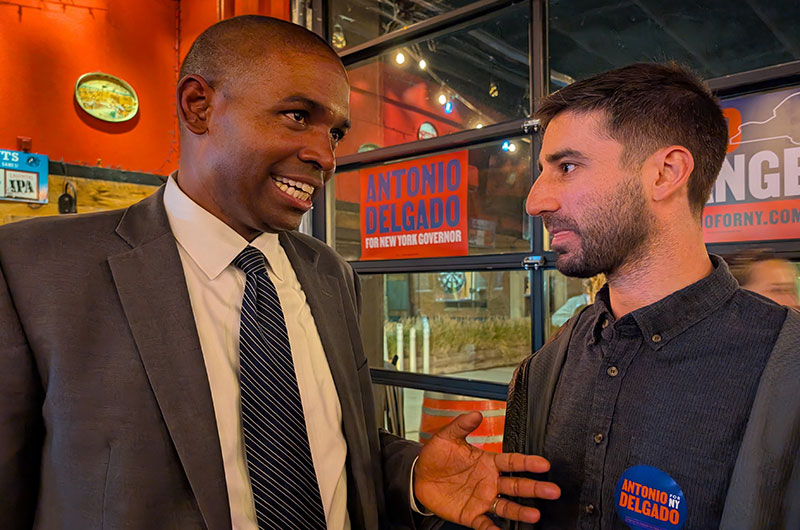
The Jewish Press recently caught up with him at two campaign stops, one in Albany and one in Saratoga County. Each event lasted one hour, which included questions from the audience. Delgado didn’t always answer the questions on point, but for the most part he was animated in the give-and-take with citizens and seemed to enjoy the experience.
The legislative session begins in January, and Delgado said he’s looking forward to “opening up the Senate as I’ve done since I became Lt. Governor. It’s a true honor.”
While Delgado talked about how he attends church services, his wife, Lacey Schwartz, is Jewish, and the couple are bringing up their children with a Jewish education.
“I go everywhere, whether it’s the synagogues, the mosques, churches – I go and try to engage with every faith-based community,” he said. “I spent the Jewish High Holy Days with my family. We went to synagogue, Temple Emanuel [a Reform Congregation in Kingston, NY] for services there…We have wonderful High Holidays, break the fast together (after Yom Kippur) with Lacey’s mom, my mother-in-law. My focus is every New Yorker. Certainly, because I have a personal connection [through] my wife and my children with the Jewish faith, there is always a personal connection.”
Delgado is campaigning with a message of taking the higher moral ground, insinuating that Hochul is selling out. “I’m compelled to serve…When I graduated from law school – Harvard – I had three law firm offers on the table,” he told the crowd at one of the upstate events. “I listened to my parents and told them I want to become a hip-hop artist. I was compelled to do something that I felt was right. To speak truth to power through music for five years. For five years I struggled economically.
“I never thought of myself as a career politician…I was compelled to serve and I have been compelled to serve ever since,” he continued.
“What I’m doing right now – challenging a sitting governor – is not a politically wise decision… This has nothing to do with politics. It has everything to do with the morality in what is right. I’m not looking to get the power from the people to keep myself in power, like a lot of elected officials do. I’m looking to take that power and for every second, every minute, every day, every week, every month to use that power to the fullest extent that I can for the betterment of the people,” he said.
Delgado has made clear that he has many differences with Hochul on the issues including housing, energy, education, childcare, utility monopolies, tax credits for businesses, and style of governing.
“I’m running for governor of New York because the status quo, in my estimation, is broken,” he said. “The will of the people is not being reflected in the system. We have leaders now who are more concerned with protecting a vision tied to party, power, or profit as opposed to purpose and people,” Delgado said. “When you don’t have leadership that is grounded in people and is more grounded in maintaining power, it drifts away from a critical component of who we are as Americans and New Yorkers. That is upward mobility. That is economic freedom.”
Delgado is campaigning, in some ways, in a style of political naiveté, although he is actually an experienced, time-hardened elected official. “You can’t be the typical politician. It’s got to be an uninhibited force that is constructive, is liked, is unifying, is raw, and is just as compelling, if not more because it is covered in love, not hate. That’s what I mean when I say it’s a moral fight. I’ve got some answers and I’ve got some solutions. And I’ve got a vision,” Delgado told the crowd of Democrats at one of the recent events. “When you’re talking about integrity, when you’re talking about decency, honesty, truth, compassion – these are the same things we raise our children on… I don’t care what your party affiliation is, if you’re a human being, I’m hoping this can resonate with you on a human level.
He stressed, “It takes leadership from someone who is not wedded to the donor class, who is not wedded to corporate power – and that is why I don’t take corporate PAC money, by the way. And never have. Another contrast point between myself and the governor – she does.”
Besides the governor’s office, the Democrats control all levels of state government, including the offices of the comptroller, attorney general, both houses of the legislature, and possibly even the judges on the courts, who are mostly Democrats.
“The last time I checked, Democrats are the ones who are in charge at the statewide level...We need to start asking ourselves why do all policies reinforce economic inequality? Why do our policies leave more and more kids in poverty? We’re in charge,” he said. “The way we govern is too much influence by concentrated wealth and power. No matter what the political persuasion is, your objective becomes holding on to power, and the easiest way to hold on to power is to cozy up with power. Once you get in and focus on self-preservation, you no longer are about perspectives of the people… We are not investing in systems that actually make sure folks have economic opportunity in a robust way. We underfund our educational system…”
Being lieutenant governor is often a frustrating experience if the governor does not assign her number two to oversee significant projects. It seems apparent that Delgado (who succeeded another one of Hochul’s failed picks, who resigned during her first term) has been tired of merely sitting on the sidelines waiting to take on an assignment from Hochul. He’s had a lot of time to think about what he could do if he were governor.
One issue that impacts the Schenectady native is getting a handle on poverty. “One in five kids across New York are growing up in poverty. Half those kids beat poverty,” Delgado noted. “Two out of five households can’t afford basic necessities, whether they are energy costs, groceries, rent, health care, or childcare. Everybody’s being priced out. People are struggling. Even what we call the middle class – they might be that on paper but in real life they’re struggling…If anybody is working, it’s the working poor. Working poor – that shouldn’t go together. It’s the fastest growing class across the country.”
“We cannot keep putting on paper how morally bankrupt Washington is when in our own backyard, we’re leaving communities behind. There’s a level of hypocrisy with that,” he said.
Delgado is on a mission that has only been tried once before in New York electoral politics: He is challenging the person who brought him into the executive chamber, Gov. Kathy Hochul. The lieutenant governor’s role is to preside over the New York State Senate and be the governor’s political partner and partner in government.
The only other person to have done this was Lt. Governor Mary Ann Krupsak, who challenged Gov. Hugh Carey in the gubernatorial race of 1978.
Political observers thought a Hochul-Delgado ticket was a well-thought-out plan, which it was – until it wasn’t. Delgado grew weary of the policies Hochul was pushing forward. Both had served time in the U.S. House of Representatives and knew federal policy and procedures well.
He is making his way around the state to introduce himself to other disenfranchised Democrats who feel that Hochul is not representing their interests.
“We need our elected officials to have the political and moral courage to say what is true and to go out there and communicate to the public what the truth actually is and not just hide behind the narrative when it is convenient for them to do so,” Delgado said. “There are a lot of actors right now in politics who look at politics as their gateway to success. Their meal ticket and that’s about all it is for them. It’s their meal ticket. It’s not a calling. It’s not a purpose for them.”
In a statewide primary race whose cost could exceed $30 million, Delgado is going the route of public financing, which he estimates could net him $3.5 million if campaign donations are raised in the correct denominations.
“If we qualify for the full amount, $3.5 million, it would require having 5,000 New York residents giving between $5-a-piece and $250, which will be matched six to one, so a $5 contribution becomes a $35 contribution,” he explained. “We have to raise $500,000 within that group to unlock that $3.5 million, which is a powerful tool to raise from the people for the betterment of the people.”
Meanwhile, on the Republican side, there is a bit of drama emerging between Congresswoman Elise Stefanik and Nassau County Executive Bruce Blakeman, who identifies as Jewish.
Stefanik has locked up 72 percent of the weighted vote prior to the GOP nominating convention next year. The Conservative Party has already put their imprimatur on her campaign. When Stefanik released a vast list of supporters from across the state, the only missing names were from Nassau and Suffolk counties.
Blakeman’s support is coming from those two Long Island counties, which could carry him to the GOP ballot without having to engage in the expensive process of circulating petitions. A candidate needs at least 25 percent of the weighted convention vote to gain ballot access. The nominating convention traditionally occurs in late February or early March. State Republican Chairman Ed Cox has said his preference is to avoid a primary. If Blakeman, a resident of Atlantic Beach in Nassau County, was to win a Republican primary, it would split the ticket, giving the Democrats an easier path to victory.
The last Republican to win the governor’s office was George Pataki in 1994. He defeated the incumbent, Mario Cuomo, by the margin of votes he garnered on the Conservative Party line.
As for campaign rhetoric from the candidates, Stefanik, 41, a resident of Schuylerville, Saratoga County, has nicknamed Hochul “The Worst Governor in America.”
Outside the state capitol in Albany recently, Blakeman, 70, said, “I think I have a base and a springboard for becoming a governor that’s much stronger than anybody else. If you’re not rolling up big numbers in Nassau County and Suffolk County as a Republican, you have no shot to become the governor of the state.”
“We don’t coronate candidates in New York state,” he continued. “The Democratic Party did that with Kamala Harris. That didn’t work out very well for them. Competition is good. If people think that I’m the best candidate and that I would make the best governor, they’ll make their voices heard in the party. If they think it’s Elise, then I will support Elise 100 percent.”
While managing the Nassau County government, Blakeman is currently touring the state, trying to shore up support from those few Republicans who have not aligned themselves with Stefanik.