October 2, 2026
 Categories: Features / Jewish Community
Manhattan Congressional Race to Replace Rep. Nadler Heats Up


Next month, enrolled Manhattan voters in the Democratic Party will be going to the polls to take the first step deciding which one of six candidates will succeed the retiring 78-year-old Congressman Jerrold Nadler who has represented the borough in Congress since 1992. Prior to that he was a member of the New York State Assembly.
New York’s 12th Congressional District covers the largest swath of Manhattan of any other congressional district and includes 21 neighborhoods. The district runs east to west from the FDR Drive to the West Side Highway and north to south from the northern reaches of Central Park at West 110 Street as well as West 114 Street. The northernmost point on the east side is East 98 Street. The Gramercy Park neighborhood around East 20 Street is the southernmost area in the district.
Six Democratic hopefuls have emerged as contenders for the seat, which Nadler described to The Jewish Press as the safest Democratic seat in the country. “If my district ever went Republican then there isn’t a congressional district in the country that would be safe,” Nadler said.
With a Cook Partisan Voting Index rating of D+33, New York’s 12th Congressional District is the most Democratic district in New York and tied with California’s 37th district (D+33) and Alabama’s 4th district (R+33) for the ninth most extreme district. It is the smallest congressional district by area in the U.S. (This is true even though we previously noted that the 12th covers the largest swath of Manhattan, because the other two districts that include parts of Manhattan – New York’s 10th and 13th – extend largely into other boroughs).
The 12th district’s per capita income is in excess of $75,000, the third highest among all congressional districts in the United States. This district also features the best-educated residents nationally.
The six contenders are Constitutional lawyer George Conway, 62; two members of the New York State Assembly – Micah Lasher, 44, and Alex Bores, 35; attorney, writer and political commentator Jack Schlossberg, 33; Nina Schwalbe, 60, a public health researcher who holds a PhD in public health; and Laura Dunn, 40, a civil and victim rights attorney.
Given the district’s wealth, the money has been flowing in, but to only the top contenders. George Conway, a former Republican, has outpaced his opponents, raising more than $3.23 for his campaign as of late April.
Caroline Shinkle, the sole Republican in the race, has been endorsed by New York Republican Chairman Ed Cox.
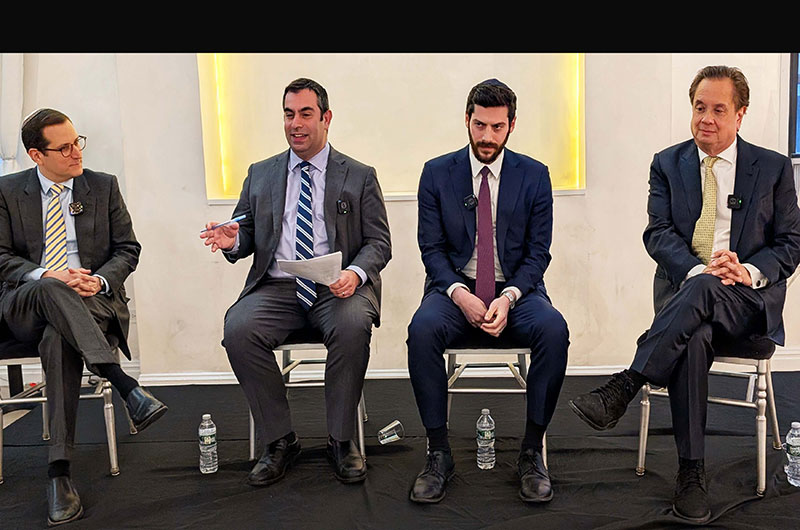
Earlier this month the latest of 12 planned panel discussions took place at the West Side Institutional Synagogue, a modern Orthodox congregation on West 76 Street. The evening was moderated by Josh Kraushaar, editor-in-chief of the online site Jewish Insider. Only Conway, Lasher and Bores attended the forum.
“I (had) approached the candidates. The community wants to be incredibly engaged or has become incredibly engaged with politics. It was important for us to have this venue to be able to have a relationship and to hear from the candidates themselves,” WSIS Rabbi Daniel Sherman told The Jewish Press. “It’s incredibly important for the community to be engaged in a very serious way with the issues and the candidates at all levels and all parties. It was a Jewish community forum. The questions were all heavily tilted towards a concern and priority to our community.”
Earlier this month, The New York Times published an investigative report characterizing Schlossberg’s campaign operation as “erratic and plagued by turnover.” Former staffers alleged that Schlossberg frequently missed weekly strategy meetings, abruptly terminated personnel or neglected to formally notify employees of their dismissal.
Schlossberg’s father, designer Edwin Schlossberg, comes from an Orthodox Jewish family of Ashkenazi Jewish descent from Ukraine. His mother, diplomat Caroline Kennedy, is a Catholic of Irish, French, Scottish, and English descent. He was raised Catholic. The 33-year-old was given all the family names: John Bouvier Kennedy Schlossberg.
He is the only grandson of U.S. President John F. Kennedy (1917 – 1963) as well as being the great-nephew of Senators Ted Kennedy (1932 – 2009) and Robert F. Kennedy (1925 – 1968). He is a cousin to Health and Human Services Secretary Robert F. Kennedy, Jr., of whom Schlossberg has been publicly critical.
The debate seemed, at times, to be a lovefest between Lasher, Bores and Conway as they agreed on every issue pertaining to Israel, antisemitism, new federal education tax credit for private and public schools, Iran policy, buffer zone legislation around houses of worship, and Artificial Intelligence (AI). The one issue they differed on was how they would communicate with President Donald Trump, if elected to Congress.
Conway was the hard-liner and at times all his answers ended with firing Trump.
“The problem with this president is that he does not care about the country. He does not care about the best interests of the country. He cares only about himself. The only time you can get him to do something that’s in the best interest of the country is when you convince him that it’s in his own personal best interest,” Conway said. “Unfortunately, he is so deranged at this point and getting even more deranged, that that’s virtually impossible. This is a man who tweeted dozens of times about conspiracy theories at 1 and 2 in the morning. He is completely off his rocker.
“He is somebody who, if anybody else from any party ever behaved one half or a third as crazily as he has over the past 16 months, he would have been gone by now. The problem is we’ve gotten too used to it and we need to stand up to him and fight back. That’s the principal reason why I’m running for Congress.”
Bores took a more moderating approach.
“He has clearly supported Israel’s right to exist, the hostage deal finally bringing home all of the hostages. He said some good things on housing, wanting to liberalize it. He said good things about AI for the first time, let’s see if he sticks with it,” Bores said before turning the tables toward the negative.
“The problem is you don’t always know where he’s going to be, and it might be whatever the last donor that spoke to him said. We shouldn’t oppose the policies just because they’re coming out of his mouth. We should oppose him because he’s unfit to lead. If he is saying things and moving towards a direction that makes sense, of course you work to deliver and to bring that forward. You can say he is unfit to lead. You can say he is untrustworthy. You can say I disagree with him on all kinds of things, but if he comes over and starts agreeing with us, then great. Let’s work together for the American people.”
And Lasher was more succinct with his views towards Trump.
“I’m very proud to be endorsed by former [NYC] Mayor Mike Bloomberg in this race. He is someone who models the idea that you can vehemently disagree with someone as I vehemently disagree with this president and his Republican Party, which has been made at this point in his image and it is an extremist image,” Lasher said. “I will work with anyone to get things done for the people of this district. That’s my commitment.”
The moderator, Kraushaar, wanted to know from the candidates their reaction to Trump’s policies as it pertains to antisemitism on college campuses and what specific steps would they support as a member of Congress to protect Jewish students and the harassment that’s been taking place.
“When we saw the anti-Israel rhetoric at Columbia University, I called that out. I have repeatedly spoken out. And more than that, it’s the power of righteousness,” Lasher said. “There are a bunch of pieces where you have to speak out with moral clarity, build up governmental power in ways that are effective and build political strength for people in the Jewish community or to elect people to office who are willing to stand up, speak out and act likewise. I am personally motivated to do that as a member of Congress.”
Bores took a wider approach when answering the query.
“There are other organizations that collect this data and call it out. The ADL for one. We need to be clear and unambiguous on antisemitism coming from either party. We need to be taking strong actions to fight it,” Bores said. “In New York City alone, as of January 2026, year over year from the year before, antisemitic incidents in New York were up 182%. This is not a one-party problem. This is a societal problem and we need to address it equally.”
Conway continued on his single-messaging.
“We live in an era where our president is encouraging hatred among groups against smaller identifiable groups, against immigrants,” Conway said. “He [Trump] has given a permission structure for people to be their worst selves. One major step that we will have to take as a nation to get beyond antisemitism and all the other hatreds is to remove Donald Trump.”
Lasher is carrying the bill in the state Assembly to add buffer zones around houses of worship.
“Right now, I am in the middle of trying to pass a state law to establish a buffer zone around houses of worship,” Lasher said, to which Bores expanded on.
“We can protect the right to express speech, to express political opinions. We can also express disapproval of expanded settlements in the West Bank and say that trying to intimidate people entering a house of worship should be out of bounds,” Bores told the audience of approximately 100 people. “Both of those things can and should be true. I support Micah’s bill on buffer zones. I’m a proud co-sponsor of it. I think we should pass it and we could look at things like that federally.
“We need to be able to protect everyone’s ability to worship while we’re protecting everyone’s free speech. Everyone can be safe. We should change what the security grant funds can be used for. We should be expanding the amount of money that we are giving to security grants. That everyone can be safe and we should change what that money can be used for. Right now, it can only be used for infrastructure and not for people. A lot of the costs of protecting these spaces are people. We can make those amendments.”
Conway echoed the sentiments of his opponents.
“We need protections like my fellow candidates have advocated for – to create buffer zones around places of worship and other mechanisms to prevent violence,” Conway said. “That being said, it doesn’t excuse any violence anywhere inside, outside a buffer. We have to call that out. People who engage in that kind of violence and engage in that kind of rhetoric that encourages violence must be punished to the extent permissible in the Constitution.”
In a lightning round segment, all three congressional hopefuls said they would vote to abolish ICE, they would be in favor of having additional seats on the U.S. Supreme Court, and they all want to end partisan gerrymandering, also known as redistricting.
The candidates also weighed in on the future of Israel.
“I would speak from my heart as someone who shares the pain and the anxiety of everyone in this room about what is going to happen to Israel and what is going to happen to the Jewish community in America,” Lasher said.
“I would show that you can be someone who can get support from progressive groups and still stand for supporting our allies, supporting a safe, democratic Jewish state,” Bores said. “You need to be able to engage in all of the communities in order to do that. I would be very happy to play that role in Congress.”
“I would stand up against singling out Israel in an effort by some people to score political points. It’s just wrong, it’s destructive and it promotes division and antisemitism so I will stand up against that in the Democratic Party,” Conway said at the conclusion of the forum.
Conway left the room immediately after the forum and was not available for questions.
I thought it was a great conversation about issues of enormous consequence. I'm very glad the community is so engaged in this race,” Lasher told The Jewish Press after the forum. “I know the concerns, pain and aspirations of the Jewish community as my own. All of the candidates tonight spoke eloquently and shared a lot of common ground. These issues are personal and animating for me in a way that is simply different.”
Bores also weighed in afterwards.
“We agree on a lot of issues, so maybe that's why we have 15 forums so we can find the differences, but I think this was a great discussion and I'm thankful to the rabbi and to the West Side Institution for hosting,” Bores told The Jewish Press.
“I enjoyed the questions and the answers and it's given me a lot to think about,” Rabbi Sherman told The Jewish Press. “There was definitely a lot of agreement but there were things that they disagreed upon and there's what to think about for all of us in terms of figuring things out. I thought the answers overall were coherent to what the community wants and needs.”
The Democratic primary is Tuesday, June 23.