 October 16, 2026
 Marrying Jazz and Klezmer: Violinist Ben Sutin’s Unique Sound


On Shabbat, when I can’t read my X feed, I usually read the newspaper and magazines, and recently I was reading a local magazine we get in our mailbox once a month. On one of the last pages, a small article caught my eye because it was about a local, family-run music school. At the end of the article, it mentioned that one of the sons, Ben, plays Klezmer music.
Klezmer? I love Klezmer! It’s one of my favorite genres. My favorite Klezmer musicians are Hanan Bar Sela, Chilik Frank, and Moshe “Musa” Berlin. They are considered the top Israeli performers of this style. It would be interesting, I thought, to learn more about Klezmer musicians in the U.S.
After Shabbat, I went to Google Ben. It turns out he’s a really talented musician. I was curious to learn more about him and about his journey in music. So, I reached out to him and we had a great conversation. I can talk to musicians for hours – there’s so much to learn from them.
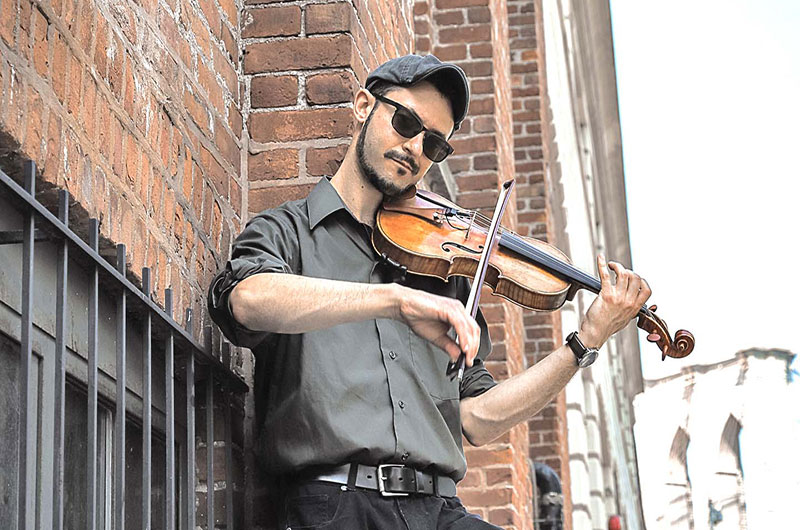
Benjamin Sutin is an award-winning jazz violinist, composer, and music educator based in New York City. His style is different from the typical Klezmer players. He’s not only a Klezmer violinist; he’s also a jazz violinist – he mixes the two genres. I am also a fan of jazz, so I appreciate the result.
Sutin grew up with a mixture of musical influences and constant exposure in the house: mostly classical, jazz, and rock. As mentioned above, his family owns a music school, the New Jersey School of Music, which has two locations (Medford and Cherry Hill). His oldest brother, Matt, is a guitarist and guitar teacher and helps run the school with his mother, Renee, an amateur cellist. Matt’s wife, Emily, is a music therapist and also teaches at the school. His father, Mark, is retired; he’s not a musician but is a lover of music who introduced Sutin to a lot of music as a kid, which became some of his biggest musical influences. His middle brother, Andrew, is a former jazz drummer and now a professional chef in Philadelphia and NYC.
“Why Klezmer?” I asked Sutin. “How did you get into Klezmer music?”
When his brother had a bar mitzvah, his project was to form a band and Sutin was the violinist. (His brother played guitar.) The band played Jewish music. As a child, Sutin used to play during the holidays in his temple. On Purim and Chanukah and at other community events, he played Jewish music. Not Klezmer. He knew how to play “Hava Nagilah” and other traditional holiday songs. When he was in high school, he put together a community band, and again played on holidays, at bar mitzvahs, and so on. His band in high school was called “Blue Suede Jews” (a play on words of the famous song title).
After high school, Sutin went to the Manhattan School of Music to study jazz violin. At some point during his studies, he became very interested in Klezmer. During college, he visited Israel for the first time through Birthright. After coming back from Birthright, he wanted to get more connected to Judaism. He’s not religious and didn’t grow up religious, so his path to connect to his Jewishness was through music.
After his first year in college, he met Yale Strom, a famous Klezmer player. He started to study with him and they became close. Strom is based in San Diego, but every time he came to visit New York, Sutin would study with him. Through his studies with Strom, Sutin got inspired to start his own Klezmer band. The purpose of the band is bringing together jazz and klezmer.
Sutin plays traditional Klezmer songs such as “Tumbalalaika” but he also creates his own Klezmer music. It’s very jazz-inspired but he uses the rhythms and grooves of Klezmer.
I asked him what are the unique features of Klezmer music?
Some of the rhythms and grooves of Klezmer include Freylekh, bulgar, zhok/Hora, khosidl, sher, sirba and kolomeyke, Sutin explains. The two most common scales and modes unique to Klezmer include Freygish/Ahavah Rabbah (borrowed from the 5th mode of Harmonic minor in Western music theory), and the Mi Sheberach scale, characterized as a Dorian minor scale with a raised 4th degree.
Klezmer is very emotional music. The Jewish people are very emotional, and that gets expressed in the music.
Besides his Klezmer band, occasionally Sutin also plays in Jewish wedding bands in the New York area when they hire him as a violinist.
Where does he get his inspiration for his own compositions?
He’s inspired by nature. He likes to walk and observe the clouds, trees, and animals, as well as watching people. Also, walking in the city and hearing all the sounds inspires him. But sometimes he just has a melody in his head and he’ll compose it.
Sutin’s Klezmer repertoire is interesting. It ranges from classical traditional Klezmer to the music of Rabbi Shlomo Carlebach (who wasn’t a typical Klezmer). Sutin says he really likes Carlebach music and therefore he likes to give it the Klezmer interpretation. His favorite Carlebach song is “Esa Einai.” Sutin’s performance of “Esa Einai” starts with an accordion intro (oh, I love accordion) and then he enters on violin with another clarinet player. The combination of violin and clarinet makes for an interesting sound. In the middle of the piece, the contrabass gets a short solo which gives it the jazz vibe. Sutin and the clarinet also have their own solo during the piece which makes it sound like a jazz piece, but then they return again to the tune of “Esa Einai.”
In some of his pieces, he also has an electric guitar in the background which might not be a “very” Klezmer instrument but it integrates nicely. In “Svalava Kozatshok,” Sutin kind of has a dialogue between his violin and the electric guitar. The electric distortion sound together with the violin creates an unusual result.
Another song of his I really liked is his version of “Bei Mir Bist Du Shein,” a popular Yiddish song written by lyricist Jacob Jacobs and composer Sholom Secunda for a 1932 Yiddish-language comedy musical. In my Tu B’Av column a few months ago. I recommended the Neil Sedaka performance of this song. On Sutin’s YouTube channel, he has a video where he plays an instrumental version accompanied by accordion and drums. It’s good.
Besides his YouTube channel, you can also find Sutin’s music on his website, www.bensutinmusic.com.