 August 21, 2026
 Categories: Perspectives / Op-Eds
My Father’s Short Story: The Will to Live


My father was a Yiddish writer of prose and poetry. He has published over 20 papers in Yiddish and English journals from 1945 until his death in 1976. As a Holocaust survivor, his stories were about the unsung heroes of the Holocaust – not depressing stories but true accounts revealing the unyielding strength, hidden nobility, and astonishing spiritual creativity of Jews who lived through the unimaginable.
In 1970 I met a Columbia University professor of Yiddish who knew my father and I asked him what he thought of my father’s writings. He described three characteristics that my father displayed in his writings. As a yeshiva-trained student my father understood Jewish laws and Jewish symbols that the classical Yiddish writers knew but few modern-day Yiddish atheistic writers appreciated. Secondly, he was extremely talented in forging new Yiddish words blending Polish, German, and Russian into expressions that felt ancient and new at once. Finally, he wrote with a literary musicality, shaping sentences that bent or even broke Yiddish grammar to reveal subtler shades of emotion, symbolism, and soul.
I want to retell one of his most extraordinary stories, whose mussar echoes across time and Jewish experience.
In the year 1939, Grodno was no longer a city; it was a trembling breath before a scream, a ghost story waiting to happen. Two souls, Rivka and Yitzchok, held a promise of getting married to each other until the Nazis shattered their fragile glass lives. In the shadow-world of the camps, where the sky was made of ash and the earth of iron, Rivka carried a secret. Not in her pocket, not in a letter, but in her very mouth: a single gold tooth.
To the Nazis, gold was loot. To Rivka, it was a spark of hope, a tether to a future that did not yet exist. In the fall of 1944, Rivka was sent to the Auschwitz concentration camp where every breath became a battle, where all her energy was spent trying to survive. By the winter, the guards heard that the German war machine was beginning to collapse and their eyes flickered with the fear of their own coming end, and they grew sloppy in their cruelty. One bleak morning, at 6:00 a.m., Rivka awoke and walked to the front gate. She did not beg; she did not cry. With the strength of a woman who had already died a thousand deaths, she extracted the gold tooth.
"Take it," she whispered to the guard. "I only want a walk. A walk away from death."
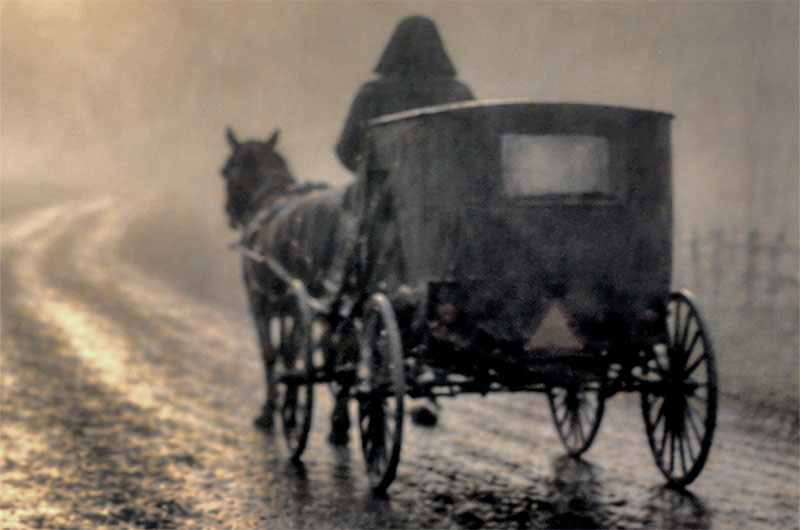
The gate creaked open, like the sound of a sob – and she was let out. Emaciated, a skeleton wrapped in skin, Rivka stumbled into the forest roads. And there, the bashert (destiny) met her as a horse-drawn carriage driven by a mother superior whose eyes carried the burden of too many truths.
"I know the scent of the furnace," the Mother Superior said. "Come. I will save you. I will revive your health. You will act as a nun. You will wear the habit, the heavy wool of silence. You will feed the poor, and you will never, by the life of your soul, speak of the Jew within."
For six months, Rivka lived in the "Outer Chamber." She was a shadow in a cathedral, her Jewish heart beating beneath a crucifix, her hands kneading bread for the hungry. She, like Esther in the King’s palace in Shushan, never revealed her Jewish roots.
The war ended, but the "disguise" did not. A few months after the war was officially over, the Mother Superior asked Rivka (whom she called Rebbecca) to take the horse and buggy and go to town to buy food for the other nuns in the monastery and for their food kitchen to feed the poor. While paying for the food Rivka bought at the grocery store, she felt a hand on the shoulder of her Catholic traditional habit.
"Rivka?"
She turned. It was Yitzchok. He did not see the black habit or the wimple; he saw the soul he had lost in Grodno. Rivka asked Yitzchok how he recognized her. He answered that no disguise can ever hide true love. They wept and exchanged their stories of survival. "It is time," Yitzchok said. "We must remove our disguises and get married and live again as Jews."
But Rivka could not leave like a thief. Rivka agreed but pleaded to Yitzchok to allow her to return to the abbess to personally explain to the Mother Superior her new decision and to thank her. Yitzchok agreed but told her he was coming with her – never to leave her again. She returned to thank the Mother Superior. In that quiet office, the "Mother" listened to their plan to return to their people, and suddenly, the stone face of the Abbess cracked. The Mother Superior began to weep – not the quiet tears of a nun, but holy tears.
"Why do you cry?" Rivka asked.
"Because," the Mother Superior sobbed, "it is time for me to remove my disguise, too. I am a daughter of Israel. I escaped a camp four years ago. The previous Mother Superior found me wandering the road and took me in. When she passed away, the sisters chose me as the new Abbess. From that day, I rode the roads every morning, praying to find escaped Jews. In fact, over half of the nuns in this abbey are really Jewish, hidden sparks waiting for the dawn. The three then left the abbey to restart their lives as Jews.
The most powerful lesson is the indestructibility of the Jewish spark. Even when wrapped in the garments of another faith, even submerged in silence and survival, the inner chamber or essence of the Jewish soul is preserved. No matter how far a Jew may wander or how thick their "disguise" (secularism, assimilation, or trauma) is, the inner chamber faces Hashem with strength and hope. The second lesson is that the Mother Superior did not just hide; she used her position of "disguise" to go out every morning in her carriage to look for other "escaped Jews." Our survival is not for ourselves alone. When G-d grants us a "carriage" (wealth, status, or safety), our first duty is to look for our brothers and sisters who are still wandering the roads.
Finally, this story teaches us that the world we see is often a mask. Beneath the surface of the monastery lay a sanctuary of Jews; beneath the surface of our lives often lies unseen Divine providence.
A Jew must always look deeper – past the "habit," the "outer walls," and the "disguise" – to find the holiness hidden, waiting beneath to emerge.
This story was originally told by Chaim Loike (1906-1976), zt”l. He was a Holocaust survivor, a man of letters who viewed the Yiddish language not just as a means of communication, but as a vessel for the Jewish soul.