 October 23, 2026
 Categories: In Print / Arts / Upcoming Events
Overcoming The Silence


October 7: Terror, Faith, Hope Juneberry Tree Gallery, 1714 President Street, Crown Heights, Brooklyn, NY Runs from October 7 - November 30, 2024. Open Tues. & Thurs. 7-9 p.m., Sundays 1-5 p.m. Extended Chol HaMoed hours 2-8 p.m. Also by appointment – call (718) 774-0914. Curated by Abigail H. Meyer A Project of ATARA: The Arts and Torah Association www.artsandtorah.org/october7 (catalogue available online) ATARA Exhibition Manager: Miriam Leah Gamliel
One full year since the horrific events of October 7, 2023, this October 7 dawned and I began the day with Selichos, reciting: “To you, O L-rd, belongs righteousness, but to us the shame. How can we complain? What can we say? What can we say? What can we declare? What justification can we offer? Let us examine our ways and analyze – and return to You.”
It has been a year of war not finished, a year of hostages in continued captivity, a year of worldwide Jew hate, a year with so few answers to questions that weigh on every Jewish heart and soul. Just as walking into a shiva house, the halacha at first commands silence until the mourner first speaks, what can we do on this terrible anniversary when there is ultimately nothing to say?
ATARA: The Arts and Torah Association has constructed an art exhibition in Crown Heights in the hope that it would pierce the silence with Jewish art. Thirty artists, some ATARA members, participated with oil paintings, watercolor, pastels, photography, textiles, sculpture, calligraphy, mixed media, digital art, video, and installations that are displayed in the Juneberry Tree Gallery on President Street in Crown Heights. We are confronted in this exhibition with a wide range of visual expressions chosen to be sensitive to Orthodox sensibilities, especially mindful of any children who may see the show.
This exhibition faces many of the same challenges that Holocaust memorials have faced over the last 70 years: how to respectfully, accurately, and creatively reflect an event in Jewish history that at its core is too horrible, brutal, and personal to begin to express. We are all aware of the role of symbols in Jewish mourning and tragedy. Therefore, even more difficult for these artists is the challenge of how to avoid using simplistic symbols and text as slogans. The temptation is great for quick and easy signifiers to express enormously complex concepts such as Israel, hate, faith, and pain. Confronting these fraught subjects, the artist’s creative job is to tell us something new that we didn’t know or feel about the unspeakable. This may be one of the most difficult challenges to be faced for contemporary Jewish artists – to move beyond mere illustration.
ATARA began its activities in 2007 and Miriam Leah Gamliel, one of the original founders, explained that its mission was to “empower artists and performers in the observant Torah community,” especially observant women. It has developed into a worldwide community fostering acceptance, spiritual growth, outreach, and healing. In conjunction with Tamar Adelstein’s Juneberry Tree Gallery and advisor and curator Abigail H. Meyer, this exhibition is the first visual arts project for ATARA. During the exhibition, running through November 30, the gallery is planning to host guest speakers from Regavim, Nachala, and Women in Green.
Meyer, the curator, has framed the artwork in three narratives of October 7: Terror, Faith, and Hope, to help contextualize the artworks in four exhibition galleries.
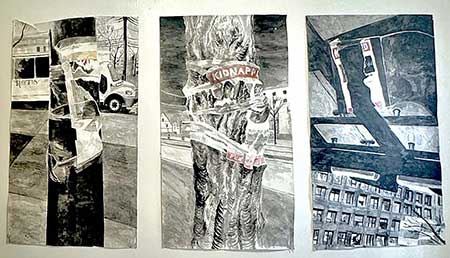 Terror is brought home to us in “A Walk Down College Ave” by Hannah Finkelshteyn. This triptych, each different panel measuring 65” x 30”, is a stark black and white ink drawing that depicts the vandalized and ripped down Israeli hostage posters on one street on the campus of Rutgers University in New Brunswick, New Jersey. The images are brutal and disjointed, only showing scraps of the red and white KIDNAPPED posters: one on a light pole, one on a gnarled tree trunk, and one on a bus stop. These images in their graphic violence manage to evoke the horror of the Hamas crime of abducting the hostages and the heartless desecration by our antisemitic American neighbors.
Yitzchak Moully, aka The Pop Art Rabbi, created the “Simchat Torah Torah Cover,” an actual leather Torah mantle emblazoned with the text: “In Memory of the Kedoshim of Simchat Torah, Tishrei 5784 - October 7: ‘Awake and shout for joy, you who dwell in the dust!’ Isaiah 26:19” inscribed in Hebrew. The dark lower section of the mantle depicts two iconic dancing hasidim with dozens of purple and blue cyphers of light ascending from them, representing more than 1,200 Jewish holy souls, “remembered and not forgotten.” The pulsating splashes of color circle around the back, growing larger, and finally rise to the white upper third of the Torah Cover, crowning the animated letters of Am Yisroel Chai.

Moully explains the dilemma: How do we commemorate the terrible Simchat Torah massacre and still perform this year the mitzvah of dancing with the Torah on that very same day? His Torah mantle, specifically to be used with an actual sefer Torah, literally combines these two deeply contradictory elements – to clothe the holy Torah commemorating a tragedy, and at the same time, to dance with limitless joy in the divine Torah to bring in a hopeful new year. In his words, “we rise again, we transform darkness into light.” Moully, as a conceptual artist specializing in bridging the spiritual and material worlds, has liberated more than a few precious sparks to illuminate our fearful times.
“We Will Dance Again” by Michal Neiman brings the audience into a memorial for the Nova Music Festival where 364 out of 3,000 participants were murdered and brutalized by rampaging Hamas terrorists. Another 44 were taken hostage as they attempted to flee to safety. Neiman’s message of hope is illustrated on an 8’ by 12’ wooden panel with four dancing figures in neon acrylic paint glowing in UV light. The figures are engulfed with the spiritual energy of hundreds of “butterflies,” hoping the clarion call of “We Will Dance Again” will be soon realized. Each “butterfly” bears a name of a slain Nova participant.
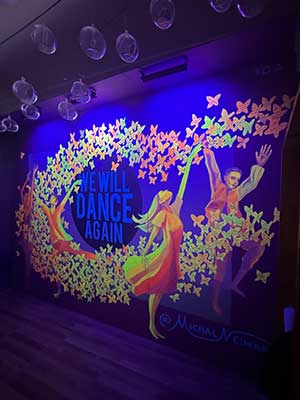
As you stand quietly in the darkened room illuminated with the black lights in front of the massive glowing mural, you become aware of soft meditative music. You start to read some of the names and then a more strident rock music sounds and then fades, imagining you are reliving the Nova festival itself. You are asked to take a named card from a bowl and say the name of one victim, and, perhaps, do something positive in that person’s honor. “We Will Dance Again” is a performance piece that endeavors to create an atmosphere of hope and human connection in the midst of names of the murdered.
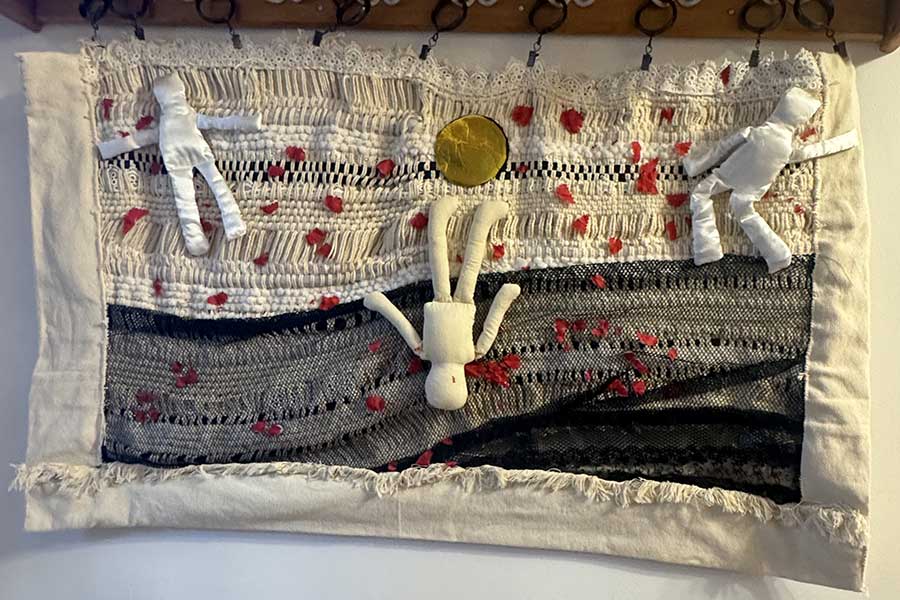
As you first enter the exhibition area, there is a subtle cloth artwork, “October 7th” by Judith Tantleff-Napoli. It is handwoven fabric that is shockingly simple and almost childlike in its power. Hanging on the wall, the predominately off-white cream color is contrasted with a midsection of dirty grey-brown, looking like a rug partially covering a floor seen from above.
Evenly sprawled out are three childlike figures, two in white and one cream-colored. Their little arms and legs are lying akimbo on the “floor,” splattered with red spots. The simple execution and merely suggested realism make this image one of the most powerful in the entire show. It is as if you have joined the first responders and just walked into a Kfar Aza bedroom on October 7.
This exhibition includes the work of the following artists: Gayle Asch, Sarah Begun, Rikki Benenfeld, Ilan Block, Lloyd Bloom, Gabriella Broome, Rachel Conen, Chana Flicker, Hannah Finkelshteyn, Naomi Guez, Natalia Kadish, Pinny Segal Landau, Carol Man, Babette Marciano, Yitzchok Moully, Michal Neiman, Marc Provisor, Leah Raab, Sharon Sauerhoff Abeles, Eve Schachnow, Haim Sherf, Irina Sheynfeld, Lipa Shmeltzer, Yael Rachel Smith, Judith Tantleff-Napoli, Yossi Wagshul, Sara Wax, Rena Williams, Talya Zahler, and Jana Zimmer.
While the themes of Terror, Faith, and Hope dominate the artworks and the wall texts that accompany each image, it is the hand and heart of each individual artist that opens a deeply human dimension to this exhibition. A year after the massacre, this exhibition answers the need we all feel – to be together so that we may cling to the unity that brings. Am Yisrael Chai!