October 2, 2026
 Categories: Featured / Parsha / Torah
Precious Tears


In this week’s parsha we learn the laws of the korbanos that were brought in the Mishkan and later in the Beis HaMikdash.
The Sefer HaChinuch asks (mitzvah 95): Why did Hashem give Bnei Yisrael these commandments? Certainly Hashem, Himself, does not need a Mishkan or korbanos.
The Sefer HaChinuch explains that all the mitzvos are, in fact, for our own benefit. When a person can build a special place for Hashem, then he can dedicate his service to Hashem, and concentrate on thoughts of holiness and purity. When the individual considers the time, money and effort necessary to obtain the sacrificial animal and to bring it as a korban, he begins to realize that the aveirah for which he is seeking atonement is a weighty matter. He grasps the severity of his problem and understands his obligation not to repeat the transgression in the future.
The Sefer HaChinuch cites the Ramban who expounds that the individual must appreciate the fact that the animal being sacrificed is really in place of the sinner. That awareness will inspire and compel the person to do complete teshuvah.
After the destruction of the Beis HaMikdash, we no longer have this setting to inspire thoughts of holiness and purity. Today all we have is our “mikdash me’at” – our shuls and batei midrashos – and the tefillos which replace the korbanos. These holy places are governed by many halachos to ensure the sanctity and inviolability. Some of the ambience of the Beis HaMikdash is replicated in the shuls and batei midrashos with the presence of the aron kodesh, the paroches, the bimah, the recitation of Birchas Kohanim in order to recreate the inspiration and spirituality that we once experienced.
The Michtav M’Eliyahu writes that a certain element of imagery and vision is required to generate the enthusiasm and fervor that was prevalent when one brought his korban in the Beis HaMikdash.
The Mishna in Rosh Hashanah (16a) describes the day of Rosh Hashanah when “all creatures pass before Hashem like sheep.”
Rav Dessler quotes R’ Simcha Zissel of Kelm who said that the great people throughout our history used their vision to create inspiration. Just as the evil inclination uses imagery to lead a person to sin, chas v’shalom, so too we should use our imagination for positive motivation.
The disciples of Rabbeinu Yonah noted that when one davens Shemoneh Esrei he should remove all earthly matters from his mind and imagine that he is standing in Heaven, and talking directly to Hashem. In this way his prayers will be more pleasing to Hashem.
The Alter of Kelm once happened upon a stone bench as he was taking a walk. Regarding it, he recalled an interesting Medrash that tells of R’ Yehuda finding the rock that R’ Meir had sat upon when he learned Torah. R’ Yehuda approached the rock and kissed it, comparing it to Har Sinai, the place where the Torah had been given to the Jewish people.
The Alter noted that conceptualizing the image of R’ Meir’s rock could perhaps be understood intellectually. The effectiveness of a visual, tangible object such as the stone bench, however, was much more powerful and impressive. The Alter had learned the Medrash in his youth, but the vision of the stone bench brought the Medrash to life.
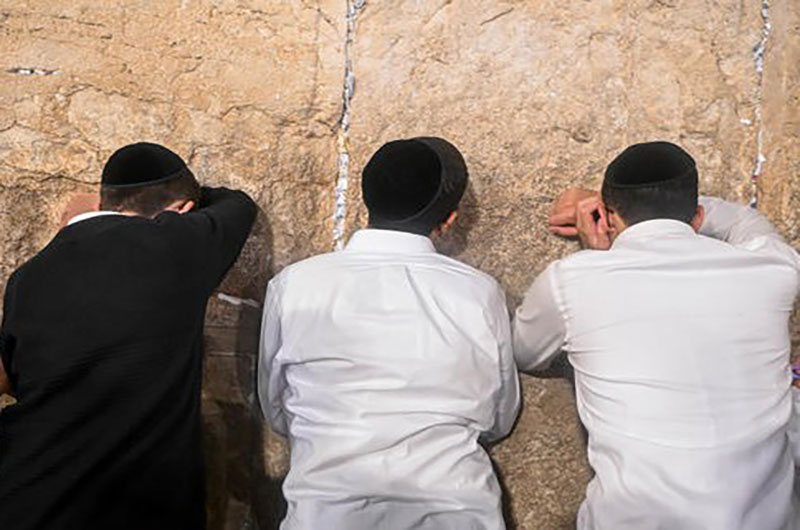
The Talmud (Brachos 32b) tells us that although the Gates of Prayer may be closed, the Gates of Tears are never closed. The Meiri writes that one cannot say that the majority of prayers are not heard, because when the prayer emanates from the depths of one’s heart, to the point that one is overcome with tears, then the prayer is certainly more accepted.
The Shaar Metzuyanim B’Halacha cites the Orchos Tzaddikim and the Kav HaYashar that this does not mean that the tefillos do not enter the gates of Heaven; however, the tefillos have to be accepted with great mercy. When a person cries, it arouses the Heavenly mercy and the gates open wide. It is comparable to a person who knocks gently on the door but his knock is not heard. However, when the person knocks on the door with tears, the Heavenly compassion is stirred. The Sefer Erez Tzvi adds that even if one has committed certain aveiros which could possibly close certain gates, those gates can be opened when the petitioner cries. Furthermore, they are also brought closer to Hashem.
Our Sages ask: If the Gates of Tears are never closed, then why are gates necessary at all? The Ye’aros Devash states that one must first purify himself from sin before he cries, otherwise the gates may remain closed.
Recently I was visited by a young family who had a child facing a serious medical challenge. They came for chizuk and to have some questions answered regarding her treatment. As they were getting ready to leave, I saw the wife lean over to whisper something to her husband. The husband turned back and said, “We asked you our medical questions with regard to Pesach, but frankly, we don’t even know where we will get the money to actually make Pesach. We are struggling,” he said softly. I couldn’t hold back my tears. Here was a family beset with a child’s critical medical issue and they were dealing with the added distress of not having the financial means to buy the minimal necessities for Pesach. I immediately promised that they would have enough to be able to celebrate the Yom Tov with dignity.
Every year before Pesach, I personally reach out to all of our loyal readers and friends of The Jewish Press to help me help others in the community who are in dire financial straits. There are families, individuals, and children who need our encouragement, our support, and our monetary assistance so that they can rejoice on the Yom Tov of Pesach along with the rest of Klal Yisrael. Please join in this great mitzvah.
I personally administer and distribute the monies from the special Yom Tov Fund I have established directly into the hands of those who are most in need.
In the zechus of your contribution may you merit blessing and success, good health, nachas, happiness and prosperity. You may also include the names of anyone in particular who is in need of shalom bayis, shidduchim, refuah, parnassah, etc. and I will say special prayers on their behalf. May we be worthy, with all of our tefillos, to celebrate a good, healthy and joyous Pesach, and may we see an immediate end to the current situation that plagues the world. Amen.
Please send your contribution to Khal Bnei Yitzchok Yom Tov Fund, c/o Rabbi Dovid Goldwasser, 1336 E. 21 Street, Brooklyn, NY 11210. Donations can also be Zelled to 718-954-4343.