 November 13, 2026
Categories: Headline / Ask the Rabbi / Torah
Q & A: A Thread of Blue (Part I)
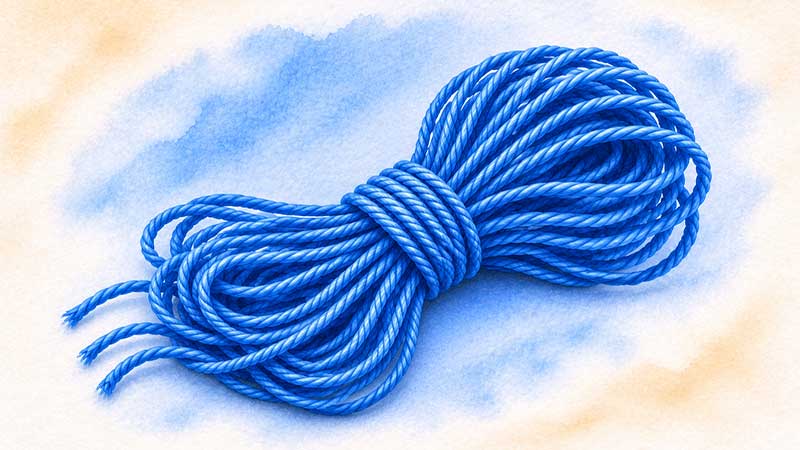


Question: We say in Keriat Shema that we are to “place upon the fringe of each corner a thread of blue.” Are we fulfilling the mitzvah of tzitzit today, when we do not know the source of this blue dye?
Moshe Jakobowitz
Brooklyn, N.Y.
Answer: The Mechaber (Orach Chayyim 18:3) states: From when in the morning do we utter the blessing on the tzitzit? From the time that one is able to discern between the techelet (the blue) in it and the lavan (the white) in it.
From the above halacha, it would appear that most of us today do not fulfill the mitzvah of tzitzit properly, if at all. The Mechaber’s halacha is based on the pasuk in Parshat Shelach (Numbers 15:38): “Daber el Bnei Yisrael ve’amarta aleihem ve’asu lahem tzitzit al kanfei bigdeihem le’dorotam, ve’natnu al tzitzit hakanaf petil techelet” – Speak unto the Children of Israel and say to them that they shall make for themselves fringes on the corners of their garments throughout their generations, and that they place upon the fringe of each corner a thread of blue. This passage clearly indicates that “a thread of blue” is part of the proper fulfillment of the mitzvah of tzitzit.
At the same time, we are fully aware that there are numerous precepts that we are unable to fulfill today. These include the korbanot (sacrifices) that we cannot offer because we are bereft of our Holy Temple, as well as many of the mitzvot that are connected to the Land of Israel.
But the mitzvah itself still exists, for Rambam writes in Hilchot Yesodei HaTorah (9:1) that a mitzvah stated in the Torah is eternal, and should a man arise and proclaim that he was sent by G-d to add a mitzvah, to omit a mitzvah, or to interpret a mitzvah in a way that is different from what we heard from Moshe, he is to be considered a false prophet, for his statements constitute a denial of the prophecy of Moshe. (See Lechem Mishneh ad loc. and his question regarding Tractate Horayot 4, for which he does not have an answer.)
Thus, it is quite clear that the mitzvah of tzitzit applies today, just as all the other mitzvot do, but we lack the means to fulfill all of its requirements – in this case, to add the techelet to the fringes. Our question, in essence, is whether we are able to fulfill the mitzvah of tzitzit even though we lack one of its elements.
Indeed, that concern is addressed in the first Mishna of the fourth chapter of Tractate Menachot (38a), which states: “[The absence of] the blue [thread in the fringes] does not impair [the validity of] the white [thread], and the [absence of] white does not impair [the validity of] the blue...” As long as there are four threads at each corner – which become eight when they are folded – the absence of either one of the colors does not hamper the performance of the mitzvah of tzitzit. Rashi and Tosafot(ad loc.) both understand that two of the threads should be blue and the other two should be white. (Rashi is consistent in this view when he comments on the discussion in Tractate Shabbos 27b regarding the materials of which the garment and the fringes are made, noting that two of the threads are blue and two are white, and the latter are like the corner of the garment which is usually white.)
Tosafot (ad loc. s.v. Ha’techelet einah me’akevet and Shitah Mekubetzet ad loc. who clarifies the Tosafot) cites the similarity with tefillin, where if one has only the tefillin shel yad or, conversely, only the tefillin shel rosh, the mitzvah may nevertheless be accomplished, as the lack of one does not impede the mitzvah.
Thus, in effect, the mitzvot of tzitzit and tefillin are unique in that the lack of one element required for the fulfillment of the mitzvah does not preclude its performance as long as the other components are present. In fact, further on, the Talmud states (ibid. 39a), “Techelet she’karach rubbah keshera” – if the greater part of the techelet was wound around the other threads, it is still valid. Rashi (ad loc. s.v. techelet) notes that this is the name by which we refer to the whole fringe. Thus, we fulfill the mitzvah of tzitzit even though “the thread of blue” is not available.
As we noted at the outset, the term techelet is also used in another context – the time at which we are permitted to recite the morning Shema, which is when one can distinguish between blue and white (Berachot 9b, Mishna). The Gemara then continues with other parameters, concluding with, “Others say: from the time that one can distinguish his friend at a distance of four cubits.” The intent, of course, is to ascertain that the night has ended and that it is sufficiently light outside. And while the Mechaber (Orach Chayyim 58:1, Hilchot Keri’at Shema), opts for the wording of the Gemara – when “one can distinguish his friend,” and not for the text of the Mishna (as he did in his earlier halacha regarding the blessing on the tzitzit) – the MishnaBerurah(ad loc.) explains that there is actually no contradiction between these two definitions.
Rambam’s view regarding the thread of blue in the fringes (Hilchot Tzitzit 1:6) is that only one of the eight threads hanging down from the corner of the garment is to be blue while the other seven are to be white. Raavad (ad loc.) immediately takes issue with this text, which he views as describing an impossibility, and amends it to read “two threads of blue” and “six threads of white.”
KesefMishneh and MigdalOz both dispute this new reading of Rambam’s text, arguing that it is the original text (i.e., the text before us) that represents the view of Rambam. Their evidence is that in his responsum to the sages of Lunel, Provence, Rambam advised them to dye one of the threads blue – but only halfway, since it is written “petil techelet,” a thread of blue, in the singular, and only one of the eight threads hanging down should be blue.
The Tur (Orach Chayyim 11, Hilchot Tzitzit) follows Rashi and Tosafot on this matter – that two threads of blue and two threads of white are required, each one folded in two. BeitYosef (ad loc.) explains Rambam’s text, as noted above, to mean that one of the threads is dyed blue halfway, since it is written “petil techelet,” a thread of blue.
However, the AruchHaShulchan (Orach Chayyim 9:2) reads Rambam’s text as the Raavad does, and accordingly rules that tzitzit require one thread of blue and three of white.
Commenting on the chapter “Hatechelet” (Menachot ibid.), the Mordechai follows the ruling of BeitShammai (as cited in Sifrei) on this matter – that we must have two threads of blue and two threads of white. Additionally, there must be five knots separating the several series of windings of one thread around the others. We are not particular about the number of times the thread is wound around until the next knot is made, but the knots must be no less than a thumb’s width apart.
The Mechaber (Orach Chayyim 11:14, Hilchot Tzitzit) states that there are four series of windings, and provides specific numbers for each one of them: The thread is wound around seven times below the top knot, nine times after the second knot, eleven times below the third knot, and thirteen times between the fourth and fifth (the last) knots. The total number of windings equals the numerical equivalent of Hashem’s four-letter Name – Yud, Keh, Vav, Keh –plus “echad,” which is 39.
The Ba’erHeitev and the MishnaBerura (ad loc.) quote the kavanot, the Shelah and the MagenAvraham, to the effect that the series of windings after the second knot actually numbers eight (not nine) for the total to be 39 (the gematria of “Hashem echad”).
To be continued.