 November 13, 2026
Categories: Torah / Ask the Rabbi / Headline
Q & A: It Is Our Prayers That Bring Rain (Part I)
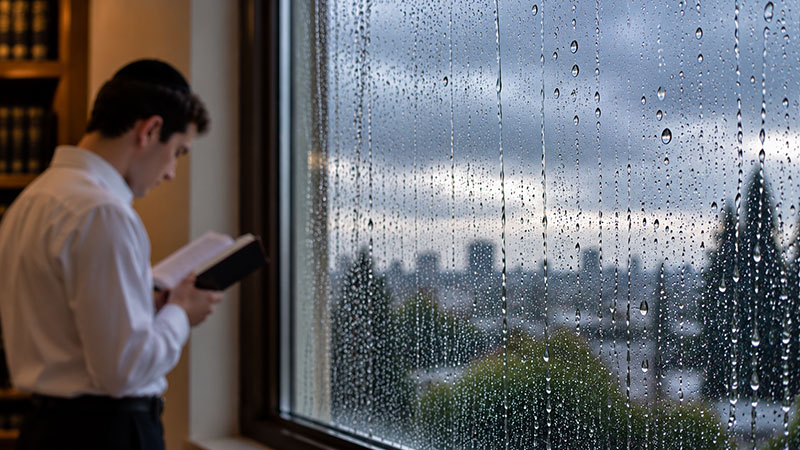


Question: I have a number of questions about the Prayer for Rain. Is there really a need for a prayer for rain when rain generally comes in the fall and winter seasons? When is the proper time to begin praying for rain – December 4 or December 5? Also, if one forgets the request, must he repeat the Shemoneh Esrei? Additionally, what if there is a severe need for rain before that time?
Sam Cohen
Via email
Answer: Hopefully, this discussion will answer all your questions.
The Torah in Parshat Bereishit (Genesis 2:5) states that although the earth was fully formed, “v’chol eisev hasadeh terem yitzmach”–there still was no grass sprouting. Why is that so, if everything else was developed? The pasuk continues, “ki lo himtir Hashem Elokim al ha’aretz” – because G-d had not yet sent any rain, and without rainfall, grass cannot grow. And why did G-d not send rain? To this the pasuk concludes, “v’adam ayin la’avod et ha’adamah”– and man was not yet present to work the land. Chazal say that “la’avod” here also means to pray for rain (avodah she’ba’lev is tefillah). In other words, The Torah is teaching that rain will only come if Adam – and in the future, Bnei Yisrael – pray for it.
That also connects to another reason for our prayers and their efficacy in general. The Gemara (Ta’anit 2a) declares, “Shalosh mafteichot lo nimsaru b’yad shali’ach”– three keys were not given over to an agent [of G-d].In other words, they were never permitted to function automatically through the forces of nature, as the sun, moon, and the stars do. These function naturally, whether we deserve their benefits or not. It matters not whether we pray for the sun to rise – it will do so automatically, for it was given over to the shali’ach of natural law. But rain will fall only if we pray for it. So, it is with the other two “keys”: techi’at ha’meitim (reviving the deceased) and fertility (the ability of women to conceive). Only sincere and fervent tefillah will secure the rain we need.
Unfortunately, unbeknownst to the world at large – much of which is hostile to the Jewish people – it is the prayer of the Jew, whether he is in Eretz Yisrael, America, Hungary, Australia, South Africa, or any other place in G-d’s world, that brings forth rain. This is not a matter of chauvinistic boast but rather fact. We should politely inform our gentile neighbors of such. It is based on the Talmud (Yevamot 64b), which explains why our forebears, the Patriarchs and the Matriarchs, were initially barren. R. Yitzchak states that this was so that they would pray to Hashem because He very much desires the prayers of the righteous. Indeed, all Jews are considered righteous according to the Talmud (Sanhedrin 90a), which states, “All Jews have a portion in the World to Come” (quoting Isaiah 60:21, “V’ameich kulam tzaddikim l’olam yirshu aretz…” – All your people are righteous; they shall inherit the land forever).
Interestingly, I heard the following story from my late chaver and mentor Rabbi Aharon Ziegler, zt”l. In Poland in 1750, a severe drought engulfed the entire region. As conditions grew progressively worse, the Polish Catholic Church, looking for a scapegoat, put the blame for their plight squarely upon the Jewish community. The rabbi of the community in Lizhensk, Rabbi Elimelech Wajsblum, zt”l (who happens to be my sixth great-grandfather on my late mother’s side, Hinda bas Reb Simcha HaLevi, Mrs. Hilda Klass, a”h), popularly known as the Rebbe Reb Meilech or posthumously by his sefer Noam Elimelech, was given three days to produce rain or else he and his family would be executed and the rest of the people would be driven from their homes. The rabbi proclaimed a three-day fast for the entire community, with special prayers to be recited each day.
On the third day, seeing that the sun was shining and there was not a cloud in the sky, the rabbi decreed that the entire community should gather at the synagogue for Mincha services that afternoon wearing their heavy rain gear, including raincoats, boots, and umbrellas. The Catholic priests and their followers, observing this sight, mocked the Jews for listening to their rabbi. As Mincha was about to be concluded and still not a single cloud had appeared in the sky, the rabbi began reciting “Avinu Malkeinu” – each line with greater feeling. When he got halfway through, a slight breeze was felt. Soon the breeze turned into a wind, then a strong wind. A drizzle was felt, and soon a steady stream of rain began to fall. Within minutes, a heavy downpour began. The Catholic priests and their followers were all drenched, while the Jews shouted and declared, “Hashem Hu HaElokim, Hashem Hu HaElokim” seven times.
One would think that, upon witnessing this, these haters would have acknowledged the obvious power of Jewish prayer, but that was too much to ask.
To be continued.
Rabbi Yaakov Klass, rav of Congregation K’hal Bnei Matisyahu in Flatbush, Brooklyn; is chairman of the Presidium of the Rabbinical Alliance of America; and Torah Editor of The Jewish Press. He can be contacted at yklass@jewishpress.com and Rabbi@igud.us.