 November 6, 2026
Categories: Headline / Ask the Rabbi / Torah
Q & A: Standing During Chazarat HaShatz (Part I)
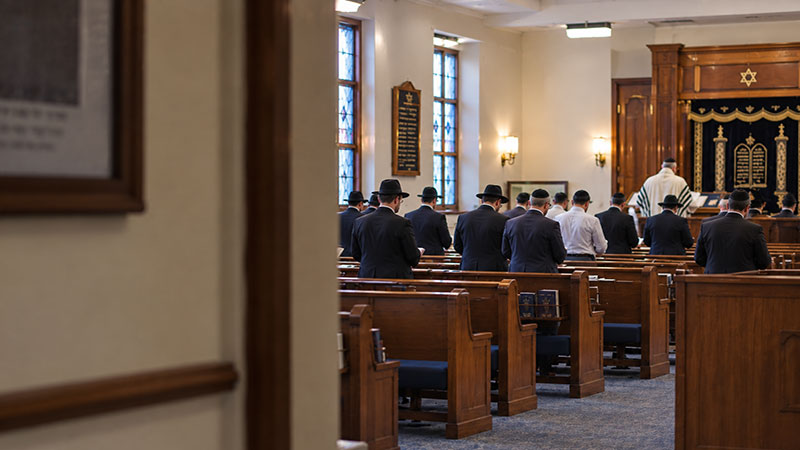


Question: Is one obligated to stand while the sheliach tzibbur repeats the Shemoneh Esrei? I have observed that some people stand during the whole repetition of the Amida while others sit most of the time.
Menachem
Via Email
Answer: The Mishna in Tractate Rosh Hashanah (33b) states the following: “...Just as the sheliach tzibbur (the cantor or prayer leader, lit. the representative of the congregation) is required [to say the daily prayers], so is each and every individual under that same obligation.” This is the first view mentioned – that of the first Tanna. Rabban Gamliel, however, says that the sheliach tzibbur fulfills the obligation of the entire congregation.
Discussing the Mishna, the Gemara (34b) states, “[The Sages] said to Rabban Gamliel: According to your view, why does the congregation [first] say their [silent] Amidah? He replied, ‘To give the cantor sufficient time to prepare his prayers’ [that is, to put himself in the proper frame of mind before the public recitation of the Amidah].
We thus see that when the cantor prays as our “representative,” through him we fulfill the obligation of tefillah b’tzibbur, congregational prayer, as the baraita indicates in Berachot (6a): “Rabin b. Ada said in the name of R. Isaac: How do we know that G-d is found in the synagogue? It is said (Psalms 82:1), ‘Elokim nitzav b’adat K-el’ – G-d stands in the congregation [convened by] G-d.”
The Gemara(Berachot 7b-8a) also teaches: “R. Yochanan said in the name of R. Shimon bar Yochai: What is the meaning of the verse (Psalms 69:14), ‘Va’ani tefillati lecha, Hashem, et ratzon’ – As for me, let me offer my prayer to You, Hashem, at an acceptable time? When is it a time of acceptance? When the congregation prays.”
Rambam (Hilchot Tefillah 8:1) states, based upon the above Gemara, that even if there are sinners among them, the prayer of the congregation is answered by Hashem. Therefore, each individual is required to join with the congregation in prayer, and the cantor acts as our agent to fulfill our obligation of congregational prayer.
The Mechaber (Orach Chayyim 124:4, Hilchot Tefillah) states that when the cantor repeats the Shemoneh Esrei, the congregation is to remain silent and concentrate on the blessings that the cantor recites, answering Amen at the conclusion of each one. If there are not nine people present (besides the cantor) who are attuned to the cantor’s prayer, we could say that the blessings might be for nought (levatalah). That is why each individual has to consider himself as though he were the one completing the requirement of nine (additional) people, and he must concentrate on the blessings recited by the cantor.
The Rema adds that the entire congregation should remain standing while the sheliach tzibbur repeats the Amidah (according to Hagahot Minhagim – see Halachot Ketanot, Chelek 2, Siman 80).
Commenting on the Rema’s statement, the Mishna Berura notes that since we have the rule of “shome’a ke’oneh” – that one who hearkens is considered as though he responded – those listening to the sheliach tzibbur are considered as if they had said the Amidah themselves and fulfilled the obligation (and since the cantor stands, they do as well); however, today, because of our sins, we live in times when everyone does as he pleases and some even sit and talk (see the Pri Megadim). He states that it is surely forbidden to sit within four cubits of the cantor when he is reciting the Amidah.
From a comment of Darchei Moshe on the Tur, we are given to understand that the practice in his time was for people to remain standing at the end of the silent Shemoneh Esrei, waiting for the cantor to begin the repetition, and possibly to remain so until the conclusion of Chazarat HaShatz. He quotes R. Binyamin Zeev in the name of R. Shimon ben R. Yosef saying that when the majority of the congregation has concluded the Amidah, we caution the cantor not to wait for the few individuals who have not yet finished, due to the concern of tircha detzibbura – causing discomfort to the congregation, which is standing and waiting for the repetition to begin.
The Admor HaZaken (the Ba’alHaTanya) repeats in his Shulchan Aruch HaRav (Orach Chayyim 124:7, Hilchot Tefillah) the statement of the Rema that there are those who say that one must stand, but he adds another reason: The shofar blowing during the repetition of the Amida on Rosh Hashana is referred to as “teki’ot de’me’ummad,” lit. “shofar blasts while standing,” because the entire congregation remains standing for the cantor’s repetition.
The Aruch HaShulchan (Orach Chayyim 124:9) also repeats the Rema’s statement that some say that all should stand, but adds that if one is not well, it is permissible for him to sit.
Harav Yitzchak Yosef, the Rishon Le’tzion (Chief Rabbi of Israel), in his work Yalkut Yosef, quotes Rav Elyashiv, who says that those who walk about during the cantor’s repetition cannot be included under the principle of “shome’a ke’oneh” (and thus are not fulfilling their obligation); that is not the case of those who sit in place, who are still fulfilling their obligation. It is clear to him that those who are not versed in the text must stand. Rav Yitzhak Yosef then adds that “Bnei Sefarad,” the members of the Spanish and Oriental communities, who follow the rulings of the Mechaber (Rabbi Yosef Caro), may sit after the cantor has concluded “Ha-Kel HaKadosh.”
It is interesting to note that we find the Rema’s rule in Rambam (Hilchot Tefillah 9:3): All stand and listen and answer Amen after each and every blessing.
To be continued.