 October 16, 2026
 Categories: Ask the Rabbi / Torah
Q & A: The Chanukah Candles and Danger
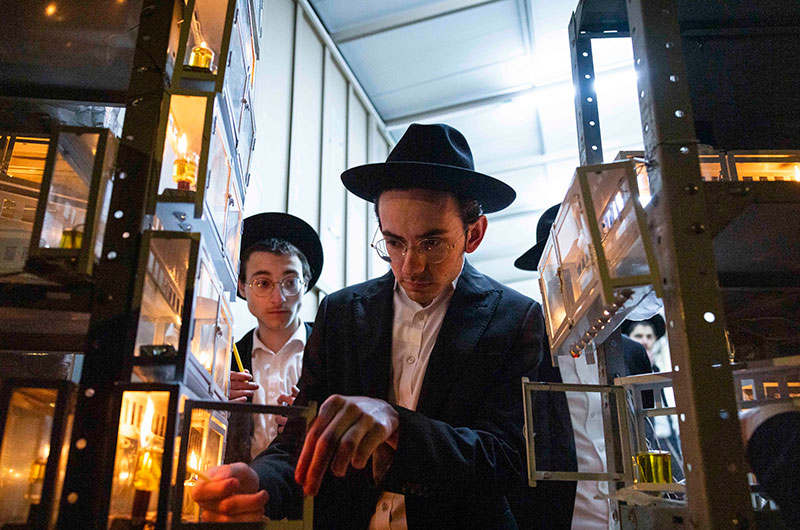


Question: The Gemara in Shabbos, in discussing the laws of Chanukah, teaches that the proper placement of the menorah is by the side of the outside door, but if there is danger, one may place it on a table inside the house. If the concern is that hostile gentiles might persecute us, isn’t there the same worry if the menorah is placed indoors? After all, the candles will likely be seen through the window, and even if not, we might fear that the hostile gentiles will search out every Jewish home. How would one light in such a circumstance?
Menachem Via E-mail
Answer: Though most of our readership resides in locales where there is relative calm and tranquility that enables the practice of our mitzvot, there still are places in the world, even today, where the authorities take a dim view of Jewish practice. In addition, there are lands where the government guarantees freedom of religious expression, but those living in close proximity to the Jews are hostile. Therefore, open practice of our religion might still be a concern, as you note in your letter.
The Gemara that you reference is Shabbos 21b. The danger you correctly refer to in regard to the Chanukah lights is hostile gentiles or, more generally, hostile elements of the local populace. Let us review the text of the Gemara: “Our Sages taught: It is incumbent to place the Chanukah lamp at the door of one’s house on the outside; however, if one dwells on an upper floor, one places it in the window that is closest [facing] the public domain. However, in time of danger, it suffices that he places it on his table.”
Rashi (ibid., s.v. “mib’chutz” – on the outside) explains the need to place the lights outside: It is in order to facilitate “pirsumei nisa” – publicizing the miracle. Thus, if one lives on the second floor or higher, where it is obviously impossible to place the lights outside, the Gemara informs us that placing the menorah at the window compensates because it still will be seen by those in the street. The last option – lighting on the table – is problematic because then the candles will not be seen outside at all.
Indeed, when the Gemara offers this last option to light on the table, the assumption is that it will not be seen outside (either because a curtain is drawn or it is lit in an interior room with no windows). Nevertheless, this placement of the menorah is considered valid.
Although this resolves your dilemma, one must wonder what pirsumei nisa is accomplished if the only option is to light it inside on a hidden table?
R’I (the Tosafist – Rabbenu Isaac Dampiere, Tosafot ibid., s.v. “u’b’sha’at hasakana”) explains our Gemara as relating to a people known as “Chavri” who came to Babylonia. (Rashi refers to them as Persians who would persecute a Jew for lighting Chanukah candles on their Persian festival, when only they themselves would light in their temples.) He cites the Gemara’s question (infra 45a): “Is one allowed to move the Chanukah lights on the Sabbath, on account of the Chavri?” and answers in the affirmative. Tosafot ask how lighting on the table is a solution, for perhaps the Chavri will enter the house and remove it. Tosafot answer that such was not their routine – they would not go as far as entering homes in search of Chanukah candles.
Ran (in his commentary on the pages of the Rif, to our Gemara) offers that the case in our Gemara is not talking about Chavri, but rather anywhere there was an edict against the performance of any mitzvot. In that case, one would light on his table; thus, if the authorities see it on the table, they will assume it was placed there not for the purpose of the mitzvah (of Chanukah), but rather simply to serve as a light.
Now, according to Ran, since the Gemara does not say “in such case let him not light,” we can understand the reason that he still lights, albeit on the table – because in doing so he will not come to any danger.
Insofar as pirsumei nisa is concerned, how is this done when the menorah is inside the house and not at all visible to the outside? We might give either of two answers: First, perhaps the pirsum is for those inside the house. Second, due to the danger, one is exempt entirely from the mitzvah, but in order that the mitzvah is not forgotten, the Sages require that the candles still be lit on the table. While this does not actually fulfill the pirsum aspect of the mitzvah, the lighting itself is accomplished.
Notably, according to this latter reason, even though the lighting of the menorah is not being done in its optimal manner, we still perform it. We might compare it to the mitzvah of Sefirat ha’Omer – which is only a zecher l’Mikdash (lit. a remembrance of the Temple) in our time, since we have neither the Omer sacrifice nor the Temple to which it was brought. (Thus, most authorities rule that the mitzvah of Sefirat ha’Omer is not Biblical in our time but rather rabbinical (Aruch HaShulchan, O.C. 489: 2).)
Let us pray that this Chanukah, our Jewish brethren, wherever they are found, will find peace, tranquility and joy. May the lights of Chanukah usher in the light of Mashiach, speedily in our days.