 October 23, 2026
 Categories: Headline / Ask the Rabbi
Q & A: Travelling and Missing Chanukah Candle-Lighting (Part I)
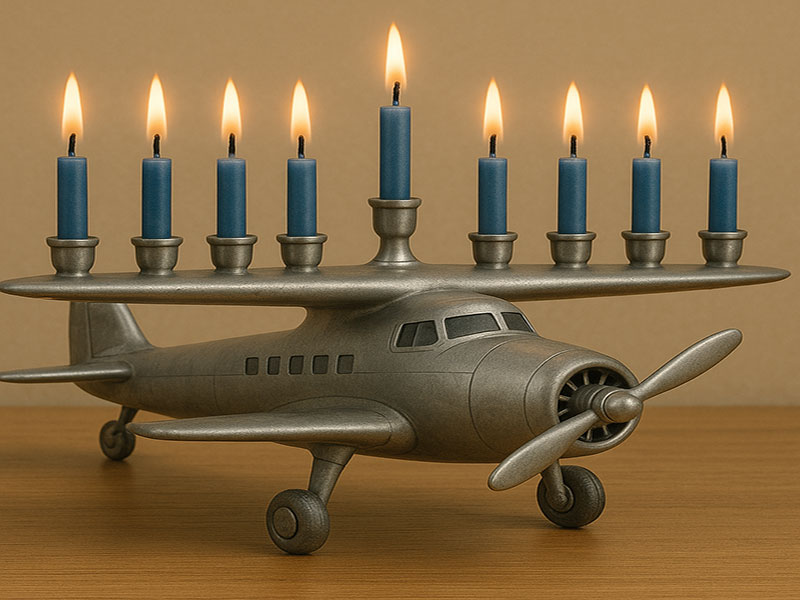


Question: I am contemplating traveling to Israel. My flight will take place during Chanukah, which means that I may miss one night’s candle lighting. What are my options?
Yaakov J. Via E-mail
Answer: You are concerned about halachic issues that may arise during lengthy air travel during Chanukah. Firstly, be assured that according to halacha, you are allowed to fly at that time. Secondly, as we shall further show, halacha rules that if someone misses lighting the Chanukah candles on one of the nights, the person may still light the candles on the subsequent nights of Chanukah.
The Gemara (Shabbos, Bameh Madlikin, 21b) establishes the timeframe for lighting the Chanukah candles in response to a question about relighting a candle if it is inadvertently extinguished. According to a baraita, “Mitzvatah mi’shetishka hachama ad she’tichleh regel min hashuk” – Its observance is from the time the sun sets (shekiah) until pedestrian traffic in the marketplace (e.g., the streets) has ceased. The Gemara then asks: Does that mean that one is required to relight the candle if it became extinguished within that period of time? No – the baraita can also be understood to mean that if one has not yet lit the candles, he can still do so; alternatively, it may be referring to the quantity of oil necessary to use so that the candles will burn for that length of time.
What time does the phrase “until pedestrian traffic in the marketplace has ceased” indicate? Rabba bar bar Hanna said in the name of R. Yochanan, “Until the people from Tadmor (also called Palmyreans) have departed.” Rashi explains that this is a reference to merchants who sold kindling branches to passersby, and were known to linger until the people had bought the lighting materials they needed.
Tosafot (sv. “De’i lo adlik madlik”) quote R”I Porat (Rabbi Joseph Ben Moses of Troyes, known as Rabbi Joseph Porat – R”I Porat, 12th century) who says that one must be careful to light the Chanukah candles as soon as possible, i.e., at sunset, and not tarry more than necessary. But in the event he did delay, perhaps due to circumstances beyond his control, he nevertheless lights the candles because of safek (a doubtful or unclear case) – here it being unclear whether this rabbinically determined timeframe affects only the lighting itself or also the quantity of oil to be used, as we have explained before. The R”I then adds that the time limit of “until pedestrian traffic in the marketplace has ceased” does not affect us today, since nowadays we light for the members of the household, as we usually light indoors.
The Rambam (Hilchot Chanukah 4:5) defines the time “from sunset until pedestrian traffic in the marketplace has ceased” as “a half-hour or more.” Thereafter, one does not light Chanukah candles.
The Mordechai (Shabbos ibid.) states, quoting his teacher Rav Meir, the Maharam of Rothenburg, that if someone misses one night, he does not light on subsequent nights. He arrives at this conclusion based on the phrasing used by the Talmud, namely, that the observance of lighting Chanukah candles is tied to a specific time frame. (We will soon see that the ruling cited by the Mordechai – that in the event one misses lighting candles one night of Chanukah, one does not light on subsequent nights – is probably attributed to Rambam as well.)
The Tur (Orach Chayyim 672, Hilchot Chanukah) takes issue with Rambam, but the text he appears to be quoting is not Rambam’s words with which we are familiar. Although our text of Rambam does not say so explicitly, it would seem that most would agree that this is the position of Rambam on this matter, i.e., that upon missing one night’s lighting, one does not light on subsequent nights.
The Tur cites the Tosafot quoted above as a basis for his own ruling that we do continue to light Chanukah candles on subsequent nights in such a situation. His proof is not clear-cut, since Tosafot do not specifically discuss the following nights. But the wording of Tosafot must have led him to think that such was the case.
In his commentary on the Tur ad loc., the Beit Yosef discusses numerous halachic sources, as well as the aforementioned Mordechai, supporting the opinion that we do not light Chanukah candles on subsequent nights if we missed lighting on one night. He also cites a Teshuvah Ashkenazit according to which the ruling of Rav Meir of Rothenburg, as quoted by the Mordechai, can be understood to mean that if one was late in lighting candles on one night, he has lost the opportunity to observe a mitzvah in the best way possible on that particular night only. But as far as the other nights are concerned, he proceeds with the lighting, for the miracle occurred on every one of the days of Chanukah.
Thus, this becomes a source for a reading of Rambam that is more consistent with the text of Rambam as we know it.
To be continued.