September 11, 2026
 Categories: In Print / Headline / Front Page
Rabbi Moshe Hauer, zt”l: A Legacy of Tov Meod
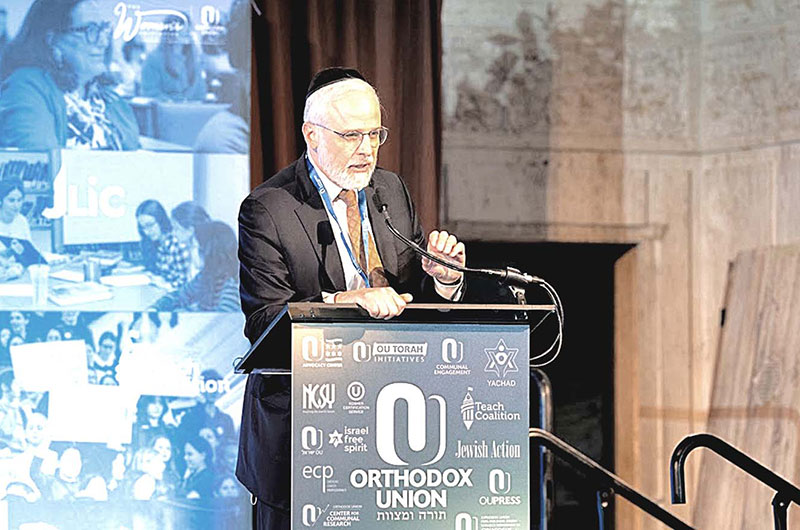


Over the past six years, Rabbi Moshe Hauer, zt”l, became a rebbe and a mentor. When I had just been elected as rav of Shomrei Torah, unsure which decisions to make or avoid, someone urged me to seek his advice. I didn’t yet know him, but at a conference he gave me two-and-a-half hours of undivided attention.
I don’t recall every word, but I remember his calm, his listening, and how he helped me leave with clarity and chizuk. From that day on, he quietly found ways to strengthen me – as, I’ve since learned, he did for countless others.
When he later visited my shul as a scholar-in-residence, people immediately felt comforted. They sensed that someone of deep intellect and humility was helping guide Klal Yisrael through complex times.
After October 7, he gathered rabbanim on Zoom and told us:
“Now we are part of the greater Jewish narrative. We thought we were safe and comfortable. But this is what our parents, grandparents, and great-grandparents lived through.”
He gave perspective without minimizing pain – seeing the larger story when the rest of us saw only fragments.
That was his essence: he saw the good, spoke the good, and brought out the good in others.
Just a few weeks ago, he was in Washington and sent a message through someone from Fair Lawn that he’d heard I was doing a good job. He didn’t have to say anything, but he always went out of his way to make people feel seen.
At his levayah, Rabbi Daniel Rose, who succeeded him as rav at Bnai Jacob Shaarei Zion in Baltimore, said about Rabbi Hauer: “If you have an opportunity to make someone else feel good – do it.”
That line captured both Rabbi Hauer’s Torah and his life.
The Torah of Tov
Several years ago, on Parshas Bereishis (5782), Rabbi Hauer shared a teaching of the Ramchal, who begins both Derech Hashem and Daas Tevunos with a simple yet world-changing truth: that Hashem created the world out of His own goodness – because it is the nature of the One who is good to share that goodness (mei’chok ha’tov li’heitiv). Hashem is goodness. Hashem is Tov.We say it daily in davening: “Ha’tov Shimcha – Your very Name, Your very Essence, is good.”
The word “tov” echoes through Parshas Bereishis. Six times the Torah says, “Vayar Elokim ki tov.” Hashem looked at creation and saw that it fulfilled His purpose: to express divine goodness.
There’s a beautiful symmetry here. Six times Hashem declares ki tov; and six times in Tanach (five in Tehillim, once in Divrei HaYamim) we answer, “Hodu la’Shem ki tov, ki l’olam chasdo.”
Hashem looks at His world and says, “It is good.” We look back at Him and say, “He is good.” Creation and Creator, giver and receiver, mirror one another in gratitude.
From Tov to Tov Meod
And then comes the seventh: “Vayar Elokim es kol asher asah, v’hinei tov meod.” Not merely good; exceedingly good.If six ki tovs correspond to six Hodu laShem ki tovs, what mirrors the seventh? The answer, Rabbi Hauer taught, lies in Shabbos. That final tov meod ushers in Vayechulu – completion and harmony.
And what do we sing on Shabbos? “Mizmor shir l’yom haShabbos; tov lehodos la’Shem.”
The highest goodness is not only to see it, but to acknowledge it – to move from “Hodu laShem ki tov” (thanking for the good we see) to “Tov lehodos laShem” (recognizing that the act of gratitude itself is goodness).
The Depth of Tov Meod
The sages teach that Rabbi Meir read the words tov meod (“very good”) as tov maves – that even death, too, serves the ultimate good. The Ramban and Rabbeinu Bachya explain that even what appears painful contributes to the wholeness of creation.The totality – “es kol asher asah” – is what is tov meod.
That’s the message of Mizmor Shir l’Yom HaShabbos: Even when the wicked seem to flourish, “Tzuri v’lo avlasa bo.” Hashem’s design remains perfect. Shabbos invites us to that broader vision – to thank not only for the good we see but for the goodness that underlies all reality.
A Legacy of Tov Meod
That was Rabbi Moshe Hauer, zt”l. He didn’t just teach about tov; he lived it. He saw the good in others, drew it out, and shared his own goodness freely.Hashem looked at His world and said ki tov. We look at Hashem and say Hodu laShem ki tov. And when we remember a person like Rabbi Hauer, we see that divine symmetry in human form – a life of giving, gratitude, and grace.
Congregants of mine who work at the OU shared that the last time they heard him speak was a month ago, at the OU staff conference, where he was the closing speaker. He urged everyone to bring G-d into everything they do, reminding them that working for the OU means representing G-d in this world.
Rabbi Avi Berman recalled that in recent months Rabbi Hauer tried consciously to include G-d more in ordinary conversation – even telling cab drivers, Jews and non-Jews alike, “May G-d bless you.” He truly saw himself as an emissary of the Ribbono Shel Olam, a living representative of divine kindness.
And at that final conference – when no one knew when the war would end, when the hostages would return, or how rising antisemitism would unfold – with all that weight on his shoulders, he ended his remarks with a simple, radiant line: “As Jews, we must dance.”
That is tov meod: faith and joy amid uncertainty, bringing G-d into every moment, living in a way that reflects Ha’tov Shimcha – the G-d Who is Good – and reminding others of that goodness through how we live.
May our Torah, our chesed, and our lives reflect his legacy. To see the tov, to share the tov, and to recognize the One Who is HaTov v’haMeitiv.