 October 16, 2026
 Categories: Halacha & Hashkafa / Torah
Root or Route? Finding Holiness in Foreign Words
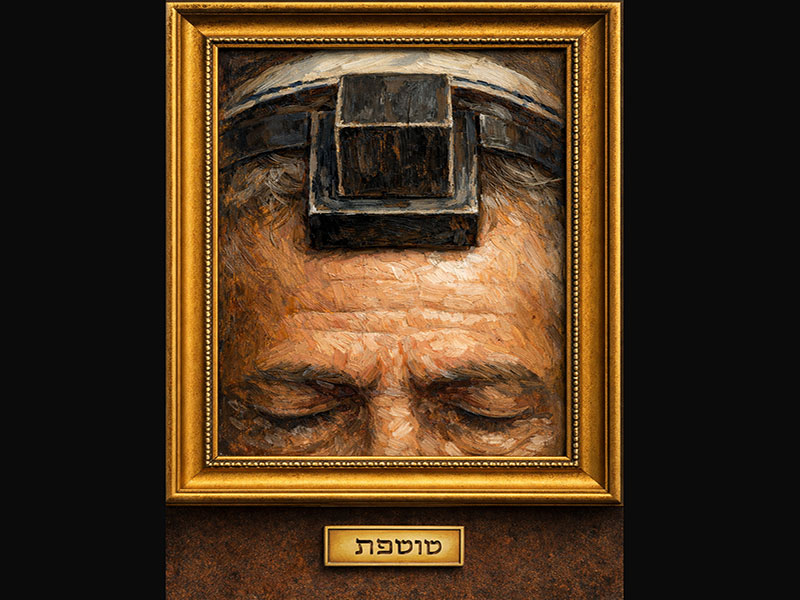


Menachos – Daf 34
Our Gemara on amud beis discusses the etymology of the word “totafos,” referring to the head tefillin (Shemos 13:16).
Rabbi Akiva explains that the word is composed of two foreign terms meaning two: tat in the language of Katfei and pat in Afriki, totaling four. Why would the Torah use such obscure terminology instead of simply saying “four?”
Sefer Daf Al Daf cites the Pri Ha’Aretz, who explains that since Hebrew is the root language, remnants of it remain embedded in other languages as spiritual pathways back to holiness. Likkutei Moharan (33:2) teaches that holiness can be found everywhere, even in secular or foreign contexts. The Torah’s use of obscure languages emphasizes that godliness can be accessed even in distant strata. The formulation “two plus two” instead of four might imply that uncovering holiness often requires aggregation – piecing together fragmented experiences to arrive at spiritual awareness.
Face Value vs. Backstory: Seeing G-d Without Seeing G-d
Daf 35Our Gemara on amud beis quotes a series of verses where Moshe asks to see G-d and G-d responds. These verses are remarkable and hint at profound theological ideas. The verses read (Shemos 33:18-23): “He (Moshe) said, ‘Oh, let me behold Your Presence!’ And [G-d] answered, ‘I will make all My goodness pass before you, and I will proclaim before you the name G-d, and the grace that I grant and the compassion that I show. But you cannot see My face, for no mortal may see Me and live.’ And G-d said, ‘See, there is a place near Me. Station yourself on the rock, and as My Presence passes by, I will put you in a cleft of the rock and shield you with My hand until I have passed by. Then I will take My hand away and you will see My back; but My face must not be seen.’”
What did Moshe really ask for, and what was the answer he received? According to the Gemara (Berachos 7a), Moshe wanted to better understand the issue of theodicy – essentially, how the righteous can sometimes suffer while the wicked thrive.
That is the straightforward explanation. Rambam in Moreh Nevuchim (I:20) adds a deeper exegetical layer to this discussion. As Rambam often asserts, Chazal speak in limited ways regarding esoteric parts of the Torah. They will therefore state a brief idea that hints at a much larger conceptual framework. Moshe did not merely want to understand one aspect of G-d’s reasoning. He wanted to see G-d as He truly is, so that he could understand how G-d does what He does. His question about Divine justice was merely one expression of that broader desire. This is what Moshe meant by seeing “the face of G-d.” G-d’s response – “you cannot see Me” – addresses this directly, yet G-d still allows Moshe to see His “back.”
What does it mean to see G-d’s back? In Hilchos Yesodei HaTorah (1:10), Rambam explains that even when one does not see a person’s face, one can still recognize them by seeing their back, provided one knows them well. Metaphorically, G-d was responding to Moshe: “You cannot see Me for who I truly am, in My full essence, but I will allow you to see enough that you will recognize My distinctness.” This parallels the idea we have discussed earlier that while we may not fully grasp G-d’s nature, we can apprehend the vastness and contours of what we do not understand.
In Moreh Nevuchim (ibid.), Rambam offers an even more subtle interpretation of the metaphor of G-d’s “back.” It is akin to the term “wake,” as one would use to describe the churning water left behind after a boat passes. That is, Moshe would come to understand G-d not by seeing Him directly, but by observing the results of His actions. In other words, Moshe would understand the existence and nature of G-d by studying how G-d manifests in the world.
However, when we consider this exchange between Moshe and G-d more closely – especially in light of Rambam’s explanation – we encounter a deeper logical problem. In Laws of the Foundations of the Torah (chapter 7) and Shemoneh Perakim (7), Rambam outlines the extensive prerequisites for prophecy. Beyond piety, character, and wisdom, he uniquely emphasizes the prophet’s intellectual capacity to understand G-d as closely as possible, without distorted or simplistic notions. Without such sophistication, one cannot qualify for prophecy, regardless of personal righteousness. (This stands in contrast to Rav Yehuda HaLevi in Kuzari IV:3.) If such intellectual refinement was a prerequisite for Moshe’s prophecy, how could Moshe have asked such an apparently naïve question – to see G-d – when even a child knows that G-d is invisible?
The most compelling answer I have heard is that Moshe’s question was process- and relationship-oriented. In essence, prayer itself seems futile, since G-d does not change. Yet we pray not to change G-d, but to change ourselves (see Sefer HaIkkarim 4:18), or to align ourselves with Divine influence so that we may receive guidance and blessing (Moreh Nevuchim III:51). Moshe knew his request was impossible. He asked nonetheless, because he understood the power of prayer – namely, that the act of asking, of relating, can itself effect change. And indeed, it did. In relationships, we must never forget the importance of asking.
Bind and Unwind: When Action Yields to Stillness
Daf 36Our Gemara on amud beis discusses the halachic phenomenon that tefillin are not worn at night or on Shabbos.
Dover Tzedek, in Kuntres Ner HaMitzvos 1, offers a beautiful psychological explanation that unites these two laws. There are two dimensions to mitzvos, represented by positive commandments of action and negative commandments of restraint. Symbolically – and also practically, especially in a pre-industrial society – nighttime is a period of passivity. One withdraws, hunkers down, and remains safe and contained. Tefillin represent the opposite of passivity. They are an active externalization of accepting the yoke of Heaven upon one’s head and heart (Megillah 16b). Activity belongs to the daytime. Similarly, Shabbos is a time for reflection and inner work, not for outward action; therefore, tefillin are not worn.
On a deeper level, avodas Hashem is not monolithic. There are times when reflection alone is insufficient and action is required. Conversely, there are times when action is excessive and quiet contemplation is necessary. G-d designed both the world and the Torah according to this rhythm. As the Zohar states, Hashem looked into the Torah and created the world (Zohar II:161a). Our cycles of sleep and wakefulness, night and day, reflect a deeper truth: There is inherent value in alternating between action and reflection.