 October 9, 2026
 Categories: Headline / Features / Arts
Songs of Forgotten Heroes of the Holocaust


The songs you are going to read about in this column are not the typical Yom HaShoah songs that are played every year at the ceremonies and, in Israel, also on the radio. You perhaps have never even heard of these songs, or about the heroes behind these songs. I did a quick anecdotal survey of friends, family, and a community WhatsApp group for this column to check if people are familiar with these stories. I was not surprised that most answered no, they were not familiar. So, I think it’s important to tell the stories and learn about the people behind them.
Next week is Yom HaShoah V’Hagvurah. In Israel, the whole day features sad music on the radio, and on the eve of Yom HaShoah there are ceremonies all over the country. Classic songs of Yom HaShoah are played every year on the radio and at the ceremonies. But today, I’d like to review two songs that are not considered “typical” Yom HaShoah songs. Many of you might not have heard of them or the stories and heroes behind them. You probably never learned about them in school or heard them at a ceremony.
I did a quick anecdotal survey of friends, family, and a community WhatsApp group for this column, and was not surprised that most people answered no, they were not familiar with these stories. I think it’s important to learn about these heroes who were intentionally ignored and silenced. You can guess why they were canceled: Because they did not belong to the right group.
The songs are “The Rescuers” and “Battle Hymn of the Ghetto,” which was written specifically for a monumental pageant, We Will Never Die.
Those were dark days. In the concentration camps and the gas chambers, Jews were murdered on the cursed soil of Europe. And while their brothers and sisters in the United States couldn’t do much for them, the little they could do was to shout. To cry out in a loud voice. Yet many of the Jews in America chose to stay silent. Not only did they stay silent, they tried to minimize what was happening in Europe. The New York Times, for example, which was controlled by a Jewish family, hid the reality from their readers. During the Holocaust, many of the Jewish organizations in the U.S. also ignored the situation of the Jews in Europe.
Jabotinsky once wrote in Beitar’s Hymn, “For silence is filth.” But there were Jews who chose not to be silent. They fought to speak out about what was happening to their people. They were not afraid. They knew they needed to do the right thing, even if they had to pay a personal price. And they did pay a big price.
They called themselves the Bergson Group.
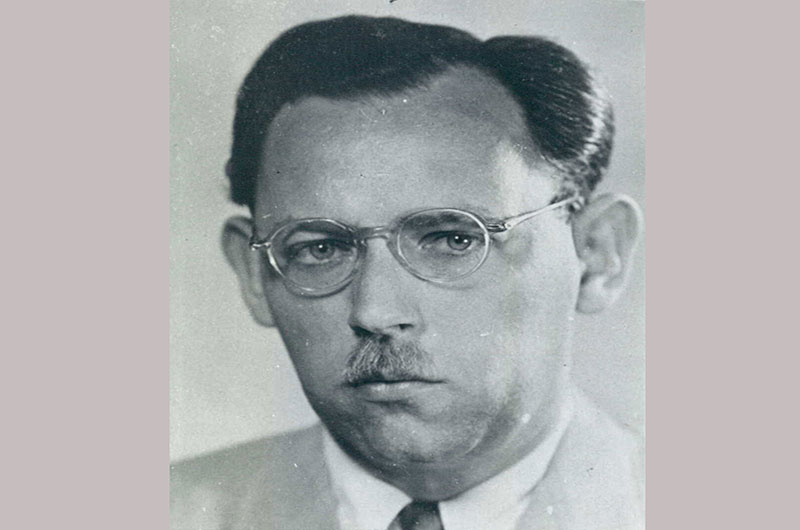
The Bergson Group was a small, defiant circle of Jewish activists in the United States during World War II. Led by Hillel Kook (who operated under the pseudonym Peter Bergson), the group challenged both the American government and the established Jewish leadership to take immediate action to save European Jews from the Holocaust. Kook was the nephew of Rabbi Abraham Isaac HaKohen Kook, first Ashkenazi Chief Rabbi of Eretz Yisrael.
Kook was a Revisionist Zionist activist and politician. He led the Irgun’s efforts in the United States during World War II and the Holocaust in order to promote Zionism, attempting thereby to save the abandoned Jews of Europe.
He was born in Russia, and in 1924 his family made aliyah to Israel. While attending his uncle’s religious Zionist yeshiva, Merkaz HaRav in Jerusalem, he became friends with David Raziel, one of the greatest leaders of the Irgun (also known as Etzel). He first went to Poland and later traveled to the United States with Jabotinsky in 1940, where he would serve as the head of the Irgun and the Revisionist mission in America.
Other key figures in the group were Ben Hecht and Kurt Weill. While Hillel Kook (Peter Bergson) provided the political leadership, Hecht and Weill provided the creative fire and the “Hollywood” reach that made the group impossible for the American public to ignore.
As reports of the existence of Jewish extermination camps increased, the Bergson Group’s activities became more intense and widely publicized. Despite active opposition from the leaders of Zionist institutions in the U.S. (mainstream American Jewish establishments, like the American Jewish Congress led by Stephen Wise), the Bergson Group – through the “Emergency Committee to Save the Jewish People of Europe” – succeeded in persuading the administration to establish the War Refugee Board. As a result, approximately 200,000 Jews were saved from extermination.
Hecht was an Academy-Award-winning screenwriter, director, producer, playwright, and novelist. He started out as a journalist and wrote 35 books over the course of his career.
During the 1940s, he used his writing to bring attention to the Holocaust and played a significant role in supporting the Jewish resistance in Palestine. His activism was so controversial at the time that his films were actually boycotted in the United Kingdom for several years.
Hecht used his mastery of the American media to shatter the silence surrounding the Holocaust. In the early 1940s, news of the mass murder of European Jews was often buried in the back pages of American newspapers. Hecht used his status as a famous writer to thrust the issue into the public eye.
Hecht’s involvement is often cited as a turning point in how American Jews engaged with political lobbying. He proved that Hollywood-style showmanship and aggressive advertising could influence public policy and challenge the status quo in Washington.
Weill was one of the most significant composers of the 20th century, famous for bridging the gap between “high art” opera and popular musical theater. A German-Jewish refugee, he fled the Nazi regime in 1933, eventually settling in the United States where he became a cornerstone of the Broadway stage.
His primary contribution to the Bergson Group was composing the score for the massive dramatic pageant We Will Never Die.
Weill also composed Hecht’s A Flag Is Born (Degel Nolad) – a 1946 musical play (starring a young Marlon Brando) that was intended to raise funds for bringing Holocaust survivors to Israel. Weill’s original music for this work is considered a musical gem, entirely dedicated to the Zionist struggle led by Kook.
The members of the Bergson Group paid a heavy professional, political, and personal price for their activism during the Holocaust. Acting as “rebels” against both the U.S. government and the established Jewish leadership, they faced significant consequences: government harassment and legal threats, social ostracism, and institutional boycott. The established Jewish leadership (led by figures like Rabbi Stephen Wise) viewed the group as charlatans or fascists and radicals, due to their Revisionist ties. Also today, the leftists in Israel, led by the Kaplan gangs, call the right-wing people fascists, radicals, and other insulting names. The equation is simple: You support Jews, you love your country, you love the tradition – the leftists and leftist-controlled media will label you a fascist.
Hecht, the group’s most famous voice and a Hollywood powerhouse, suffered the most visible career damage. He was boycotted and blackballed. Today in Israel, too, many artists who hold right-wing opinions try to hide them to avoid being boycotted and blackballed by the left-wing media.
For decades, the Bergson Group’s contributions were omitted from official Zionist and American Jewish histories for political reasons. They did not belong to the right side.
We need to salute these heroes. We can’t do much for them, but the little we can do is to talk about them. Learn about them and teach others about them.
Now, for the music.
“The Rescuers” by David Ben Reuven begins with a single strumming guitar, and in a dramatic voice, Ben Reuven calls out the name of those who worked to rescue Jews from the Holocaust. Throughout the song, there’s only the guitar strumming in the background, which adds to the somber atmosphere. I encourage you to listen to this powerful song on YouTube.
The words speak for themselves:
“Rabbi Michael Ber Weissmandl and Gizi Fleischmann in Bratislava;
George Mantello and Recha Sternbuch in Switzerland;
Raoul Wallenberg, Per Anger, Giorgio “Jorge” Perlasca, Carl Lutz, Monsignor Angello Rotta in Budapest;
Josef and Rivka Bau in Plashow;
Chiune Sugihara in Lithuania;
Hillel Kook (alias Peter Bergson) in New York;
Rabbi Solomon Schonfeld and Nicholas Winton in Britain.
The list is small. Their task is great
To rescue Jews
From their tragic fate
In the darkness of the night
They shine their light
The courageous few
With a sacred task
To save the Jew.
Boldly they step into the darkness
They do not hesitate
They will not, they cannot
Leave the Jews to their dismal fate
The Rescuers...
Let their names be inscribed forever
In the Golden Book of Life
Tell it to our children
For generations yet to come
How they saved tens of thousands of our people
From the Nazi Gehinnom.
So, tell the world their story
Their heroic feats make known
Not for fame or glory,
With them we were not alone
SPOKEN:
All over Europe
When all hope of deliverance had gone
Lights suddenly went on.
In Slovakia, in Budapest
In the East and the West
The rescuers rose up
The doomed Jews to wrest
From the Nazi beast,
Of humankind they were the best,
The Rescuers...”
The next song I want to share is called “Battle Hymn of the Ghetto.” Hecht authored a massive dramatic pageant titled We Will Never Die to memorialize the victims of the Holocaust and demand action. The work combined music, poetry, drama, and prayer. The production, which included this song, was intended to shock American public opinion and to protest the world’s silence in the face of the murder of European Jewry. It featured a score by Kurt Weill and starred Hollywood legends like Edward G. Robinson and Paul Muni.
The show opened at Madison Square Garden in 1943 before a crowd of 40,000 and toured across the country, including a performance at the Hollywood Bowl. It is credited with significantly raising American public awareness that the Final Solution was a literal, ongoing reality.
The music for “Battle Hymn of the Ghetto” was composed by Franz Waxman, with lyrics by Frank Loesser – both giants of Hollywood and Broadway who mobilized in support of Hillel Kook’s cause. Performed by massive choirs during the production, the song served as a musical outcry against the extermination of European Jewry. It is considered one of the artistic highlights of the group’s activism.
“Rally! The tanks will roll over the old and the dying...
Rally and meet them!
This is the last of the battle of the Warsaw Ghetto.
With grenades and pistols, with clubs and swords...
Shouting and singing, they leap from the wall into the street!”
You can hear the song on YouTube if you search “We Will Never Die - Holocaust Dramatic Pageant - Ben Hecht & Kurt Weill.” The song appears at approximately 59:12