October 2, 2026
 Songs of the Exodus & Tu B’Shvat


This week we will read Parshat Beshalach, about Yetziat Mitzrayim and Kriat Yam Suf. Early next week we’re also going to celebrate Tu B’Shvat – the New Year of the trees.
And as you might guess, Jewish music has some songs about these events.
One of my favorite Avraham Fried songs is “Hisyatzvu” which is about the Exodus from Egypt. While the song didn’t really make its way to the wedding playlists, it’s still a nice, upbeat song. It’s from Shtar Hatnoim, released in 1993, which is one of my favorite Avraham Fried albums. Despite it being many years old, it still has gems like “Boruch Haba” and “Shtar Hatnoim” (which I wrote a column about last year), and “Hisyatzvu,” which was composed by Gershon Frenkel.
“U’Bnei Yisrael yotzim b’yad rama,” And the people of Israel are going out with a strong hand. “Nelech, b’nareinu; nelech, b’zkeneinu; nelech b’baneinu, b’vnoteinu” – We’ll go with our youth; we’ll go with our elderly; we’ll go with our sons and daughters. “Hisyatzvu ur’u es yeshuas Hashem” – Stand up and see the salvation of Hashem.
The song begins with a dramatic intro of drums, piano, and brasses. While many of Fried’s upbeat songs make use of a rock beat, this one is more freilach. I personally really like that style and make use of it when I play. However, for some songs the rock beat is more suitable – for example, his “Chazak” or Shwekey’s “Shehecheyanu.”
“Hisyatzvu” features a clarinet solo in the middle, followed by a piano solo, which sounds jazzier. I can understand why it didn’t become a first or second dance song at weddings, because it is a little complex. But it’s a great song.
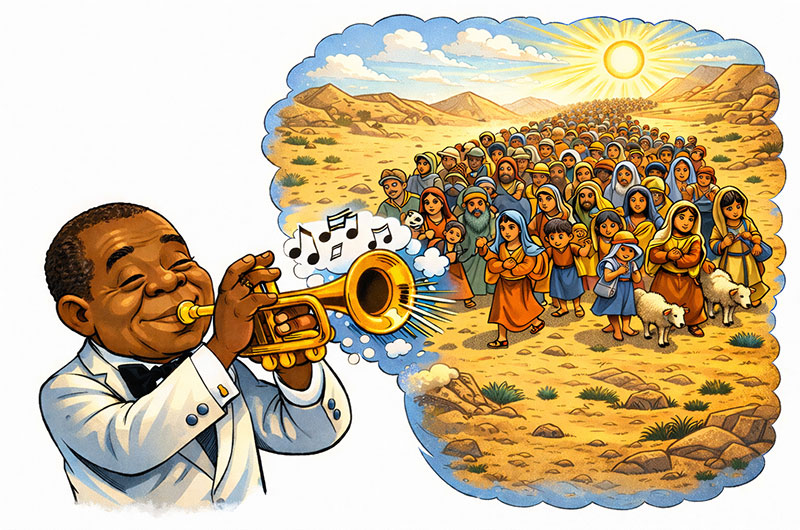
Now, how many of you know the story of the Karnofsky family? OK, I’ll tell it again. (If you are already familiar with the story you can skip to the next paragraph.) The Karnofsky family immigrated from Lithuania to the U.S. There was a young, non-Jewish child in the neighborhood whom they took into their home. He would do odd jobs and they would give him food and a place to sleep. At the Karnofskys, he experienced kindness and tenderness for the first time in his life. He used to come to their house on a regular basis, and he became very good friends with one of their kids. He even learned how to speak fluent Yiddish. They got him his first musical instrument – a trumpet. They boy was a very talented musician, and as he grew up and became a professional composer and musician, he incorporated these Jewish melodies into his compositions. One of his famous songs was “Go Down, Moses.” The musician was Louis Armstrong.
When Israel was in Egypt’s land,
Let My people go!
Oppressed so hard they could not stand,
Let My people go!”
As a kid, I remember learning and singing in school the Hebrew version of this song, “Shlach na et Ami,” with lyrics by Ephraim Dror. I don’t think we knew that it was actually an American song.
“Maher Moshe tzav es Paroh, Shlach na et ami” – Hurry up Moshe, tell Pharaoh to let my people go.
* * * * *
Next Monday is Tu B’Shvat – Rosh Hashanah L’Ilanot, the New Year of the trees. As there are many songs both in Chasidic and Israeli music about this holiday and about the land and nature, I’d like to review some of them.Last year, Avrumi Weinberg released the song “Ilan” which means “tree.” It’s a quiet song, yet a little upbeat and has a nice rhythm and an electronic sound. In the YouTube video, Weinberg explains that when the composer and writer sent him the song, he immediately connected to the deep meaning of the words. They are inspired by a story about Rabbi Nachman who asked for a beracha from Rabbi Yitzchak.
“Ilan, Ilan, kasheh lomar she’ani lo mekaneh. Peirotecha metukim, tzilcha na’eh.
Amat hamayim overet tachtecha” – Tree, Tree, it’s hard for me to say that I’m not jealous. Your fruits are sweet; your shadow is pleasant. The water aqueduct is flowing beneath you.
“Ilan, Ilan, ata hasemel l’shlemut, kol davar becha mushlam, hakol im mashmaut; rak tegaleh li ma hasod shelcha” – Tree, Tree, you are the symbol of wholeness, everything in you is perfect, everything holds meaning; just reveal your secret to me.
One of the most beautiful Israeli songs is “Ima Adama” which was performed by Arik Einstein, who is considered one of the greatest Israeli singers, on his album Yasmin in 1972. The song was written by Yaakov “Yankele” Rotblit and composed by Miki Gavrielov.
“Hi tabit elay tova vechachama k’mo b’ben hashav habaita min haderech. Techabek oti elehah b’neshima chama, Ima Adama” – She’ll look at me, good and wise, like a son who returns home from the road. She’ll hug me to her with a warm breath, Mother Earth.
Another favorite song about nature is one I used to sing to my older son when he was a baby. (It’s not “Pizmon Layakinton” – if you remember the column from last year at this time.) The cute song which he used to love is called “Hatiyul Hakatan” and was written and composed by Naomi Shemer and performed by Dudu Zakai. It’s a children’s song about a group of kids who go out for a small hike in nature and find flowers, an old turtle, and other things.
The song has a happy rhythm and adults would enjoy it as well. Find it on YouTube and listen, and then share it with your kids.
“Latiyul yatzanu, kalanit matzanu al givat hadesheh bamaarav. El hahar alinu, et hayam ra’inu u’misham yaradnu b’dhara” – We went out for a hike and found anemone on the grass hill in the west. We climbed up the mountain, we saw the sea, and from there we ran all the way down.
“Tzav zaken pagashnu baderech, bayit anaki hechzik al gav. Betahalucha nehederet elef nemalim nasu chagav” – On the way we met an old turtle with a huge house on his back. In a great parade, one thousand ants carried a grasshopper.
“Banu b’shura el hakerem, ruach saara v’anaf nishbar. Shama bein tilei chapharpheret elef rakafot kol echad safar” – We came in a line to the vineyard, the wind blew and a branch broke. There, between the mole piles, we each counted one thousand cyclamen flowers.
“Az me’od ayafnu v’habaita shavnu; shuvu b’shalom, nipagesh machar” – Then we got very tired and returned home. Go in peace, see you tomorrow.
Another nice song for Tu B’Shvat is “Tzaddik Katamar” by Yosef Karduner. The lyrics are the pasuk from Tehillim: “Tzaddik katamar yifrach k’erev balvanon yisgeh...” – A righteous person will bloom like a date, like a cedar of Lebanon he will grow tall.
The song appeared on the album Road Marks / The Whole World (Simanim Baderech / Kol HaOlam), which was released in 1994-95.
Shabbat Shalom and Happy Tu B’Shvat!