יום שישי, ד׳ תמוז תשפ״וFriday, June 19, 2026



Follow Us


Sections
E-Edition

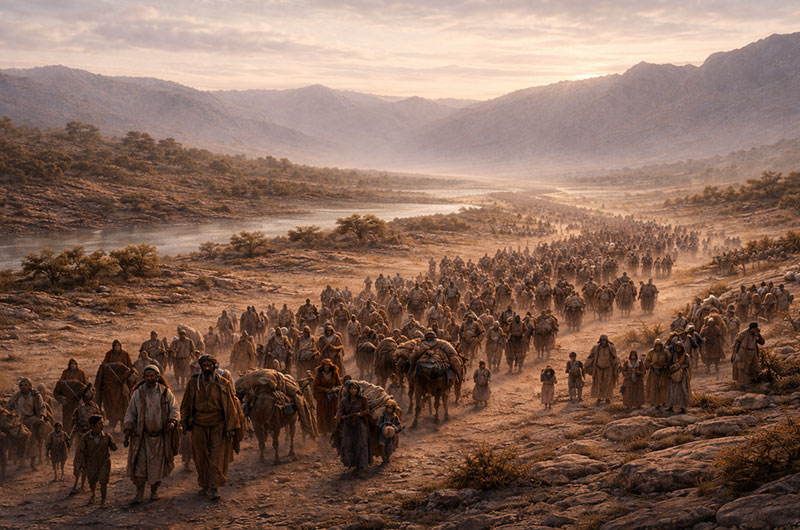
Towards the end of this week’s parsha, God speaks about a malach that he will send in front of the Jewish people but it is not clear what He is referring to. We will consider one understanding
No one is surprised that the Torah wasn’t given immediately after the Jews left Egypt, even though it was the first logical time for such an event to happen. But why not earlier or later on the trek?
The role that God played towards the Jews in the desert was not far removed from that of a parent. While they were on the desert, He provided them with the challenges that would allow them to mature
When Moshe is told about the plague of the first born (4:22-23), God gives an explanation, something we do not see with any of the other plagues. Yet is it actually middah keneged middah?
Moshe complained to God that even though he would have the best human understanding of the Divine will, he had difficulty bringing it down to regular people. That role-"turgaman/navi"-Aharon filled
While Moshe may have eventually become even greater than the avos, we must always strive for the faith of his predecessors and for the inner flexibility that such true faith brings with it.
Ya’akov decides to prioritize the younger son, Ephraim, over the older Menashe
Yosef wanting to see his father Yakov again is understandable. Perhaps Yosef could not have left Egypt to do so. But did Yosef’s desire to see him justify making his father leave Israel for Egypt?
We generally assume that Yosef, as a victim of cruelty and not its perpetrator, had nothing to regret. Yet a careful reading shows he had a significant role in creating the tension with his brothers
How could Ya’akov make the same 'mistake' as his father, to favor one child over another after all the troubles that plagued him resulting from Yitzchak favoring Esav?
The actual tale of Rivkah and Esav is of a mother who continued to care and love a delinquent child who became a problematic adult, proving she will always be his mother and he will always be her son.
Like Rivkah before them, neither Rachel nor Leah created the situation that was about to have extraordinary influence on the rest of their lives and, ultimately, on the lives of countless others
On the one hand, we see that Rivkah was right about Ya’akov’s potential. On the other hand, we will never be sure who was right about Esav.
Yitzchak, did not go to Be’er Lechai Ro’ee to pray or meditate. Rather he was on a mission, and that mission was to return Hagar to Avraham in marriage.
Isn't it surprising that Avraham who prayed for Sodom's salvation did not protest God commanding him to kill his own son? For the Netziv, this was actually exactly what God wanted from Avraham. Why?
While we read of tests of Avraham, it is clear that Sarah endured tests of her own. According to Ramban, she failed her test in her treatment of Hagar
The Torah itself presents parallel narratives of the same stories, thereby showing that the same events can truthfully be constructed in more than one way.
Though a woman helps her partner and remains his equal, she nurtures and thereby becomes a man's superior. Paradoxically, therefore, woman may be just a bit closer to the image of God than man.
It was not enough for Moshe to die by himself, however; his separation from family and nation had to be total, even after his death. And so his burial spot would need to be hidden from all.
God’s foremost desire is to conduct a relationship with the Jewish people built on love and commitment. The song of Ha’azinu reassures us that the relationship will never die.
As we approach Yom Kippur, it is time for us to think creatively, the willingness to chart a new path, about what we can do better.
Many commentators sense a significance to the placement of the bikkurim declaration, at the beginning of this week’s pasha, right after the injunction to destroy Amalek. What is the connection?
Battling Amalek presents an important warning to any Jewish military leader that there is a need to maintain a basic respect for what it means to be human, even when dealing with mortal enemies.
Is the Torah to be read exactly as the Jews who received it would have, or, is it actually to be read in a contemporary way that can't possibly be the same as those who first received the Torah?
A musical perspective on Parshat Ekev...
Understanding why these Ten Statements were chosen-as opposed to others omitted-could well lead us to a greater grasp of the essence of this venerable text.
An obstacle to understanding Devarim is thinking of it as a book. Devarim literally means “[spoken] words” and should therefore be primarily considered in its 'orality'
Why did Moshe include part of Menashe together with Gad and Reuven in the Transjordanian settlement?
The fact it was specifically Midianite and Moabite women involved with Jewish men {Moshe and men involved with Ba'al Peor) shows that an existential bond existed between these nations and Israel.
Bilaam not only doesn't appear to be great, he seems to be base as well as foolish (outsmarted by his own donkey!). So how can the midrash claim he was really at least as great a prophet as Moshe?
Moshe was ideally suited to the role of an intermediary between God’s immanent presence and Israel but not so well suited to leadership in front of a hidden God
The communication gap here is really two-sided. It certainly starts with Korach and his group, but it subsequently infects Moshe as well.
The incident of the spies was a completely new and problematic transgression, it was not toward the rarified wilderness, but rather toward the earthly existence promised in the Land of Israel.
If Moshe was the greatest man that ever lived, his silent partner Tzipporah deserves much of the credit for it.
Enjoyment of God’s world always comes with some innate meaning – something which is lacking in the case of abstinence, the case of the Nazir.
The Torah recognizes the phenomenon of leadership and brings it to our attention subtly in the Book of Bemidbar, through the way it lists the names of the different tribes.
Had the Jews not sinned with the spies, they would have gone into the land led by Moshe at the end of Parshat Shelach. Hence the end of Vayikra would have basically been the end of the Torah
The Torah is telling us something here: Though we may sometimes act too rashly, there are times when rash action is the only way to prevent a complete catastrophe.
In this week’s parsha, the Torah further develops the statement that opens Parshat Kedsohim, the need to be 'Kadosh.'
Parshat Achrei Mot represents a transition in the book of Vayikra from an emphasis on Aharon and his sons to the Jewish people as a whole