 October 16, 2026
 Categories: Features / Book Reviews
The Holocaust, Trauma, and Empathy
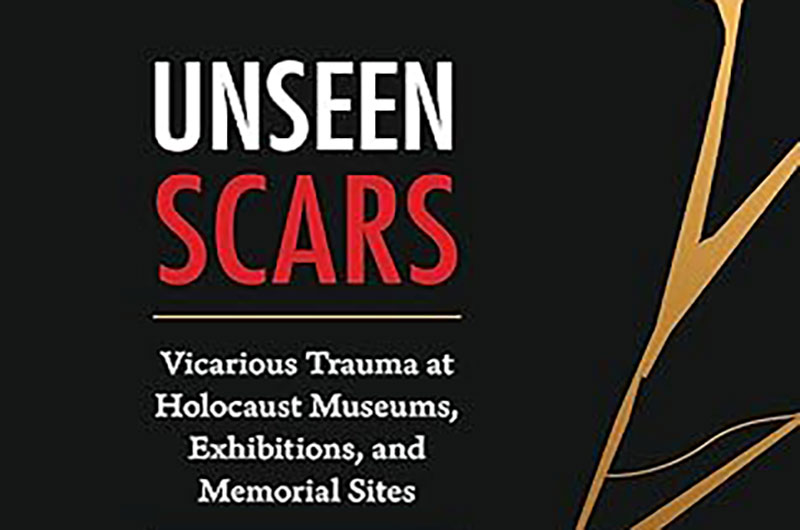


Title: Unseen Scars: Vicarious Trauma at Holocaust Museums, Exhibitions, and Memorial Sites
Author: Dr. Julie J. Golding
Bloomsbury Academic
How many people do you know who are grappling with Post-Traumatic Stress Disorder (PTSD)? There are probably far more than you think among those with whom you cross paths during a regular day. America’s alarming statistic is that childhood trauma affects two-thirds of its children. Israel’s population is composed of Holocaust survivors, second-generation survivors, thousands who were uprooted from their homes in the disengagement from Gush Katif twenty-one years ago, and, of course, soldiers affected by PTSD. The national trauma since the vicious Hamas assault on Simchat Torah 2023 and the resulting, ongoing war on all fronts has perhaps left much of the remaining population traumatized to some extent or another.
This is one of the reasons Julie Golding’s latest book, Unseen Scars: Vicarious Trauma at Holocaust Museums, Exhibitions, and Memorial Sites, is such a vital addition to the to-read list of educators, museum workers, and tour guides at memorial sites. Golding draws on her own experience as a museum professional, currently a curator at the Holocaust Museum & Center for Tolerance and Education (HMCTE), and as a teacher of Holocaust studies. Parents of youngsters studying what Golding calls “difficult histories,” or considering joining a trip to Poland, would also certainly benefit from this book.
Unseen scars: the scars of trauma are ever-present if not seen, but a visit to a Holocaust museum, a memorial site, or a “difficult history” lesson may well cause them to start festering. The teacher, the museum curator, and the guide at the museum or memorial site must be mindful of this reality.
Traditionally, educators have taught about “difficult histories” by teaching facts, presenting images, eye-witness testimonies, etc., without considering their students’ backgrounds and the psychological impact on the students. Such educators, museum workers, and guides to memorial sites will undoubtedly reconsider their approach after reading Hidden Scars.
Under no circumstances does Golding recommend glossing over the horrors. To the contrary, she insists on transmitting historical knowledge accurately; however, it must all be accomplished with balance: balance between teaching about atrocities and “considering the unique psychological and emotional needs of each student” (p.9), their possible personal trauma histories, and in a museum context – balance between exhibiting horrific images and artifacts and protecting visitors’ emotional safety.
This balance is a true challenge. As a former teacher, I recall numerous times when I witnessed students’ inappropriate responses while a guide led my class through Yad Vashem or on visits to other memorial sites. These responses took such forms as giggling, taking selfies nonstop, and complete disengagement, such as standing at a distance or chatting with a friend about last night’s TV movie. Golding addresses this phenomenon, noting that extremely difficult content may be counterproductive, triggering such responses, especially in those who have undergone trauma, where these reactions may well be self-defense strategies. Looking back at my experience, I just hope that I didn’t voice my disapproval too sharply.
Golding devotes significant attention to the psychological mechanisms of trauma and vicarious trauma and their implications for students, educators, and museum workers. She introduces us to the concept of encouraging historical empathy as opposed to sympathy: entering into the minds and lives of those who lived in the past in the context of the historical and social conditions of the time, which is accomplished by sharing stories of individuals, forging understanding and respect, and allowing students to struggle with dilemmas people faced at the time.
The book is in no way just dry psychological theory. It is peppered with anecdotes drawn from Golding’s own experience. We meet Tali, whose mother took her at a young age to the 9/11 Memorial Museum and from there to the Empire State Building; we meet the grandchildren of a famous survivor who grew up in the shadow of their grandfather’s Holocaust experiences; we hear the reactions of visitors to the Whitwell Middle School’s exhibition in which they represented the number six million with a collection of paper clips. These and many more are presented with the profound sensitivity that Golding demands of us. Golding’s own sensitivity is keenly felt when she describes the “crown jewel” of the Judaica exhibit, which she curated at the HMCTE – the Jakubowicz Family Megillah, its history, its symbolism, and the powerful responses it elicits from visitors. Golding writes, “I’ve often returned to sit quietly with the megillah during off-hours. In its presence the themes … trauma and resilience, memory and witness, education and empathy seem to converge” (p. 167).
There are no clear-cut answers on how to succeed in the act of juggling the difficult history with the students’ emotional needs in practice. But we are given guidelines in the later chapters, where Golding discusses active coping strategies versus avoidance strategies, presenting the ABC model of Awareness, Balance, and Connection. She discusses connection not only to the past, but also to peers and educators, as well as to religion and faith that can give meaning to events.
In the last chapter of Hidden Scars, the author discusses vicarious resilience. Holocaust testimonies in books and videos abound with stories of resilience among victims and survivors. Ida Schwartz’s blouse and Lili Lax Friedman’s wedding dress, symbolizing these survivors' inner strength to continue with life and not succumb to the past horrors they experienced, are examples of artifacts displayed in museums. Students and visitors to memorial sites and museums can be encouraged to tap into this resilience and allow it to transform their own outlook. Fostering vicarious resilience is perhaps the greatest gift Holocaust educators can give their students.
Golding does an excellent job in raising our awareness of the prevalence of trauma and the need for teachers, curators, and tour guides to take this into account. By recognizing the reality and sensitively implementing the guidelines presented in this book, the unseen scars may be allowed to heal.