 October 23, 2026
 Categories: Features / Book Reviews
The King and the Commentator
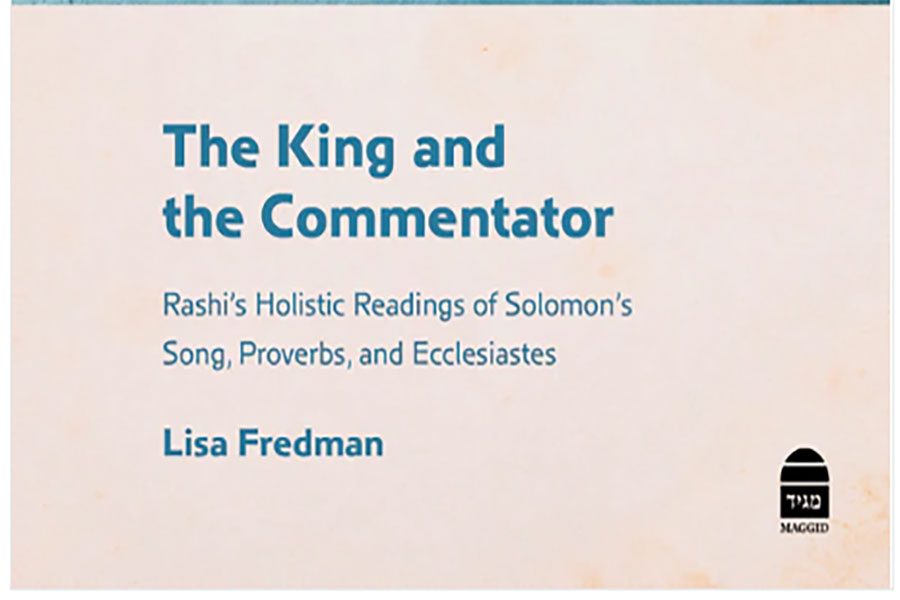


Title: The King and the Commentator: Rashi's Holistic Readings of Solomon's Song, Proverbs, and Ecclesiastes
By: Lisa Fredman
Maggid Books, an imprint of Koren Publishers Jerusalem
Rabbi Akiva had a warning about the Song of Songs: anyone who recited it as a drinking song at a banquet, he said, had no portion in the World to Come. The warning tells you something about the poem. It has no prayer. No sacrifice. The name of G-d does not appear in it. The Sages debated whether it belonged in Scripture at all. What finally saved it was allegory: Rabbi Akiva himself declared that while every other book of Ketuvim was holy, the Song of Songs was holy of holies, because its love story was not about two people but about G-d and Israel. That settled one argument and started another. How, exactly, does allegory work across eight chapters of love poetry? Which verse maps to which moment in Jewish history? And what do you do with the parts that don't fit?
Rashi had answers for all of it.
The King and the Commentator: Rashi's Holistic Readings of Solomon's Song, Proverbs, and Ecclesiastes, published by Maggid Books, an imprint of Koren Publishers Jerusalem, is a careful reconstruction of what those answers were and what they add up to. Lisa Fredman's doctoral work on Rashi's commentary led to the critical edition of his Proverbs she edited for the World Union of Jewish Studies in 2019. This volume, the second Kitvuni publication in English, from Matan's fellowship dedicated to supporting exceptional women Torah scholars in writing and publishing serious Torah scholarship, is the result. The argument is specific: that in his commentaries on Solomon's three books, Rashi built something he built nowhere else at this scale, and built it openly enough that you can see the structure from the outside.
Rabbi Shlomo Yitzhaki, known by the acronym Rashi, lived in northern France from 1040 to 1105 and wrote the commentaries that remain, nearly a thousand years later, the gateway to studying both the Talmud and the Hebrew Bible. For nine centuries he has been understood as working through both the same way: one word, one verse at a time. He drew from rabbinic sources that treated each passage in isolation. James Kugel, an American scholar of Jewish biblical interpretation, captured it precisely: the individual verse treated as "isolated in suspended animation." For the vast majority of Rashi's biblical commentary, that description holds. But for the Song of Songs, Rashi built a timeline the individual verses had to serve, and when a rabbinic interpretation violated it, he said so flatly: "There are many homiletical midrashim, but they do not accord with the seder hadevarim," the sequence of the text. The word he used was seder: order.
The love story, in his reading, is a precise historical allegory. It runs from the Exodus through the sin of the Golden Calf, the Tabernacle, the entry into Canaan under Joshua, and Solomon's Temple. It keeps running: through the Babylonian destruction, the Second Temple, the Hasmonean rise and fall. It arrives, finally, at the Roman exile that stretched from the Temple's fall through Rashi's own lifetime in eleventh-century France. Every verse is assigned to a specific moment. The same phrase, read one way in chapter 2 where the chronology is the desert, is read an entirely different way in chapter 4 where the chronology has advanced to Shiloh. Same words. Different history.
The poem praises the woman's physical features, and Rashi reads each one as a part of the nation. For example, her eyes, like pools of water, are the Torah scholars at the gates of Jerusalem whose wisdom flows before the nations. Even the same word, appearing in two different chapters, gets read as two entirely different people: the watchmen who find the woman in chapter 3 are Moses and Aaron; the watchmen in chapter 5 are Nebuchadnezzar's armies, who destroy the Temple, because by chapter 5 the chronology has moved from Sinai to the Babylonian destruction.
You have to sit with that for a moment. The same word. Two chapters apart. One is the greatest teacher in Jewish history. The other is the general who burned the Temple. Rashi holds both readings without apology because his timeline requires them both.
The destruction of the First Temple is narrated plainly: Nebuchadnezzar and his armies, the Temple's mantle stripped away. But the fall of the Second Temple is rendered in sideways language. In his gloss on chapter 6, Rashi writes only that "my soul set me" to be "like a chariot, with the nobility of other nations riding upon me." The destruction itself is simply not recounted. Christianity had built a theological argument, grounded partly in the book of Daniel, that the Second Temple's fall was divine punishment for the Jewish rejection of Jesus. Rashi's silence at precisely this point gives them nothing to work with. The commentator who enforced sequence became, here, deliberately imprecise.
He casts the Congregation of Israel not as a young lover but as a living widow, separated from her husband but not divorced, the bond not severed. The figure is Rashi's invention. It refutes the Christian claim that G-d had permanently abandoned His covenant with the Jewish people. A living widow is not abandoned. He let the image make the case.
Proverbs and Ecclesiastes required a different approach, and a different one for each. Both had nearly been excluded from Scripture – Proverbs for seeming too pragmatic and worldly, Ecclesiastes for seeming too skeptical and unorthodox. For both, Rashi finds the same center: wisdom means Torah. But how he builds from there reflects his reading of each text's distinct nature. In Proverbs, more than 140 verses about the pursuit of wisdom and practical success become, in Rashi's hands, a guide to Torah study. How to learn, how to teach, what neglect costs, what diligence yields. The book that seemed too worldly for the canon becomes a manual for Jewish education. Running alongside it is a second polemical thread that most readers would miss entirely: the strange woman who tempts the young man away from wisdom throughout the book's opening chapters is Christianity, and the capable wife who anchors its final chapter is Torah. Rashi threads that identification through the commentary without announcing it once.
In Ecclesiastes the problem is different. Kohelet doesn't offer pragmatic advice; he questions whether anything has meaning at all. Rashi doesn't redirect the skepticism. He inhabits it: the toil that is empty is worldly, and the life that has meaning is the life of Torah and commandment. Solomon, who wrote the book and sinned, repents within its pages. Rashi attributes divine inspiration to him no fewer than six times. In rabbinic tradition the presence of prophecy is a sign of divine favor, and its attribution to Solomon implies, without Rashi needing to say so, that Solomon had been forgiven.
In the Chumash and the Neviim, Rashi's instinct for the whole is present but buried, available only to a reader patient enough to reconstruct it from his verse-by-verse notes. Fredman's term for what she finds in Solomon's three books is precise: the cohesion there "demands no detective work." He tells the reader he is rejecting an interpretation because it violates the sequence. He even has a name for it: dugma, the Hebrew word for illustration. He uses it more than 20 times in the Song alone. He shows his hand. Fredman raises the question honestly: was this a response to texts that had nearly been excluded from the canon and needed defending, or was it something always present in Rashi's method that here, finally, came to the surface? She doesn't claim to know.
What is clear is simpler. Rashi was not just commenting on Solomon's writings. He was arguing that they belonged in the Bible at all. That argument required a structure, and what Fredman has done is show us it was always there. The verse-by-verse commentator was also, in these three books, someone who could see the whole. And for once, he let you see it.