 September 25, 2026
 Categories: Features / Book Reviews
The Ladder Is Not the Goal
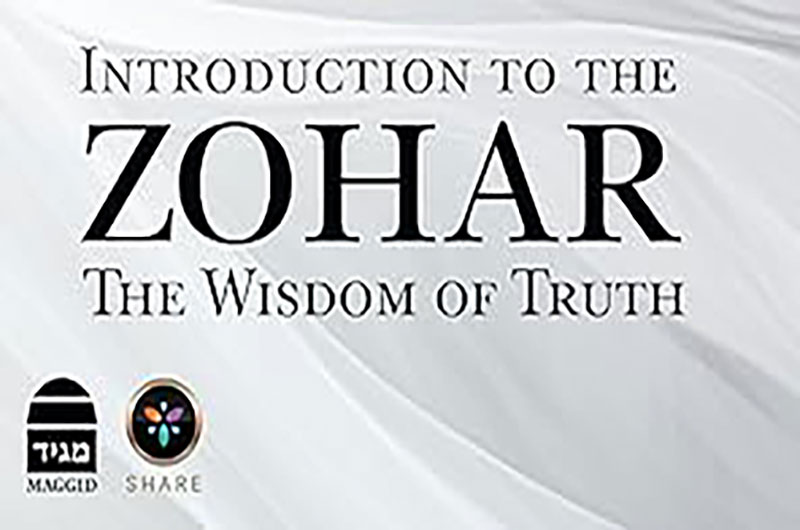


Title: Introduction to the Zohar: The Wisdom of Truth
By: Rabbi Yehuda Leib HaLevi Ashlag
Translated by Yoel Finkelman
Maggid Books
Most sefarim of machshava describe the spiritual world from the outside, mapping its structure, its order, its hierarchy of worlds and sefirot. The Ramchal maps the terrain. Nefesh HaChaim argues for the cosmic weight of Torah. Rabbi Yehuda Leib HaLevi Ashlag (1884–1954), a major Kabbalist known as the Baal HaSulam after his commentary HaSulam (“The Ladder”) on the Zohar, does something harder. He tells you what's happening on the inside: what the retzon lekabel, the desire to receive, is doing in your body right now, what Torah and mitzvot are instrumentally doing to it, and why that process is the entire point of creation. It's less a map of the world than a physiology of the soul.
Introduction to the Zohar: The Wisdom of Truth by Rabbi Yehuda Leib HaLevi Ashlag addresses with extraordinary precision the questions serious learners carry but rarely find answered: what Torah and mitzvot are actually for, why we suffer, how the soul relates to G-d, what the Zohar is and why it matters now. The Baal HaSulam wrote this from inside the catastrophe. In his final section he writes that all the glory of Israel in Poland and Lithuania has been reduced to a handful of refugees in the Holy Land, and that it falls to those who remain – shar'it hapletah – the surviving remnant, to repair what has been broken. That weight runs through every word.
He opens with six questions, none of them rhetorical. What is our essence? What is our role in this chain of being? We look at ourselves and feel defective and low; we look at the One who made us and know that a perfect Maker produces perfect things. How do we reconcile that? His answer: look at the end of the action, not the middle. What did G-d intend when He created? That intention, he argues, was to bestow infinite good on His creatures. But infinite pleasure requires infinite desire to receive. And the retzon lekabel is the one thing not already present in G-d, because from whom would G-d receive? It's the single genuinely new thing in creation, a description of what you are right now, not a philosophical abstraction.
What separates the soul from G-d isn't distance but difference in form. Two people who love the same things and reject the same things cleave together as one body. Two people of opposite nature are as distant as east from west. G-d gives; we receive. That difference is what cut the soul from its Source, and closing it is what the six thousand years of human history exist to accomplish. The retzon lekabel must be transformed through Torah and mitzvot into a retzon lehashpia, a desire to give. You can't repair what you don't possess. The three states of the soul map this arc absolutely: nothing in the system is incidental, and even suffering is built in as the alternate route to the same destination for those who don't choose the path of Torah.
His defense of Rashbi's authorship of the Zohar is characteristically direct. He says he never investigated the question because anyone who genuinely understands what the Zohar contains can't doubt that its author was at least at the level of the Tanna Rabbi Shimon bar Yochai. If he were told it was written by one of the forty-eight prophets, he'd find that more plausible. If he were told Moshe Rabbeinu received it at Sinai, his mind would be fully at rest. He's positioning you before you open the Zohar itself: know what you're approaching.
The sefer's final sections are its most urgent. The Baal HaSulam builds his own argument, rooted in the Tikkunei Zohar, a kabbalistic work of meditations on the Torah, that when Jews neglect pnimiyut haTorah, the inner dimension of Torah, performing mitzvot without inner intention, the external forces of the world gain power over the internal. The nations' destructive elements rise. He names what he has witnessed. He isn't speaking in metaphor and he isn't looking at the destruction from the outside. He is writing as one of the remnant, issuing a call: each one of us who remains must commit with his entire being to elevating the inner Torah and giving it its rightful place. The study of the Zohar, he insists, is what brings us out of galut berachamim, out of exile, in mercy. That phrase closes the sefer. It opens the Zohar, Parshat Naso.
He named his commentary on the Zohar “HaSulam,” the Ladder, and explained: if an attic is full of treasure, all you need is a ladder. But the ladder isn't the goal. If you rest on the rungs you'll never reach the attic. Yoel Finkelman's translation is precise without being reductive, and the editorial additions orient without intruding. What this sefer gave me wasn't new information. It was a way of understanding what I'd been doing all along, and why it matters more than I knew.