 October 16, 2026
 The Quiet Power of Yitzchak Meir
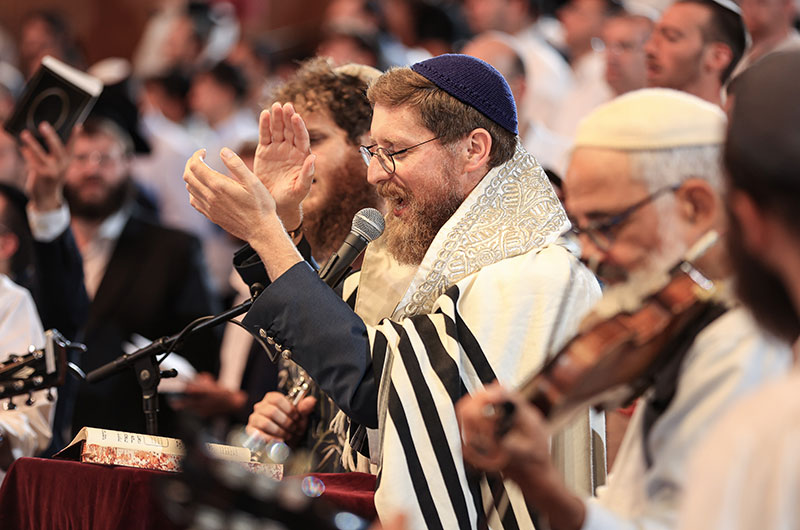


His brother is a host on one of the most popular TV shows in Israel, The Patriots, and husband of a famous TV broadcaster and journalist in Israel who also has a column in The Jewish Press (which often appears a page or two after mine). He’s a relative of Rav Kook and also related to former IDF Chief of Staff Herzi Halevi. And he? He really wanted to be a teacher, but somehow, he became a popular singer.
Those are not the only things I discovered about him when we spoke.
Besides being a singer, he also teaches. When we arranged to speak, he had to reschedule at the last minute because he was on his way to give a Gemara class. He also teaches Chassidut.
We’re talking about Yitzchak Meir. His band is called Yitzchak Meir V’Chaverim (Yitzchak Meir & Friends).
Meir is perhaps best known for his albums of Shabbat songs. That’s what I asked him about first – why Shabbat songs?
Shabbat is the peak of the week, explains Meir. And for him, the peak of Shabbat was always singing zemirot. Let’s bring those melodies into the week, he thought. He even recorded the albums while dressed in Shabbat clothes in order to pull the Shabbat spirit into the week.
How did he get into music?
He explained that he never dreamed about or even wanted to become a singer. But he enjoyed singing with his friends from the IDF. Right after the Second Lebanon War in 2006, he began to record. (Meir was a fighter in the Nahal Brigade during that war and he’s still in active reserve duty.) He did it for the experience. Slowly it started to catch on. There was a demand for more.
In his shows, he mixes chassidic content together with music and songs from the chassidic courts.
If you happen to be in Israel on Rosh Chodesh, you can go to the musical Hallel he does on Rosh Chodesh in his Liba Ba’ei beit midrash in Pardes Hanna, located on the historic campus of Midrashiyat Noam, which was the first yeshiva high school in Israel (I wrote about it in a previous column). In this building, generations of students (including me) prayed and studied. Many of the Midrashiya alumni come often to these musical Rosh Chodesh tefillot which Meir leads. It gives them a nostalgic feeling. His grandfather was on the board of the Midrashiya (he himself didn’t study there). Today the Midrashiya is located in Kfar Sava and Meir’s beit midrash operates in its place.
When he performs, Meir does not play instruments – he sings. But as a child, he didn’t think he had a special voice, and wasn’t one of those who sang Anim Zemirot on Shabbat morning in the synagogue. He didn’t even want to lein for his bar mitzvah. Here he shares something funny: Because he didn’t want to lein, his bar mitzvah was held in a nursing home. Meir grew up in Moshav Gimzo and his father served for many years as the rabbi of the moshav. Gimzo has a beautiful big synagogue, so it is kind of understandable why a kid might be shy to read there. In the middle of the reading of the Torah in the nursing home, the elderly people started to yell.
At home, Meir grew up on Avraham Fried, Mordechai Ben David, the Miami Boys Choir, and Michoel Streicher. There was no English music at home. The highlight of the week was the zemirot shel Shabbat. The whole family used to sing a lot over Shabbat. Not only the zemirot – after they finished those, they would continue singing other chassidic songs.
At this point, I ask him why these days it seems that fewer people and families sing zemirot on Shabbat (something I personally think is important and which I’ve written about before in this column). Meir answers that the music style today has changed. People listen to music that is not in the style of the zemirot. I ask him if he thinks the zemirot shel Shabbat should be matched to the new styles, if the tunes need to be changed to more modern tunes.
No! he says. He opposes new styles. (Good to know I’m not the only one who thinks that way.) His goal is to help people connect to the zemirot of Shabbat through his music.
Meir also composes his own music. He gets inspiration from Rabbi Shlomo Carlebach and the tunes of Belz chassidic dynasty that he really loves.
In the composing process, he starts with the guitar. Even though he does not really play when he performs, he uses the guitar to compose. He starts strumming chords and then the inspiration comes. This is how he composes.
So far Meir has released about 12 albums. They include not only Shabbat songs, but also Selichot piyyutim for the month of Elul, and also an album of his original tunes set to lyrics from the Mekorot (classical Jewish texts), from the Torah of the Baal Shem Tov and of the Baal HaTanya. His albums, especially the Shabbat albums, had a lot of success and sold thousands of copies. He has collaborated with leading singers such as Ishay Ribo, Aharon Razel, Shlomo Katz, and Yosef Karduner.
How does Meir define Jewish music? It’s any music that he listens to and imagines the Baal Shem Tov enjoying, he tells me.
In the old Litvish world, there was no music. Rabbi Kahaneman, zt”l, did not allow singing in the Ponevezh Yeshiva (besides zemirot shel Shabbat) because he didn’t want the boys to fulfill themselves through music. He didn’t even want a student to find out he had musical talent. Only studying Torah mattered. It is important to note that this was not a ban on music, but rather the shaping of the yeshiva atmosphere. Rabbi Kahaneman wanted the students to focus on Torah study.
Music is designed to empower, says Meir. To arouse the soul from inside. As Mozart said, what is important is not the sounds, but what happens between the sounds. Today, Meir listens to a lot of classical music and it has an impact on him. He likes quiet and seeks out good music that refines the quiet of the soul.
His singing style is calm, one that expresses his desire for quiet. And therefore, his music is less loud and noisy. It features fewer brass instruments, for example. It is more acoustic – music that empowers the listener’s inner quiet. A quiet that is not meant to put the listener to sleep, but rather to wake him.
What’s next for Meir? Any new albums or songs in the making?
He’s going to release three new songs soon. Actually, he’s doing something unique: inviting his fans to come to the studio to record with him.
You can find out more about Yitzchak Meir and his music on his website: www.yitzchakmeir.co.il. And of course, on Spotify and YouTube.