 October 23, 2026
 Categories: Headline / Features
Training College Professors to Fight Antisemitism
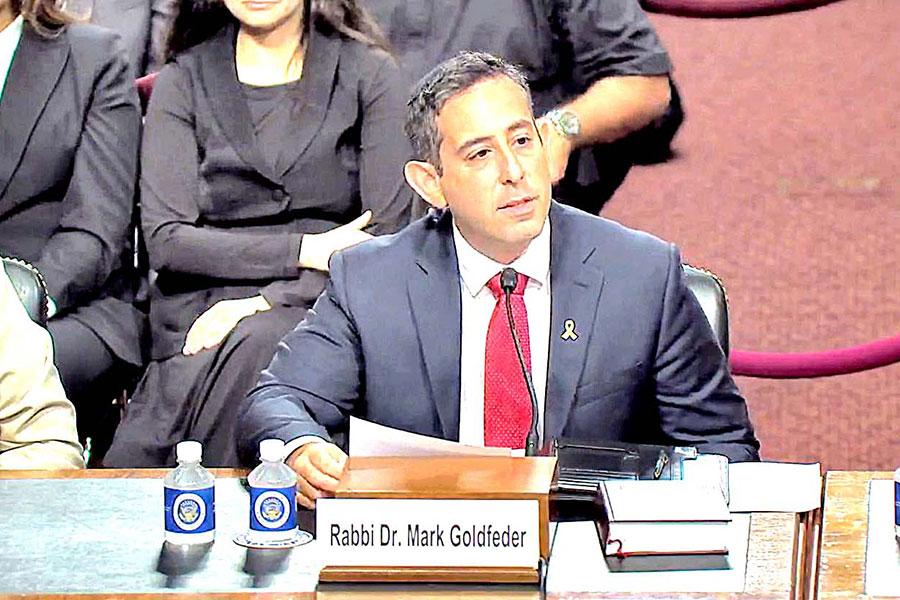


Q&A with Mark Goldfeder, Director’s of Touro’s Inaugural Teaching Fellowship
Touro University recently announced the launching of a center to study and counter antisemitism in higher education. One of the first initiatives of the Touro University Antisemitism Institute will be a teaching fellowship, to be held this summer, made up of faculty from universities around the country. We asked Touro professor Rabbi Dr. Mark Goldfeder, who will lead the fellowship, about his goals and his thoughts on antisemitism in American academia today.
Rabbi Dr. Mark Goldfeder, Esq., is CEO of the National Jewish Advocacy Center and a law professor at Touro, where he directs the nation’s first-ever Antisemitism Law Clinic. Goldfeder has taught law around the world and publishes widely both academically and in major media outlets. He served as founding Editor of the Cambridge University Press Series on Law and Judaism and was as a member of the United States Holocaust Memorial Museum Council.
The Jewish Press: Some – perhaps most famously Bret Stephens – have said it’s time to stop putting our money, energy, and resources into fighting antisemitism, and to instead concentrate on educating America’s Jewish youth. It seems that the implementation of the Touro University Antisemitism Institute (and its first initiative, the Fellowship that you will be heading), means that Touro and you as well do not agree. Fair inference? And if so, why don’t you agree?
Professor Mark Goldfeder: Yes, that is a fair inference, but I would frame it slightly differently. I do not think the choice is between fighting antisemitism and educating Jewish youth. That is a false binary, and frankly it is one our enemies would love us to accept.
Of course we need to educate Jewish students. We need them to know who they are, where they come from, what Israel means, what Jewish peoplehood means, and why they should walk through the world with pride rather than apology. That is a major part of what this Institute and Fellowship are designed to do. On a very related note, we cannot keep producing Jewish advocates by accident. For too long, the best defenders of Jews and Israel have been self-taught. That model is no longer enough. We need serious, systematic training for the next generation of Jewish civil-rights advocates, lawyers, scholars, and leaders. That is exactly the gap this program is meant to fill.
But education is not a substitute for enforcement. You cannot educate your way out of discrimination by institutions that are determined to ignore the law. You cannot tell a Jewish student to be prouder while leaving her alone in a classroom, workplace, or campus environment where her rights are being violated. Pride matters, but so does protection. Kids cannot flourish and grow when they are scared, and they need to know that someone has their back and is willing to fight for them.
So the right answer is both. We have to teach Jewish students to stand tall, and we have to build the legal, academic, and institutional infrastructure that allows them to do so safely and effectively. That means education, but it also means litigation, policy, coordination, public advocacy, and real accountability. The National Jewish Advocacy Center’s model has always been that the fight against antisemitism requires strategies that actually work: creative litigation, serious scholarship, public education, and coordinated action. So I agree with Bret Stephens insofar as he is saying that Jewish education and Jewish confidence are indispensable. But I disagree completely if the argument is that we should stop fighting antisemitism. Civil rights are not secured by vibes. They are secured by law, culture, courage, and institutions. The Touro Fellowship is not a retreat from the fight. It is how we train the next generation to fight smarter, better, and with a much deeper sense of who they are.
How are the professors who will participate in this summer’s fellowship being selected? Isn’t there a problem of self-selection, and that the program will not reach the radical, terror-apologist professors, who will continue to indoctrinate their students against Jews? Relatedly, some skeptics say such institutes, conferences, and academic reports mainly reach people who already care about antisemitism, while those driving hostility toward Jews are not interested in listening. How do you respond to the criticism that this endeavor risks becoming an echo chamber?
That is a fair concern, but I think it misunderstands the purpose of the fellowship. We are not naïve. The professor who is openly celebrating Hamas, excusing terrorism, or teaching students that Jews are uniquely unworthy of equal rights is probably not applying to spend the summer with me at Touro. But that is not the only problem on campus. A lot of the damage is not done by the loudest radicals; it is done by silence, confusion, cowardice, and lack of infrastructure. There are many serious professors who know something is wrong, who want to teach honestly about antisemitism, Jewish peoplehood, Zionism, Israel, civil rights, etc., but who do not yet have the materials, confidence, network, or institutional support to build rigorous courses in their own disciplines. Those are the people this fellowship is designed to equip.
So the goal is not to convert the unconvertible; it’s to build capacity and strength. If one trained professor teaches fifty students a year, and teaches the course twice, that is already a hundred students reached by that one fellow. Multiply that across disciplines, campuses, and decades of future cohorts, and suddenly you are talking about real change in places where it might not have seemed possible. That’s also why this is not an echo chamber. An echo chamber talks to itself and ends when the panel ends. This program requires professors to take what they learn back into real classrooms, at real universities, with real students who may not think the same way we do coming in to the course. And of course, they don’t just teach a course – in doing so they become a beacon for Jewish students who need to know they are not alone.
Shortly after Oct. 7, Ben Sasse (may he be well and healthy), then president of the University of Florida, issued a letter that included these lines: “But I also want to be clear about this: We will protect our Jewish students from violence. If anti-Israel protests come, we will absolutely be ready to act if anyone dares to escalate beyond peaceful protest. Speech is protected – violence and vandalism are not.”
It seemed so simple and easy. And yet, dozens of university presidents failed to take this moral stand. And in fact, some university presidents, incredibly, struggled even to say whether calls for genocide against Jews violated school rules. What did that moment reveal to you about the moral and intellectual culture of higher education in America?
First of all, I love Ben Sasse, and may he have a refuah sheleimah. But the crazy thing is that Ben Sasse’s statement should not have been remarkable. It was literally the bare minimum that anyone and everyone should expect from the person in charge, i.e., equal protection for everyone in the community, including Jewish students, and a basic restatement of the law: Speech is protected; violence and vandalism are not. That should have been the easiest thing in the world for every university president to say. The fact that so many could not say it tells us something very troubling. Too many universities had trained themselves to speak fluently about every form of hatred except antisemitism. They had entire bureaucracies devoted to inclusion, belonging, trauma, safety, and harm, but when Jewish students were the ones being targeted, suddenly everyone became a First Amendment absolutist (or absurdist), a procedural minimalist, or a philosopher of context.
And the “context” answer was especially revealing. Calls for genocide against Jews are not a close case morally, educationally, or legally. The First Amendment protects offensive and even hateful speech, but it does not protect threats, harassment, intimidation, vandalism, trespass, assault, or conduct that materially disrupts the educational environment or invades the rights of other students. If you can understand the line between speech and conduct when it comes to every other form of hate except antisemitism, then your problem is not about understanding the line. The problem is understanding antisemitism. These administrators hid behind the First Amendment as if it were a mystery no one could apply, when the actual rule is not that hard at all to understand: Protect speech, punish conduct, enforce rules evenly, and do not make Jewish students wait until someone gets hurt before the university acts.
How does the Institute define antisemitism? Do you believe denying the Jewish people the right to a homeland is inherently antisemitic? Has anti-Zionism become a socially acceptable cover for antisemitism on many campuses?
The Institute uses the IHRA definition as its basic working framework. We do this for many reasons, including: a) it is a good and true definition that does a good job reflecting the shared lived experience many Jewish people have of how antisemitism manifests; b) in many contexts (including much of federal and state anti-discrimination law) it is already the legal definition, and 3) because not only is it the only internationally recognized definition of antisemitism that there is or ever has been, it is also the only one that has an accrued track record of success. Over the last twenty years, it has proven to be an essential tool used to determine and protect against contemporary manifestations of anti-Jewish rhetoric and actions.
One of the things that makes IHRA work, especially in the legal context, is that it has all of the right caveats. Even the examples, including the illustrative examples of when “anti-Israel” positions become antisemitism, are not automatically inherently antisemitic. As the definition explains, they could, taking into account the overall context, be antisemitic. So to your example – no, it is not inherently antisemitic if, for instance, you believe that no one – no nation, no people – has the right to a homeland. But if contextually you think that only the Jews do not have that right, then yes, that is a double standard, and yes, it is antisemitic.
And yes, on many campuses, and even off campus, anti-Zionism has become the socially acceptable language through which antisemitism now travels. Antisemites are not (all) stupid; they adapt. As Rabbi Jonathan Sacks, z”tl, explained, in terms of its focus, antisemitism often looks at Jews as a collective, the idea being that while individual Jews or small groups of Jews might be tolerable, Jews as a separate collective identity should not be allowed to exist with the same rights as other groups. That is why the majority of antisemitism in any given era tends to focus on the primary form of collective Jewish identity at that point in time.
Throughout the Middle Ages, Jews were, for the most part, a religious community and so they were hated for their religion, even if the particular Jews that were being oppressed were not religiously observant. In the 19th and 20th centuries, when many Jews became secularized, the primary unifying collective identity of Jews was their ethnicity, and so the hatred mutated to focus on race – even when the assimilated Jews that were being oppressed had only a trace amount of Jewish blood in them. Today, when the primary collective embodiment of Jewish people on the world stage is the people of Israel in their nation state, Jews around the world are hated and held accountable for “their” state – even if they are not Israeli nor live in Israel.
In each instance, the essence of antisemitism is the same, even if the focus somewhat shifts. And while antisemitism’s focus can shift over time, in every generation those manifesting such bigotry use some variant of the same refrain: “We don’t hate Jews, we just can’t stand X.” In order to justify their hatred in a socially acceptable way, antisemites need a rationale that can pass in polite society – ideally one that appeals directly to the highest source of authority that is currently in vogue. And sometimes the justification maps directly onto the target. In the Middle Ages, for example, the highest source of authority was religion; in post-Enlightenment Europe, it was science; and today it involves using (or abusing) the language of human rights with selective claims of social justice that see only Jews, or the Jewish state, as worthy of condemnation. The vocabulary changes, but the target does not.
Some Jewish students say they are afraid to wear a yarmulke, defend Israel, or even identify themselves openly as Zionists in class. Is this now a genuine civil-rights crisis for Jewish students in America? At what point does anti-Israel activism cross the line from protected political speech into intimidation, discrimination, or antisemitism?
Yes, we are in crisis mode. The legal line is not hard to state, even if universities often pretend it is. Criticism of Israel is protected. Harsh criticism of Israel is protected. Offensive political speech is usually protected. But anti-Israel activism crosses the line when it becomes targeted harassment, threats, intimidation, exclusion, vandalism, disruption, discrimination, or denial of equal access to education. No one is trying to silence speech. Freedom of speech, even offensive and hateful speech, needs to be protected. But there are limits to what constitutes speech, and there are rules for when it crosses over into actionable unlawful conduct. At many schools, many incidents have already clearly crossed these lines. A student has every right to argue about Israeli policy. They do not have the right to block Jewish students from entering a library, surround them, spit on them, tear down their posters, vandalize Jewish spaces, exclude Zionists from student groups, disrupt invited speakers, or create an environment where Jewish students reasonably feel they must hide who they are to participate in campus life.
The key question is not whether the conduct hides behind the veil of political language. As we mentioned, antisemitism almost always borrows the respectable vocabulary of its time. The question is whether Jewish students are being treated equally. Are the same rules enforced when Jews are targeted? Are administrators responding with the same urgency? Are students being told that their identity is uniquely illegitimate? Are Zionists being excluded not because of misconduct, but because their Jewish identity or connection to Israel is somehow deemed unacceptable? At the end of the day debate is protected but discrimination is not. Protest is protected, but threats and obstruction are not. Criticism of Israel is protected, but treating Jewish students as collectively guilty, uniquely suspect, or unfit for campus life is antisemitism, and universities have not just a moral but also a legal duty to stop it.
Critics argue universities already understand the antisemitism problem, but administrators often lack the political courage to confront radical activists, faculty pressure, or donor backlash. If that is true, what can this Institute realistically accomplish?
That criticism is partly right, but I think there are really three different issues at play. Some administrators genuinely don't understand the problem and will benefit from having more educated people around them. Great, the Institute will help with that.
Some do understand perfectly well, but either do not care or are actively looking for cover to do nothing. Good, we can help there too by taking away at least some of their excuses. There will be no more hiding behind the “it's complicated” line. The Institute will be more than happy to provide anyone who needs it with the guidance, vocabulary, and tools to distinguish protected speech from harassment, and political debate from discrimination.
And third, as you correctly point out, there are administrators and professors who do care, but feel isolated, intimidated, outnumbered, or convinced that if they act, they will simply be shut down. That may be the most important group. Not every professor is radical. Not every administrator is hostile. Many decent people know something is wrong but feel alone and outgunned. The Institute gives them backup. It builds a network and creates allies inside the university system who can stand up together. It makes courage easier because people no longer have to act alone.
Touro is taking a very public stand on this issue while many institutions appear reluctant to do so. Was there concern about backlash from activists, faculty groups, accrediting bodies, or political actors?
To Touro’s credit, I do not think there was any hesitation. They understood from the beginning that this was not a political calculation; it was a values question. So the answer is: I am sure they were aware there could be noise. But I never saw them flinch. They made the decision that a serious educational institution, and a serious Jewish institution should make. They put students first, they put civil rights first, and they put their institutional values first.
You’re a great communicator – in speech and in writing. Your detailed explanation (on X and elsewhere) of why Mamdani’s comments after the anti-Jewish Park East melee were a “terrible statement” were clear and perfectly articulated. Is communication key for the incoming fellows in fighting antisemitism? Or have we reached a point in the U.S. where most everyone is solidly ensconced in their silos and no one is listening to opposing viewpoints?
First of all, thank you; that is very kind of you to say. And yes, communication is absolutely key. Law matters. Facts Matter. History matters. But if you cannot explain them clearly, they will not move anyone. I do not accept the idea that everyone is unreachable. Some people are, of course. The committed antisemites, the professional activists, the professors who have built careers around this stuff. But most people are not in that category. Even when you went to the encampments, charitably speaking, 90 percent of the people there protesting couldn’t tell you what river or what sea. They were there either for the pizza, or because they had been genuinely misled into thinking that they were on the right side of history. Those are people we can speak to, but only if we are both sincere and effective. Our fellows are not just going to be scholars. They are going to be translators. They need to take complicated ideas, thinks like antisemitism, Zionism, civil rights law, Jewish history, campus culture, etc., and make them accessible for students who may come in with very different assumptions. So yes, you are right that there are silos, but silos are not prisons. People still listen to professors they trust, and if you speak clearly and kindly and show your work, they may even shift their perspective. Communication will not solve everything, but without it, nothing else gets very far.
If Qatari’s enormous funding of many elite universities is helping to create the problem, is there really anything you or others can do to counter it?
Yes. Qatar’s money and influence are enormous, but they are not magic. They do not exempt universities from American law, and they do not give any institution permission to tolerate discrimination. So step one is enforcement: apply the laws we already have. Step two is transparency. If foreign governments or foreign-funded entities are shaping American academia, the public has a right to know. Congress is already considering bills that would strengthen disclosure requirements and impose real penalties for failing to comply. And step three is the long, hard work at the heart of our faculty fellowship: undoing the damage and taking back our campuses from those who are really seeking to undermine democracy and weaken the values that make this country great.
Won’t it take years to help reverse course on the new antisemitic groupthink coursing through many campuses? Do we have years?
As we say in Pirkei Avot: “You are not obligated to complete the work, but neither are you free to desist from it.” Yes, changing campus culture may take time. Antisemitic groupthink did not appear overnight, and it will not disappear overnight. It has been built through bad scholarship, cowardly administration, foreign money, ideological capture, and years of treating Jewish students as an exception to the rules of civil rights. So no, we may not have years to protect the students who are suffering today. But that is why the work has to begin immediately, to make sure that every tomorrow is better than the one before it. We do what Jews have always done: we start with the obligation in front of us, and we refuse to walk away.
As a Jewish university, Touro is one of the few places where Jewish students today can feel safer and more comfortable – physically, intellectually, and in every way – than at other universities. Do your efforts to combat the antisemitic climate elsewhere mean that you believe that Jewish students have a healthy future in the Ivy League and other universities, or has October 7 permanently changed how American Jews view elite universities and mainstream cultural institutions? What does the future look like for Jews on campuses across the U.S.?
I do think October 7 changed the way many American Jews see elite universities forever. Not because every student or every professor is antisemitic, of course not. But because the masks came off at many institutions that had spent years presenting themselves as the guardians of inclusion and tolerance. Jewish families saw something very clearly: when Jews were targeted, too many of these institutions suddenly became confused. They knew how to speak about every other form of hatred, but when it came to antisemitism, they discovered nuance, process, context, and delay.
That does not mean Jewish students have no future at the Ivy League or at major universities. They do. Jewish students are brilliant, resilient, and entitled to participate fully in every part of American academic life. We cannot and should not cede that ground. We should never accept a future in which Jews are pushed out of elite institutions or told that the price of admission is silence about who they are. But it does mean we have to go in with our eyes open. Families have to ask harder questions now: Will my child be protected? Will Jewish identity be respected? Will Zionism be treated as a legitimate part of Jewish life, or as a disqualifying heresy? Will administrators enforce their own rules when Jews are the targets? That is why a school like Touro matters so much in this moment. Touro is showing that academic excellence and Jewish pride are not in conflict. So the future will not be one thing. Some universities will reform because law, donors, parents, students, and public pressure force them to. Some will resist and eventually lose their credibility. And institutions like Touro will become even more important as models for what higher education should look like.
The goal is not for Jewish students to abandon American higher education. The goal is for American higher education to remember that Jewish students belong, and to appreciate everything they bring to it.