October 2, 2026
 Categories: Op-Eds
What the NY Times Tlaib Feature Represents


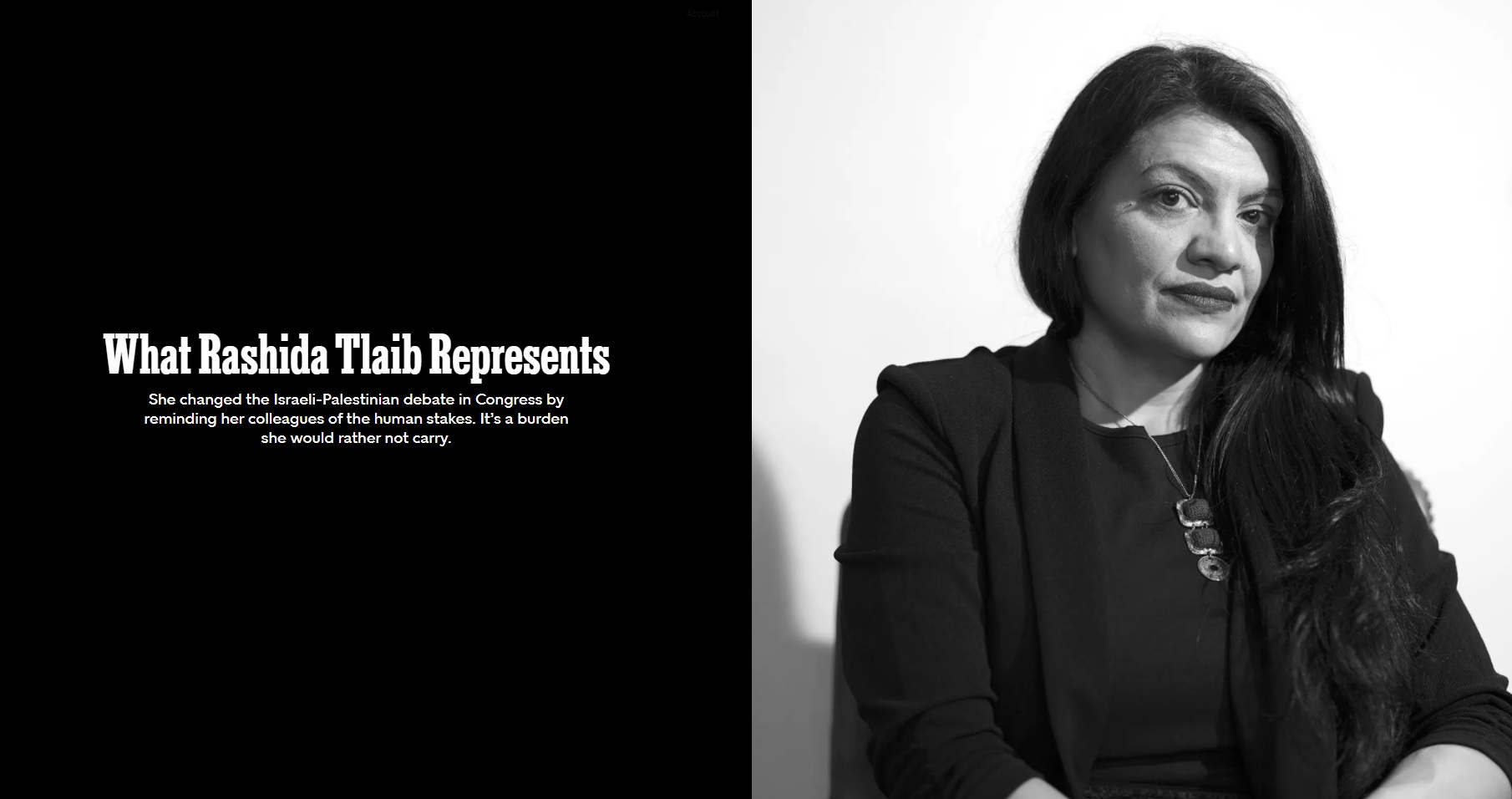
The cover image for the New York Times fawning feature on Rashida Tlaib.
During the 1990s the Israeli government and the Palestine Liberation Organization, along with the United States, agreed that the best solution to the conflict was the establishment of two states: a sovereign Palestine and a sovereign Israel coexisting side by side. Though the borders have never been agreed upon, the two-state outcome remains a “core U.S. policy objective,” according to the State Department. But since then, settlements have grown steadily, while military occupation of the Palestinian territories continues.No, the Israelis, Americans, and Palestinians had not agreed that the best solution was “the establishment of two states.” The Oslo peace accords, which this passage describes, says nothing about a Palestinian state. Nonetheless, Israel has offered Palestinians statehood. So why does the “military occupation of the Palestinian territories,” as she puts it, continue? Because Palestinian leaders have repeatedly rejected such offers. An inconvenient fact. But a necessary one for those seeking to understand the history Ali points to. In light of all these distortions, it should only be expected that the author also conceals inconvenient facts about her subject. Rashida Tlaib “has been called anti-Semitic for her criticism of Israeli policies,” Ali dismissively writes. She says nothing, though, about one of the more recent controversies. In August, Tlaib told an audience that “from Gaza to Detroit,” the system is “designed by those who exploit the rest of us from their own profit.” And the system was designed by the same shadowy forces: “If you open the curtain and look behind the curtain it’s the same people” who profit from racism. Liberal Washington Post columnist Dana Milbank wrote in response:
A vague “they” conspiring to “exploit the rest of us for their own profit” from “behind the curtain:” These antisemitic tropes have been used against the Jews for generations.The head of the ADL similarly wrote: “We’ve heard this kind of ugly antisemitic dog whistling before, but it’s appalling when it comes from a member of Congress.” Far from the impression Ali gives of bad-faith charges of antisemitism meant to stifle any criticism of Israel, these are specific and substantive critiques focused on Tlaib’s language. Ali, at least, does mention the criticism that followed Tlaib’s slur about American supporters of Israel having “forgot[ten] what country they represent.” But she seems to miss that this example, too, belies her claim that accusations of antisemitism follow from mere “criticism of Israeli policies.” This, after all, was an allegation of dual loyalty levelled against Americans, not a comment on Israeli behavior. As a whole, Ali’s piece is meant as a lesson about, first, why Tlaib should be seen as a hero, and second, why Americans are allegedly receptive to her extreme anti-Israel messages. For Ali, the answer to the first question is that Tlaib is a hero because her extreme anti-Israelism. That’s the author’s prerogative. The second question is best answered not by the arguments in Ali’s article, but by the very existence and nature of the piece, which is more of the same from a newspaper that too-often excuses, or even lauds, attacks on Israel’s legitimacy and Jews in general. Here is yet another story taking aim at Israel. Here are yet more distortions meant to misinform readers about the conflict. When editors make a point of defaming the Jewish state and whitewashing Palestinian contributions to the conflict, and do so again and again, it would hardly be surprising if some readers take the bait. That’s what the Times article represents. (Reposted from the CAMERA website}