

 November 20, 2026
Who Gets to Name the First Child?
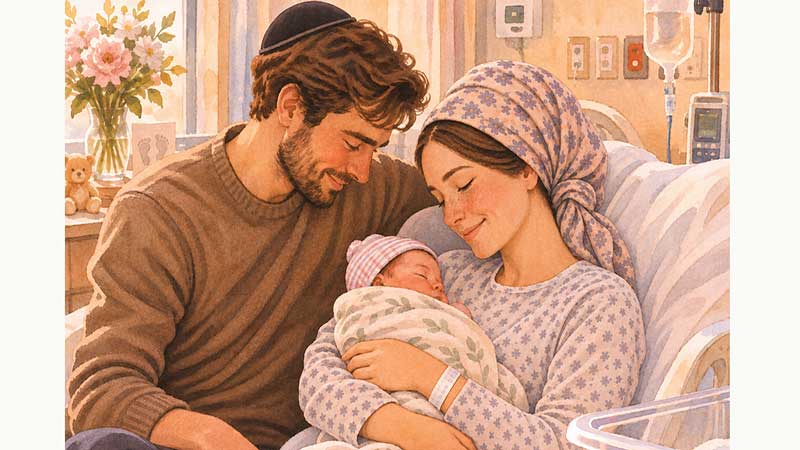


Few decisions surrounding a baby's arrival can provoke as much discussion as choosing a name. Long before the birth, prospective parents may debate which grandparent deserves the honor, whose family traditions should prevail, and who gets the final say. In Sephardic communities, naming children after living grandparents is a source of honor; among Ashkenazim, the custom is generally to name children after deceased ancestors. What happens when the mother pushes for one name from her side of the family and the father pushes for a different name from his side of the family?
Biblical Precedent
Let's look at the Book of Genesis for precedent on this question. Eve named Adam's firstborn son, Cain (Gen. 4:1), and his third son, Seth (Gen. 4:25, but see 5:3). Although the Torah does not tell us who named Abel (Gen. 4:2), these examples might suggest that naming children was the mother's prerogative. Yet in the next generation, Seth named his own son Enosh (Gen. 4:26). (Tanach and Chazal do not identify Seth's wife by name, although various sources call her Petorah (Tanach Farhi), Nova (Sefer Yerachmiel), or Azora (Toldos Adam by Rabbi Shlomo Algazi.)
Among the Patriarchs, the evidence becomes more complicated. Abraham named Ishmael (Gen. 16:15), even though an angel had instructed Ishmael's mother, Hagar, to give him that name (Gen. 16:11). Abraham also named Isaac, as Hashem had commanded him (Gen. 17:19, 21:3). Conversely, when Lot's daughters bore sons through their father, they named them Moab and Ben-Ammi (Gen. 19:37-38); their father Lot didn't name them.
When Isaac and Rebecca had twins, the Torah first reports that “they” named their eldest son Esau (Gen 25:25), apparently referring to both parents, and then that “he” named the younger son Jacob (Gen. 25:26), apparently referring to Isaac.
Jacob's children present a different pattern: their names were generally chosen by their mothers, or, in the case of the maidservants' children, by their mothers' mistress, Leah or Rachel (Gen 29:32-30:24). Levi may be an exception, as the unusual wording in Genesis 29:34 suggests that Jacob or Hashem might have named him. Benjamin received two names: his mother called him Ben-Oni, while his father called him Binyamin (Gen. 35:18). In the following generation, Joseph – not his wife – named his sons Manasseh and Ephraim (Gen. 41:51-52).
One further episode has attracted particular attention. Judah's first wife bore him three sons: Judah named the first, Er; his wife named the second, Onan; and she also named the third, Shelah (Gen. 38:3-5). In that context, the Torah makes a point of saying that Judah was in a place called Keziv when Sheilah was born. Many commentators understand this detail to mean that Judah was away when his third son arrived, and therefore could not exercise his customary right to name him.
According to this interpretation, there was an early custom whereby husband and wife alternated in naming their children: the father named the first, the mother the second, and the father the third. This explanation appears among commentators from France, Germany, and Spain, including Chizkuni, Bechor Shor, Daas Zekeinim, Hadar Zekeinim, Moshav Zekenim, Sefer HaGan, Radak, Rabbi Yehudah Chalavah, Maharam of Rothenburg, Rabbi Shlomo Ibn Parchon, and Alshich.
What's the Minhag?
Interestingly, even if there was such a custom, it seems that Judah himself did not consistently follow it: When Judah subsequently had twin sons with his former daughter-in-law Tamar, he named both children himself (Gen. 38:29-30). Perhaps in light of this fact, Nachmanides (to Gen. 38:5) dismisses the aforementioned proposed explanation of Judah's naming practices as lacking “taste or smell.”
Nevertheless, Rabbi Ovadia Yosef (1920-2013) observes in responsa Yabia Omer (vol. 5, Yoreh Deah §21) that even Nachmanides appears to have recognized the customary preference for naming the first child after the father's side. Responsa Rashbash (§291) relates that Rabbeinu Yonah's daughter married Nachmanides' son Shlomo. When they had their first son around the time Rabbeinu Yonah died, Nachmanides acknowledged that the child should be named Moshe, after himself, the living paternal grandfather. Nevertheless, he deferred to Rabbeinu Yonah's greatness and asked his son and daughter-in-law to name the baby Yonah, after the deceased maternal grandfather. Rabbi Ovadia sees this episode as evidence that even Nachmanides agrees that the father would ordinarily choose the first child's name (just that Nachmanides did not want to explain the passages about Judah in light of that custom).
Other commentators offer explanations for the names in Judah's family. The Bible explains that Jabez (a name derived from the Hebrew word atzuv, "sad") was named because his mother gave birth to him in pain or sorrow (I Chron. 4:9). Rabbi Avraham Menachem Rappaport (1520-1593), in Mincha Belulah (to Gen 38:4), suggests that Judah's wife was given the right to name Onan because she was similarly grieving; Onan evokes the Hebrew onen, "a mourner." Sforno (to Gen. 38:5) adds that the Torah records that Judah was in Keziv to hint to us that Judah's wife gave their third son an inappropriate name that Judah would not have permitted had he been present. See also Rabbi Avraham Saba's Tzror HaMor (to Gen 38:4).
The question arose explicitly in a responsum penned by Rabbi Avraham Meyuchas (1696-1767), Sde HaAretz (Yoreh Deah §22). A couple's firstborn son had been named after the maternal grandfather at the mother's insistence, despite the father's preference to honor his own father. The father subsequently worried that he had slighted his father's honor by departing from the accepted custom.
Rabbi Meyuchas acknowledged that he had not found the issue discussed explicitly in earlier sefarim, but ruled that the father should ordinarily name the firstborn after his own father. Failing to do so might slight the paternal grandfather, particularly because the father could not be certain he would have another son whom he could name after him. A simple solution, however, would have been to give the child two names. Rabbi Daniel Tirani (d. 1814), in Ikkarei HaDat (Yoreh Deah §26:7), specifies that when taking that approach, the paternal grandfather's name should come first, followed by the maternal grandfather's.
Rabbi Meyuchas also cites Rabbi Yisrael Meir Mizrachi, the eighteenth-century Rishon LeTzion and author of Pri HaAretz (vol. 3 §22), who offers a striking explanation for the deaths of Aaron's eldest sons, Nadav and Avihu (Lev. 10:1-2). According to this interpretation, Aaron violated the proper naming order: Nadav was named after his wife's father, Amminadav (Ex. 6:23), while Avihu – whose name literally means “he is my father” – was named after Aaron's own father. Amram. Had Aaron followed the custom, he should have named his first son after his own father and his second after his father-in-law. Thus, Rabbi Mizrachi explains, since Aaron upended the usual naming order, his children were punished.
Although he attributes this explanation to Chazal, it does not appear in the classical rabbinic sources, such as the Talmud or Midrash. Rabbi Nachum Meir Bronznik, however, argues that it is rooted in the poetry of the early payytan Yannai (Tzefunos vol. 17 1993, pp. 99–100), who explains the onomastic basis of Aaron's sons names in this way.
Rabbi Nissim Avraham Ashkenazi (Maaseh Avraham, Yoreh Deah §47) initially rules that if the mother's father has died while the father's father is still alive, the mother should receive precedence in naming the first child. After considering Rabbi Mizrachi's warning about reversing the naming order, however, he concludes that the established custom favoring the father still applies even then. Rabbi David Zacut Modena adopts the same conclusion in Zecher David (ma'amar 1, ch. 86).
The Ben Ish Chai (Year 2, Parashat Shoftim §27) likewise maintains that a husband should not relinquish his customary right to name the first child after his father. Nevertheless, he advises the husband to appease his wife by explaining that Aaron's sons died because their father had reversed the proper order (per Rabbi Mizrachi). Rabbi Ovadia Yosef adds an important qualification: the paternal grandfather may waive his honor, for example, out of deference to a mechutan who is a talmid chacham. Moreover, he stresses not every departure from custom – whether in naming a child or choosing a sandak – should be considered an affront to the grandfather.
The Ashkenazi Custom
Interestingly, the prevailing Ashkenazi practice today often gives the mother the privilege of naming the firstborn. Rabbi Avraham Stern (1884-1944), father of Rabbi Betzalel Stern (1910-1988), author of Betzeil HaChachmah, and Rabbi Moshe Stern (1914-1997), the Debreciner Rav, records in Melitzei Aish that Rabbi Yosef Chaim Sonnenfeld (1848-1932) wrote to him rejecting Rabbi Mizrachi's explanation for the deaths of Aaron's sons. Since the prevailing custom was for the mother to choose the firstborn's name, Aaron's naming Nadav after his father-in-law presented no problem. Rabbi Menashe Grossberg (1860-1927) likewise writes that the mother has the right to choose the first child's name (Responsa Livnei Menashe, §4).
I also heard from Rabbi Nechemia Kaplan (son-in-law of Rabbi Meshullam Dovid Soloveitchik) in his weekly Chumash shiur on Parashat Vayeitzei (2008), that the Brisker Soloveitchik family follows a custom whereby the mother names the first child and the father the second. Thus, the Brisker Rav, Rabbi Yitzchak Zev Soloveitchik, named his second child Yosef Dov (Rabbi Berel Soloveitchik) after the Beis HaLevi. Although his brothers, Rabbi Moshe Soloveitchik and Rabbi Yisroel Gershon Soloveitchik, named their respective first child Yosef Dov after the Beis HaLevi.
This custom raises an intriguing historical question. As seen above, many Medieval Ashkenazi commentators, including Ashkenazi authorities, describe a practice in which the father named the first child. Even Rabbi Yisrael Isserlin (1390-1460), author of Terumas HaDeshen, is quoted as maintaining that the father chooses the firstborn's name. So when, then, did the Ashkenazi custom change?
Several biblical precedents have been proposed for the mother's right. Some point to Jacob's children, whose names were chosen by their mothers, although others argue that Jacob made a special concession to Leah and Rachel because of their prophetic insight. Hannah and Elkanah's firstborn, Samuel, was named by his mother (I Sam. 1:20). Rabbeinu Efrayim (to Ex. 18:3) asserts that Moses' wife, Tzipporah, named their first son Gershom, while Moses named their second son Eliezer. However, a closer reading of Exodus 2:22 and 18:3 suggests that Moses himself named Gershom.
The Sanz-Klausenberger Rebbe, Rabbi Yekusiel Yehuda Halberstam (1905-1994), derives support for the Ashkenazi practice from Eve's naming of Cain (Yetziv Pisgam, to Gen. 4:1), arguing that although the Torah does not say so explicitly, Adam named their second son Abel.
Other explanations are more pragmatic. According to responsa Keser Efrayim (§39), a wife traditionally leaves her birth family to join her husband's, and granting her the right to name the first child compensates her for that sacrifice. Rabbi Asher Anshel Greenwald (Zocher HaBris §24:19) offers a socioeconomic explanation: young Torah scholars were often supported by their fathers-in-law during their first years of marriage. Since their firstborns were therefore typically born while the couples lived in the maternal grandparents' homes, the custom developed for the mother to choose the name and honor her own family.
Rabbi Chaim Kanievsky (1928-2022) offers another explanation: the mother deserves the first naming privilege because she endured pregnancy and childbirth. His brother-in-law, Rabbi Yitzchok Zilberstein, makes a related point in Vavei HaAmudim (to Lev. 16:1): naming the first child compensates the mother for the danger she faces in childbirth, particularly with her firstborn (see Rashi to Bava Kamma 49a).
Rabbi Chaim Kanievsky also challenges the assumption that naming a child after a deceased relative is principally an act of honoring the ancestor or elevating the ancestor's soul in Heaven. Rather, he asserts, the purpose is for the child to carry the ancestor's name. Accordingly, choosing one side of the family over the other need not constitute an insult to the overlooked relative.
A Name for Both Sides
Rabbi Shlomo Luria (1510-1573), the Maharshal, recounts a delightful compromise in Yam Shel Shlomo (Gittin 4:26). His ancestor, Rabbi Menachem Tzion, had a father named Meir and a father-in-law named Uri. When a son was born, the family disputed whether to name him Meir, meaning “one who enlightens,” or Uri, meaning “my fire.” They resolved the disagreement by naming him Shneur, interpreted as a combination of shnei (“two”) and ohr (“light”), thus honoring both grandfathers.
The Chida, however, cautions in Shem HaGedolim that this story should not be treated as the origin of the name Shneur, which was already in use generations earlier, in the time of Nachmanides and Rabbeinu Yonah. Linguists have also connected that name to the Spanish word señor, French seigneur, and English senior.
Finally, Rabbi Chuna Halberstam of Kolshitz (1884-1943) strongly opposed fathers naming children without consulting their wives. As he observed, it should be obvious that the mother, having endured pregnancy and the pain of childbirth, must be involved in deciding what their child will be called. Any man with even a modicum of decency would realize that he has to make the decision of how to name their child together with his wife.
Ultimately, the many customs and opinions surrounding naming should remind us that honoring ancestors is important, but maintaining peace between husband and wife is more important still. The purpose of intergenerational personal names is to preserve a connection across time, not to turn that connection into a source of resentment. Even when tradition seems to favor one spouse, wisdom and consideration demand that the couple approach the question together. A beautiful name should begin a child's life with shalom bayit, not with a dispute that overshadows the joy of his or her arrival.