 September 4, 2026
 Yussi Sonnenblick Goes Back to the Future


A while ago I got an email from a reader of this column. He told me about a new album he had released and added a link to it on YouTube. I like music and I always enjoy learning about new albums, so I listened to some of the songs. Some of them sounded very familiar.
Wait a minute – I know these songs! I used to listen to them when I was younger! I really enjoyed some of them, especially when I was in high school.
It turns out there is a really interesting story behind this album. The reader who contacted me is Yussi Sonnenblick, who as a kid sang on the original Pirchei Boys Choir records.
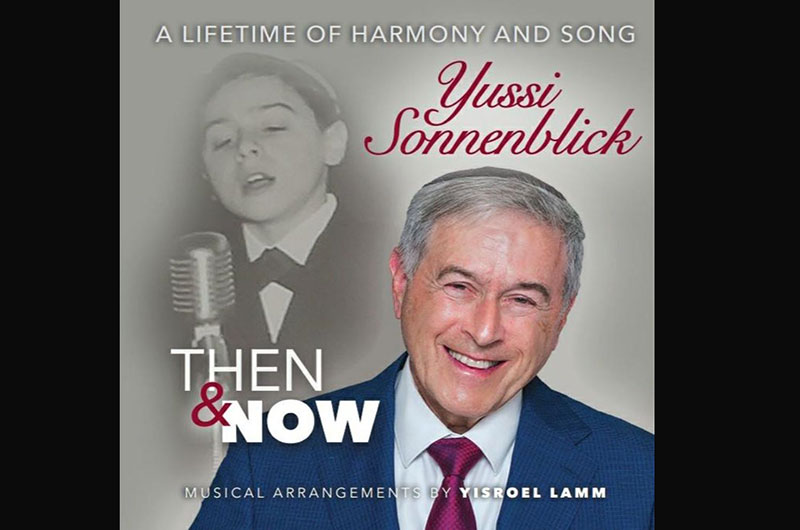
On this new release, Sonnenblick sings along with his childhood voice – perhaps the first time something like this has been done in Jewish music. Sixty years after appearing as a boy on the first Pirchei album, he now sings along with that very same youthful recording. In other words, he performs a duet with his younger self. Confused? I was too at first.
As the soloist who helped popularize these songs for the original Pirchei choir, Sonnenblick reunites with his younger self on the new album, Yussi Sonnenblick: Then and Now, through harmonies and melodies, bringing those timeless pieces back to life in a way that only he can.
We need to talk; I told him via e-mail. So, we scheduled a call and spoke about the album, his journey in music, and his story.
Sonnenblick has sung with some of the greatest figures in Jewish music, among them Chazan Moshe Koussevitzky, Ben Zion Shenker of Modzitz, and Abie Rotenberg of Dveykus and Journeys. He himself was one of the original members of Dveykus.
He grew up in Laurelton, Queens, a small, one-shul community. His father, originally from Germany, was a ba’al tefillah and loved chazzanut, especially Cantor Koussevitzky, who was the gold standard in chazzanut in the U.S. in the 50s and 60s.
As a young boy, Sonnenblick’s father sang in a synagogue choir in Frankfurt. After he moved to the United States, got married, and raised a family, he formed a choir in the shul where he was davening, the Young Israel of Laurelton. The choir sang mostly for shul events such as melave malkas.
At home, Sonnenblick’s parents listened to classical Jewish music such as Fiddler on the Roof songs and of course chazzanut. Sonnenblick’s early musical tastes were surprisingly eclectic, ranging from Koussevitzky to the Rabbi’s Sons to Jo Amar and even the Beatles. In general, he was not that into music; his focus was more on collecting baseball cards and comic books. His parents sent him for piano lessons, but he preferred to play baseball.
He attended the Yeshiva of South Shore under Rabbi Binyomin Kamenetzky and sang in the school choir led by Velvel Pasternak. As it turned out, Pasternak was working with Ben Zion Shenker on Modzitzer Favorites (Vol. 2) and was searching for a child soloist. Sonnenblick, already a standout in the South Shore choir, was the perfect fit. It became his first professional recording, and he still recalls the experience vividly. It was made “in a beautiful, huge studio, and the singing, unlike today, was done with a live orchestra. You had one or two chances to get it right – and that was it!” he says. (Note: If you Google it, you might still be able to purchase Modzitzer Favorites (Vol. 2) – I found at least one website offering it.)
Besides managing the choir at Yeshiva of South Shore, Pasternak was involved in other projects besides working with Modzitz and Shenker. One of the members of the Modzitz adult choir, Rabbi Eli Lipsker, helped launch the Pirchei Boys Choir under the auspices of Agudath Israel of America and brought Sonnenblick in as a soloist for its first album, Pirchei Sings. He already knew Sonnenblick, having heard him sing some of the solos on the Modzitz albums.
The Pirchei Boys Choir released its first album in 1964. It was the first children’s choir to release an album, even before Pirchei Miami, Pirchei London, etc. The album is called Pirchei Sings. Sonnenblick had a few solos on it, but we’ll get back to that in a moment. (To learn more about Rabbi Eli Lipsker, read the article on the Jewish Press website, jewishpress.com, “Remembering Chabad Music Legend Eli Lipsker, z”l, on His 7th yahrzeit.”)
Pirchei was a project of Agudah for young children. They had activities such as Mishnayot learning on Shabbat afternoons, and this was just another one of their programs. Originally the choir was called “Pirchei Agudath Israel.” The choir, based in Brooklyn, was for young yeshiva students after school hours. At some point they decided to record. The name Pirchei is from the Gemara’s term “Pirchei Kehunah” to describe the young kohanim who helped their elders perform the service in the Beit HaMikdash.
The Pirchei experience also introduced Sonnenblick to Rabbi Eli Teitelbaum, the multi-talented educator and musician who played clarinet on the albums. Rabbi Teitelbaum, best known as the creative force behind Camp Sdei Chemed, the first boys’ camp in Israel, as well as for the Dial-A-Daf program, later included some of Sonnenblick’s recordings on a Sdei Chemed album.
One day, when Sonnenblick was about eleven, his father, a great admirer of Moshe Koussevitzky, took him to audition for the choir at Temple Beth-El in Borough Park, where Koussevitzky served as cantor. Sonnenblick was accepted into that choir and was given the role of soloist.
On Shabbat Mevarchim, Sonnenblick would go to Borough Park to daven at Beth-El, and he had the solo of “Mi She’asa Nissim,” accompanying Koussevitzky. “Mi She’asa Nissim” is actually on the new album. It turns out that his father taped the song in a live concert with Koussevitzky, and on the album, you can hear the choir and the audience clapping in the background. Sonnenblick also performed in Chanukah concerts at Beth-El, and on one occasion Koussevitzky even took him to Florida for Passover so that he could sing with him there.
In 1966, Pirchei released its second album, which included songs such as “Mi Ha’ish” and “Eilecha.” Pirchei helped make “Eilecha” widely popular during the 1960s. Sonnenblick was the first to sing “Mi Ha’ish,” a classic composition by Baruch Chait, who later recorded it on the Rabbi’s Sons album.
When Sonnenblick sent me the link to the album and I listened to “Eilecha,” I got the chills. The song threw me back about 20 years to when I used to listen to Rabbi Shlomo Carlebach, z”l, sing it.
Later, in the early 70s, Sonnenblick was one of the original members of Dveykus, together with Abie Rotenberg who was the composer, and Label Sharfman who was the main singer.
When Sonnenblick entered Yeshiva Chofetz Chaim in Queens after high school, he connected with Rotenberg, who at the time was just beginning to tap into his own musical creativity that would soon blossom into something that would eventually define his career. Rotenberg and his chavrusa, Label Sharfman of the Rabbi’s Sons fame, brought Sonnenblick into their musical circle, and together – with Rotenberg’s compositions, Sharfman’s vocals, and Sonnenblick’s harmonies – produced the first Dveykus album. It became the foundation of a series of albums and classic songs that would make the Dveykus sound so enduringly beloved.
In later years, Elli Kranzler and Rivi Schwebel joined the group, contributing their voices to the evolving Dveykus style. Across six Dveykus albums spanning more than 30 years, Sonnenblick contributed both solo performances and rich harmonies that greatly enhanced the group’s distinctive sound.
Dveykus was more than just another band. Many people, including many musicians, grew up on and were influenced and impacted by Dveykus. I asked Sonnenblick why Dveykus had such a lasting impact on generations of musicians.
He explained that Abie Rotenberg had a unique gift. The songs he wrote were highly singable – soulful, soft, and mellow. They were easily adaptable for davening, for a chuppah, or for a kumzitz. The albums were filled with classics. Take Dveykus IV, for example. It featured “HaMalach,” “Ani Maamin,” “Mi Bon Si’ach,” “Bo’ee b’Shalom,” and “Shalom Shalom Rav,” just to name a few.
There was also something unique about Rotenberg’s compositions. They represented authentic Jewish music – without English or secular influence or pop-style beats. These songs were not built around rhythm and dancing. As Sonnenblick explained, their focus was not on beats but on inspiration and spirituality. That is part of why the music has endured. Songs like “Na’ar Hayisi” and “Haben Yakir Li,” written in the 1970s, are still widely sung today, and wedding bands continue to play them. It is the music so many of us grew up with.
I asked Sonnenblick whether, when they recorded those albums, they imagined the music would still be popular 50 years later. He said they did not think that far ahead. They simply believed the songs were great and enjoyed putting together a beautiful album of meaningful Jewish music.
Finally, I asked him why he never pursued a career as one of the major chassidic singers. “You could have been famous,” I told him.
Sonnenblick explained that he never intended to make music his profession. He loved singing, but he did not view it as a parnassah and did not see himself performing regularly. It simply was not his personality. For him, music was something to enjoy rather than a primary career – especially since turning a passion into a livelihood can sometimes add pressure and stress. Because he never had to rely on music for a living, he was able to enjoy it purely. For the past 25 years, his main profession has been teaching Jewish history at Touro College.
On the 60th anniversary of the first Pirchei album, Sonnenblick took the songs from their first two albums, added music arranged by the well-known arranger Yisroel Lamm, and sang together with his younger self, young Yussi. On Yussi Sonnenblick: Then & Now, listeners can hear the original recordings of Sonnenblick as a child, with him joining the same songs as an adult. The result is beautiful, bringing the past and present together with striking clarity.
One of the things I really liked about the album is that I was familiar with some of the songs from my youth – classical Jewish music. Growing up, I didn’t really know, or care, who performed these songs. But it was very interesting now to learn more about them from Sonnenblick. I also enjoyed the cantorial pieces in the album (obviously!) – “U’Vashofer Gadol” (featuring Ben Zion Shenker), “M’Chalkeil Chayim” (also featuring Shenker), and “Mi She’asa Nissim” (which, as I mentioned, was recorded in a live concert by Sonnenblick’s father). That last performance is a real masterpiece. No wonder he had the audience clapping by the end of it.
Sonnenblick has received such great feedback and so many comments about the album. People told him they were tearing up, experiencing real nostalgia. It brings people back to the days of their youth when Jewish music was pure – free of modern influences such as dance and trance, etc. These songs touch listeners’ hearts. Especially older people, but younger people as well. For some, it is a unique experience hearing these songs as they were first recorded – the music has a different, more authentic sound.
Yussi Sonnenblick Then & Now is available on Apple Music, Mostly Music, 24Six, and more.