 October 9, 2026
 Categories: Headline / Features / Book Reviews
A Treasury of Women’s Voices To Enrich the Seder Evening
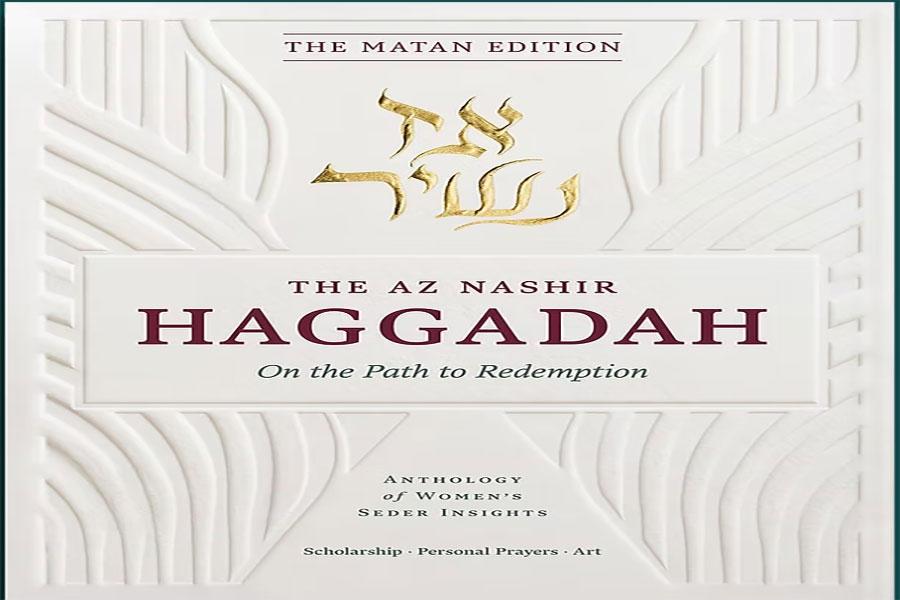


Title: The Az Nashir Haggadah
Compiled and edited by Shira Lankin Sheps, Rachel Sharansky Danziger, and Anne Gordon
The Layers Press
558 pages
My earliest visual memory of the Pesach Seder is the stack of yellow and red Haggadahs which shared space on the table with my father’s regal ke’arah. Anyone who smiles at this image may also remember a time when sefarim stores were small and cozy shoeboxes and the acquisition of a new Haggadah was a maybe and not a given.
For years I used the burgundy faux-leather Artscroll one that my husband had gifted to me the Pesach we were engaged, and every Seder I read the meforshim at the bottom of each page as if they were new, because they seemed new, obliterated each year by the amnesia of young motherhood. Eventually those meforshim grew familiar and the Pesach Seder demanded more of me, and I too, demanded more of myself.
Slowly, methodically, I began to curate an eclectic library of Haggadahs, the first of which was The Jonathan Sacks Haggadah. During my post-baby journey back to Torah learning, I had discovered Rabbi Sacks and was instantly captivated by his methodology and the way he deftly synthesized the contemporary with the traditional. Aside from his commentary on the Seder itself, his Haggadah contains a series of essays so compelling I read them over and over again, and not just on Pesach. This Haggadah would later be joined by Dr. Erica Brown’s Seder Talk which introduced me to a level of women’s Torah scholarship that I had never encountered during my conventional Bais Yaakov education. Although other Haggadahs were subsequently added to the mix, the Sacks Haggadah and Seder Talk continue to hold a special place in my heart.
The Az Nashir Haggadah is the third publication in the Az Nashir anthology of books published by The Shvilli Center and The Layers Press and is edited once again by Shira Lankin Sheps, Rabbanit Anne Gordon, and Rachel Sharansky Danziger. Like the first two volumes, it is a stunning compilation of women’s song, prayers, and artwork. But what makes the Haggadah different is the added partnership with Matan, a Jerusalem-based midrasha for women dedicated to high-level women’s Torah learning. In her introduction to this innovative and unique collaboration, Sheps writes that it “weaves together Torah essays, techinot (prayers), psychological, educational, and story-crafting insights, artwork, and thoughtful discussion prompts to support a Seder that is dynamic, reflective, and accessible to every participant.”
The anthology was created by primarily English-speaking Orthodox women living in Israel, and while the Divrei Torah and essays are in English, the techinot and Haggadah proper are in both Hebrew and English. Rabbanit Malka Bina, the founder of Matan, introduces the Haggadah with a timeless teaching from Sotah 11b: “In the merit of the righteous women of that generation, Israel was redeemed from Egypt.” Rabbanit Bina comments that not only during the Exodus, but in every generation before and since, Jewish women “have played a vital role in sustaining faith, nurturing hope, and shaping the spiritual destiny of the Jewish people.” She invites us to experience the Seder “through the lens of women’s scholarship.”
The very first techinah is a personal prayer/poem written by Ruti Eastman, titled “Pesach Preparation” contains these lines:
“Hashem, remind me that dust is not chametz
and the people that I love are not korbonot (sacrifices)...
Let us love Pesach and the days leading up to Pesach –
Rather than resenting this redemptive time.”
When I first encountered the word “techinah,” it was unfamiliar to me. I was not aware that there was an actual word that described the spontaneous and often desperate prayers I hurled at the heavens multiple times a day, although perhaps with less finesse than the techinot I encountered in this Haggadah. Pesach elicits complicated and conflicting emotions for many women and Ruti captures this struggle perfectly:
“Help me to teach (and to remind myself)
That our work in this world
Isn’t just a series of tasks to be ticked off
Or a burden to be borne,
But a resplendent responsibility
That only true princes and princesses,
Queens and kings, are worthy to perform.”
The first conversational prompt was one that made me nostalgic for the Sedarim we used to share with our cousins before they made aliyah: “What do you need to be in place to enjoy the Seder? What brings you joy year after year?”
When my children were little, they didn’t always get to spend Pesach with their grandparents due to geography and space constraints. Luckily for us, my husband’s cousins moved into our community for a finite period of time and became surrogate grandparents to my children. Each year they brought props to the Seder table – plastic jumping frogs, elaborate masks, and plush toys corresponding to the ten plagues which delighted and terrified my girls in equal measure. Although our kids are grown and our cousins are now in Eretz Yisrael, the toys are still very much an essential component of our Seder.
Continuing with the overarching theme of women’s roles in the Exodus, Rabbanit Nechama Goldman Barash’s dvar Torah asks, “We Talk about the Four Sons, But What about the Four Daughters?” As women, we are exempt from time-bound mitzvot, and yet we are obligated to participate in all the mitzvot at the Seder. Why is this? Specifically referring to the four cups of wine, Rabbi Yehoshua ben Levi says women are obligated “for they too were part of the miracle” (Pesachim 108a). The Baalei HaTosfot elaborate on this and say that women weren’t just part of the miracle – they were intrinsic to it.
Rabbanit Goldman Barash then discusses the four women without whom the Exodus never would have occurred: Miriam, Yocheved, Bitya, and Tzipporah. Miriam facilitated Moshe’s birth by convincing her parents to remarry as well as watching over Moshe in the basket as it floated down the Nile. She and her mother Yocheved were also named by the Midrash as Shifra and Puah, the two midwives who risked their lives to birth the Jewish babies. Bitya, Pharaoh’s daughter, rescued and raised Moshe in her father’s house, while Tzipporah, Moshe’s wife, rushed in to circumcise their son when Moshe balked at the task, thereby saving Moshe’s life. We learn in Sotah 11b that the Jewish women would beautify themselves in their mirrors and bring their husbands food in order to entice them to have more children. “Redemption begins,” says Rabbanit Goldman Barash, “with the courage of women – prophetic, defiant, life-giving.” She reminds us that at the same time that we talk about the Four Sons, we should remember to talk about the Four Daughters – Miriam, Yocheved, Bitya, and Tzipporah – as well as all of the other nameless women whose “faith and audacity gave birth to a nation.” Women are obligated in the mitzvot of the Seder because without them there would be no Seder.
The conversational prompt on the words “Be-Chol Dor va-Dor: In Each and Every Generation” redirects the story of the Exodus from the collective to the singular: “What stories have your family passed down, from generation to generation? Alternatively, what would you hope to pass down to your descendants?”
My grandparents escaped the Nazis and spent much of the war in a Siberian labor camp. Although Zaidy’s default disposition was happiness, he would cry bitterly during the recitation of the Haggadah. Bubby, however, was stoic, composed, her face unreadable; together they passed on a dual Mesorah of passion and equanimity.
Sheps comments at the beginning of the Haggadah that “we are all teachers on Seder night and we are all students.” Those of us who are lucky enough to stand on the bridge between generations, to simultaneously touch both the past and the future, are charged with a sacred responsibility, one that was beautifully articulated in the techinah written by Briana Grogin:
“These are the same blessings our mothers and grandmothers whispered,
Eyes covered, the words eternally woven into our collective memories
And once again, we cross the bridge together
Year after year, we return to this moment –
To teach the children, and also
To remind ourselves,
To remember who we are.”
One of the other themes that weaves its way through the Haggadah is the time-honored Mesorah of Jewish women praising and thanking Hashem through song. Rachel Abraham, in her dvar Torah “Nirtzah: A Song of Praise,” comments that Nirtzah is not just a cutesy group of songs meant to entertain the kids and prevent them from falling asleep, but rather, according to the Maharal, is a continuation of Hallel. She gives three examples of women in Tanach who burst into celebratory song after experiencing Hashem’s great miracles: Miriam, Devorah, and Chana. All three women used song as a conduit to take personal redemption and make it communal, thereby unifying Bnei Yisrael. Rabbi J.B. Soloveitchik explains, “When man experiences redemption and deliverance, the only adequate response is not prose but poetry, not plain speech but song. Hence, at the Seder…the language of redemption is shira.”
Although technically a techinah is defined as a personal prayer or supplication, its very nature defies such narrow classification. Part prose, part poem, part song, each techinah is a modern-day shira, each one a testament to the resilience, strength, and emunah of the modern Jewish woman living in Israel.
The original artwork in the Az Nashir Haggadah is not merely decorative or secondary to the text – it stands as an equal partner and conveys a different message. While writing conveys emotion through language and prose that enters the mind before touching the heart, art bypasses intellect, directly engaging the soul and giving form to emotions too subtle, too wordless, too tangled to express. From the soft yet vibrant colors of Shira Gabriela’s Nerot Shabbat to the stunning photography of the late Laura Ben-David, each brushstroke, each pixel, tells its own unique story of the redemption through the eyes of female artists.
One of my favorite essays in the Sacks Haggadah is “Women and the Exodus,” an essay whose theme is echoed and expanded upon in the Az Nashir Haggadah. Never would I have imagined that years after reading this essay, a group of talented and formidable Jewish women, living in Israel and deeply grounded in Torah learning, would publish a unique and gorgeous Haggadah that skillfully connects the modern woman back to her ancestral mothers.
One of the most challenging things about reviewing the Az Nashir Haggadah was deciding which divrei Torah, which essays, and which techinot to highlight. Although it is impossible to mention all of the Matan authors, some noteworthy contributors are Dr. Avivah Gottlieb Zornberg, Dr. Yael Ziegler, Rabbanit Shani Taragin, and Rabbanit Yael Leibowitz. The scholarship and quality of the divrei Torah was reminiscent of those that I admired so much in Seder Talk, which is unsurprising since Dr. Brown has lectured for Matan.
Although this third book in the Az Nashir series is a Haggadah, it would be a mistake to put it away for the year with all of the other Pesach paraphernalia. Its insights and reflections speak not only to the Exodus from Egypt, but also to the quiet spiritual work of every season, securing its place as a vital volume in the library of the reflective Jewish woman.
If I had to choose a techinah that encapsulates the essence of the Az Nashir Haggadah, it would be the beautifully written “Haggadah as Home” by Sorelle Weinstein:
“The Haggadah does not allow us to be silent.
It calls to us to speak, to question, to answer, to share.
Reading is not enough; the words must be voiced.
In speaking, we find sanity; in telling, we find freedom.
We thank You, G-d, that as long as we speak,
As long as we continue to be the architects of this sacred story,
we are never enslaved.
Our home is in the telling; our freedom is in the words.
And for one night each year, when we sit with the Haggadah open before us,
May we feel Your presence within this house of story.”