 August 7, 2026
 Categories: Collecting / Features On The Jewish World
The ‘Conquest of the Desert’ Exhibition – Israel’s 1953 World’s Fair


The establishment of Israel as a Jewish state constituted an inspiring victory not only over the 2,000-year exile, but also over the forces of nature themselves, as non-arable wastelands were transformed into the Jewish homeland. The fundamental Zionist pioneering narrative had always characterized the settlement process as an unrelenting and challenging struggle against the desert, and the necessity to create extensive economic opportunities in a small barren area caused Israel to expend significant effort in research and development related to turning back the desert and reducing its advance.
In the first decade of its existence, Israel, seeking to promote itself as a modern state and a developed nation ready to take its place in the world, devoted significant effort and resources to participating in exhibitions all over the world, and it was engaged in a steady campaign to present itself not just as the revival of the Jewish homeland, but also as a modern state shaped by science, industry, and a creative response to its geophysical challenges. A key expression of that ambition was the international exhibition organized in Jerusalem in 1953 under the title Conquest of the Desert International Exhibition (Hebrew: Kibbush HaShmama) widely regarded as Israel’s first internationally-recognized world’s fair. The exhibition, which was officially held September 22 through October 14, 1953 at the convention center then known as Binyanei Ha’uma in Jerusalem and was approved as a “special exhibition” by the Bureau International des Expositions (BIE), aimed to bring the spotlight on land-reclamation and desert-settlement projects, invoking the Zionist narrative of “making the desert bloom.”
From the outset, the exhibition had multiple aims. Domestically, it offered a stage for Israel’s leadership to highlight the achievements of new settlers, collective and private enterprise, and scientific research in arid zones. Internationally, it was a bid to integrate Israel into the global network of exhibitions and demonstrate that the young state could serve as host for a major, technically ambitious fair.
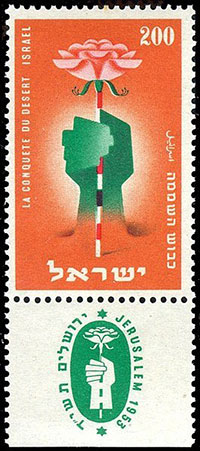

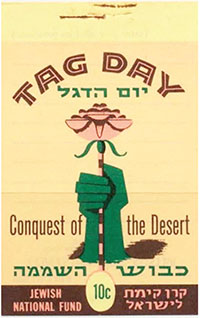
The exhibition theme, “conquest” or reclamation of desert and wasteland, was deeply rooted in Zionist ideology. Since the nineteenth- and early twentieth-century revival of Jewish settlement in Eretz Yisrael, pioneer narratives had emphasized land-clearing, afforestation, drainage of swamps, and conversion of marginal lands into productive fields. In the state-building era of the 1950s, when Israel faced acute demographic and economic pressures, the struggle against nature became a metaphor for national survival and renewal, and soil, water and desert stood as both a challenge and an opportunity.
The exhibition’s origins can be traced to the final years of Chaim Weizmann, Israel’s first president, who identified research into arid-land settlement and reclamation as one of the most promising means for economic development and political stability in Israel. Under his initiative, a symposium of eminent scientists convened in May 1952 under the auspices of UNESCO to examine the problems of cultivating arid lands, setting the scene for the 1953 exhibition, and the exhibition’s organizers thereby tied the narrative of scientific advance to the wider Zionist-settler project.
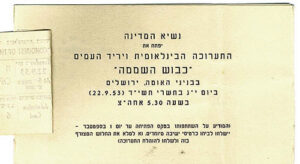
Exhibited here is a special invitation to the opening of the Exhibition:
The President of the State will open The International Exhibition and Fair, “The Conquest of the Desert,” at the Binyanei Ha'uma building in Jerusalem on 13 Tishrei (September 22, 1953) at 5:30 p.m.(Inform regarding your participation in this ceremonial opening by September 1 – special seating tickets will be sent to your home. Please complete the coupon attached hereto and send it to the Exhibition administration.)

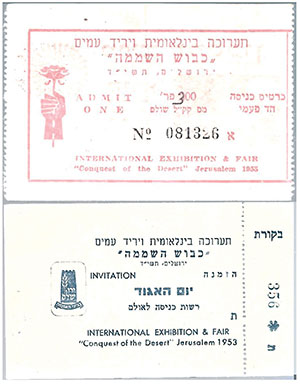
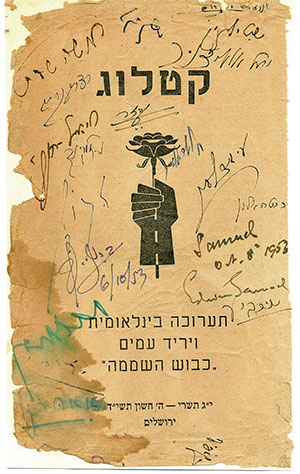
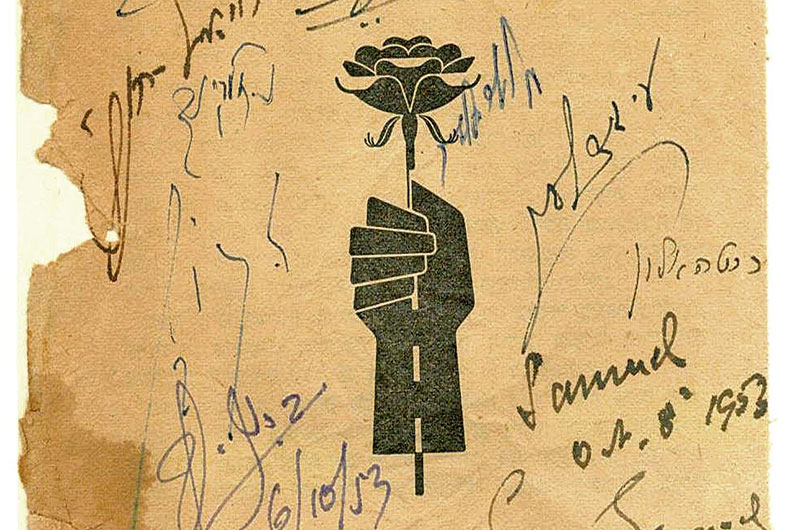
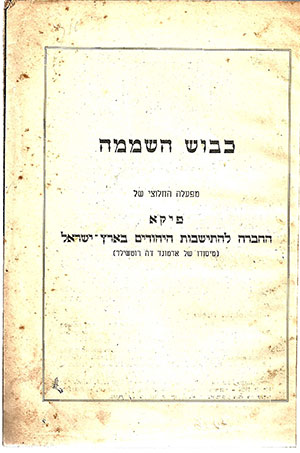
Exhibit here is the title page of the Conquest of the Desert Exhibition catalogue (which, unfortunately, has been damp stained) signed by some twenty of the Exhibition organizers, including then-Foreign Minister and acting Prime Minister Moshe Sharett (upper left); former High Commissioner of Palestine, Sir Herbert Samuel (with date); and Director of the European Office Edwin Samuel.
The Exhibition and Fair had attracted investments of over two million Israeli pounds from some five hundred private firms, public and semi-public institutions and intergovernmental bodies. Participants included UNESCO and the World Health Organization, as well as Israel government ministries, the Jewish National Fund, many organizations and companies from Israel and various foreign countries; and technologists, manufacturers, engineers, and international commerce. It was officially opened by President Ben-Zvi and Sharett and, when it closed twenty-two days later, it had been visited by some 600,000 people and featured thirteen participating nations.
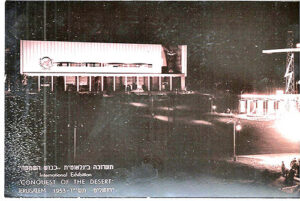
Set on a site then still under construction – the Binyanei Ha’uma center had not yet been fully completed – the fair signaled the ambition of Israel’s nation-building project, with exhibits ranging across irrigation systems, agricultural technologies, soil-conservation methods, industrial goods and settlement planning, all under the broad rubric of how man might best “beat back the desert and provide more food and living space for the world’s rapidly growing population.” The Israeli pavilion in particular drew the largest share of visitors and acclaim, presenting the state’s achievements in layout and content.
For Israel, hosting the fair served multiple strategic aims. It enabled the young state to position itself in the global community of nations as more than a regional political actor, as it sought to be a laboratory of modern agriculture and settlement, not merely a recipient of aid. The desert-reclamation theme resonated internationally, particularly because as population pressure increased worldwide, the idea of turning marginal lands into productive space had broad appeal. At the same time, the selection of Jerusalem as the location for the exhibition carried critical political symbolism: the exhibition implicitly reinforced Israel’s status of Jerusalem as its eternal capital and sought to project a narrative of renewal and modernity centered in the Holy City. As Abba Eban, then Israel’s Ambassador to the United States, explained in an official speech on the Exhibition that he delivered to the Export Manager’s Club of New York:
It is altogether fitting that the nations should dramatize the world’s land and hunger problem in Israel, that they should assemble their solutions at an exhibition site in new Jerusalem. Israel is classic ground of land reclamation, something new under the sun in the modern world, a living example of material and spiritual rehabilitation.... Jerusalem will be the scene of an exhibition which will both illustrate the performance of many countries in the conquest of the desert, the fight against soil erosion, the maintenance of the most priceless and fundamental asset which the human being has upon the surface of the globe, the fertility of its soil. Jerusalem will also be the scene of a great resurgence of cultural and artistic activities, which will be fitting to the City of David on the 3,000th anniversary of its establishment.
Israel's own achievements in the fight against the encroachments of the wilderness has already been an inspiration to many countries. If and when the time comes that the political animosities in our region fall away, as they will and must, we believe that all the countries of the Near East will see the utmost significance in what Israel has done to push the areas of cultivation and of progressive industrial life ever further into the wilderness. This achievement must have significance transcending the frontiers of Israel...
However, there were certain adverse ramifications arising out of holding the fair in Jerusalem, principally regarding American participation. Although the United States did participate in the Exhibition and Fair, it conspicuously declined to send diplomatic representation to the opening ceremony and Israeli officials were furious when the U.S. announced that its boycott of the inauguration ceremonies. Pursuant to President Eisenhower’s Israel policy, personnel at the American Embassy in Tel-Aviv were prohibited from transacting official business in Jerusalem with the Israeli Foreign Ministry or to attend official functions there. The State Department announced that its boycott was intended to protest Israel’s transfer of its Foreign Ministry on July 12, 1953 when, in a secret 24-hour operation, the Foreign Ministry moved from the Kirya in Tel Aviv to the government compound in Jerusalem.
The British Embassy, by contrast, attended and offered a form of tacit international legitimacy while insisting (in diplomatic language then repeated in press reports) that its presence did not imply recognition of any unilateral administrative restructuring because the exhibition had not been “officially” arranged by the Israel Government and that it was operating under the auspices of the United Nations. The Soviet Union declined to participate, a fact which underscored the Cold War-inflected division of global diplomacy even in the area of world’s fairs. Not surprisingly, although Arab countries arguably stood to gain the most from participating in Israel’s World’s Fair, not a single Arab representative participated. In this context, it is ironic to note a comment by Egyptian President Mubarak who, in a speech delivered to the Egyptian parliament over half a century later, referred to desert colonization as a necessity and as Egypt’s "destiny":
The conquest of the desert is no longer a slogan or dream but a necessity created by spiraling population growth. What is required is not a token exodus into the desert but a complete reconsideration of the distribution of population throughout the country.
Binyanei Ha’uma housed the national Israeli display as the centerpiece; surrounding it were pavilions and booths from government ministries, semi-public organizations such as the Jewish National Fund, Israeli manufacturers (textiles, machinery, processed foods), and several foreign participants. The exhibition catalogue, which lists Israeli exhibits ranging from agricultural implements and irrigation pipe sections to examples of processed agricultural products and industrial goods made or refined in the new state, displays show halls arranged by theme – soil and irrigation technologies, settlement and housing models, mechanized agriculture – with demonstration pieces and models positioned to make the argument that Israeli science and industry were the practical arm of Zionist settlement.
During the exhibition’s twenty-two day run, some 600,000 visitors passed through the pavilions in Jerusalem, nearly one-third of Israel’s population at the time; the large numbers reflected both domestic and international engagement and, for many Israelis, it was a moment of collective pride. As the JTA noted, the exhibits made a “tremendous impression... giving them for the first time physical evidence of the great concentrated effort of building up the country... all concentrated in one building.”
Yet, beneath the celebration lay complex realities. Israeli settlement efforts in the Negev and other marginal lands involved significant state coordination, land allocation and the reshaping of landscape and settlement patterns and the narrative of turning wilderness into cultivated land also implicitly carried territorial claims, both to land domestically and to a projected regional role of Israel as pioneer of modernization. Indeed, the exhibition invited participation from countries across the world to present their own methods of reclamation and population of arid lands and, while conceptually universal, in practice the fair served as an instrument of Israeli national diplomacy. The fact that, sadly and most ironically, no Arab country participated, despite arguably having major desert territories of their own to develop, is telling; contrary to their own interests, they elevated their overt political non-recognition of Israel and a rejection of the framing of the exhibition by Israel as host over any benefit to their own people.
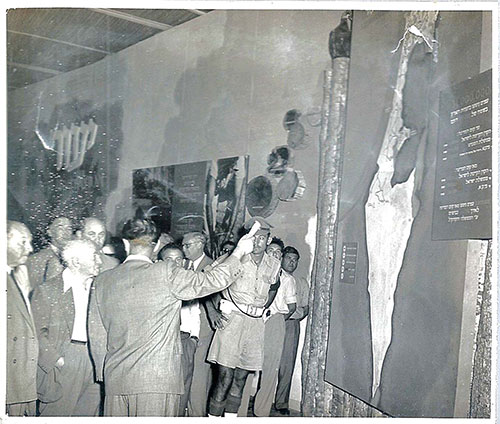
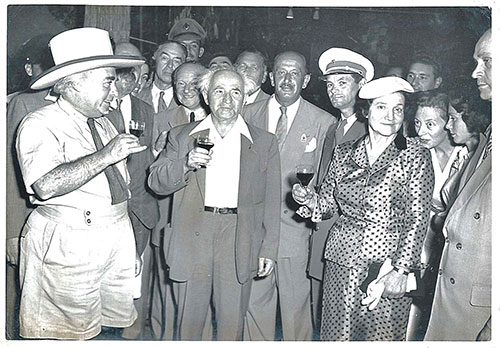
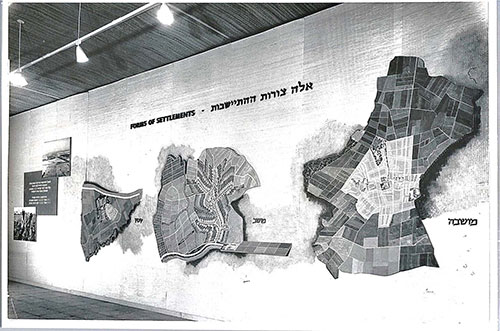
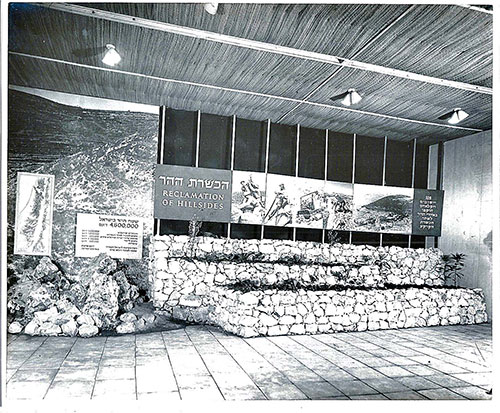
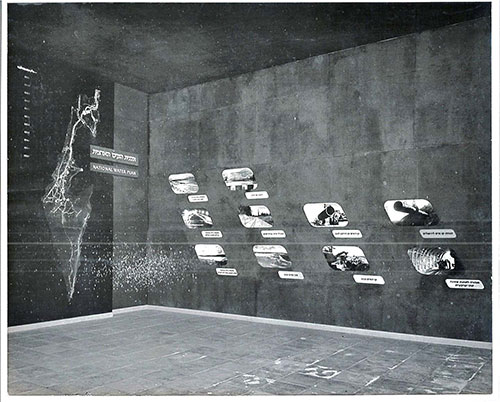
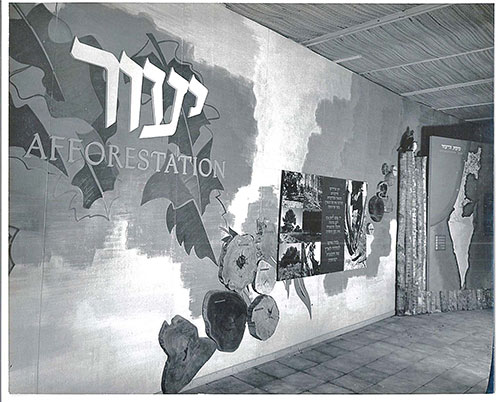
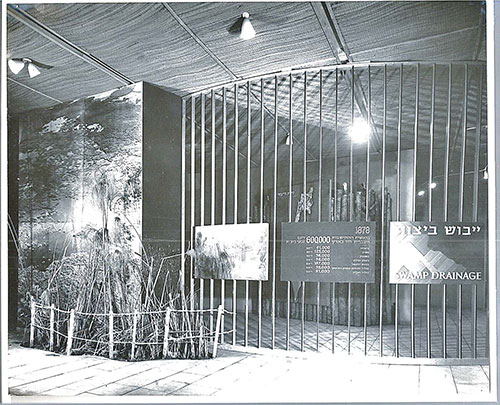
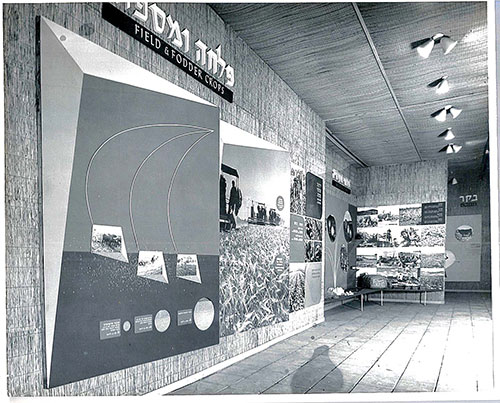
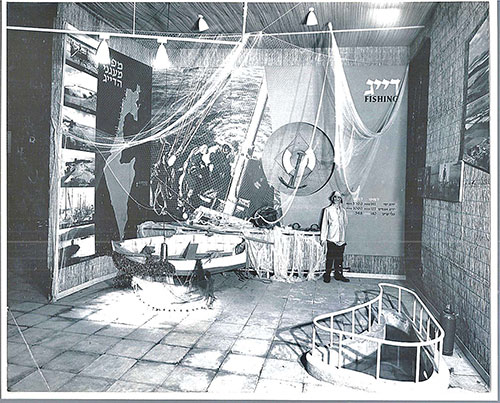
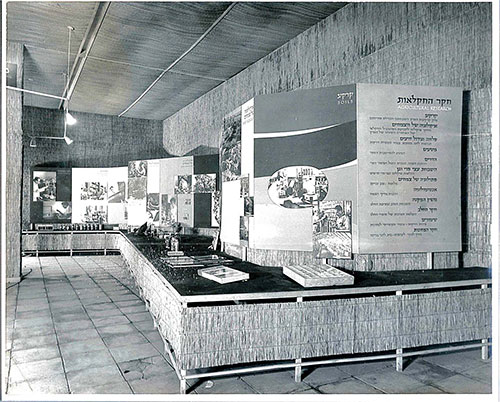
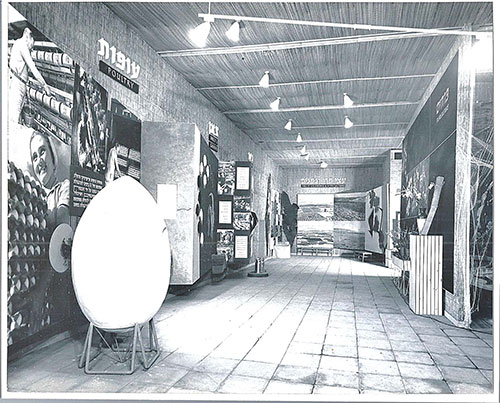
The fair’s imagery and rhetoric drew upon a long-standing Zionist iconography: the afforested hills, the green fields, the drained swamps, the kibbutz settlements, the irrigation pipelines, the blossoming desert all became public metaphors for Jewish revitalization. The physical layout of the exhibition emphasized technology and progress, but also incorporated cultural and artistic activities: the event’s International Festival of Music, under the baton of famous conductor Serge Koussevitzky, punctuated the fair with high-cultural prestige.
The Conquest of the Desert exhibition presented itself as a technical and moral demonstration: a public-facing statement that Israel’s scientific, agricultural and engineering efforts could translate a small, crowded country with large arid regions into a productive modern state. To deepen the story beyond the public-facing slogan, it is useful to separate three interlocking modes in which the fair operated: as a forum for scientific exchange; as an international trade and prestige exhibition with national branding; and as a domestic mobilization of public opinion and pride. In practice the three modes overlapped, and the evidence shows a real mixture of genuine technical discussion and carefully choreographed national promotion.
The exhibition was accompanied by at least three organized scientific meetings, which the official publicity described as a “Negev Development” symposium for engineers and architects, a meeting of more general scientific societies, and a congress of Jewish agronomists. Contemporary press reports and the exhibition catalogue show that the Negev Development sessions brought together civil engineers, irrigation specialists, and planners who discussed road and settlement design, water-capture and retention works, and methods for adapting crops and animal husbandry to semi-arid conditions. The presence of UNESCO and the World Health Organization in the list of participants indicated that organizers were seeking to situate Israel’s desert work inside broader international development agendas rather than restricting it to a national propaganda exercise. These institutional affiliations were meaningful: UNESCO’s interest in arid-land cultivation and population distribution made the fair more than a local show, giving it a degree of technical legitimacy that attracted researchers and some foreign experts. This helped to build professional networks and lend greater credibility to the exhibition beyond merely a showcase of national pride.
The Negev symposium, in particular, brought practicing engineers and planners into face-to-face discussion about the logistical costs and technical trade-offs of settlement in extremely dry terrain, matters such as seasonal water capture, the costs of long-distance water piping, road access and materials transport for often dispersed kibbutzim and moshavim. These were practical engineering concerns, not merely slogans, and they fed into the technical planning of state and quasi-state bodies that were already working on the Negev. At the same time, conference sessions were used by Israeli ministries and companies to showcase specific technologies and pilot projects, and the presence of academic societies and agronomists meant some content was genuinely scientific; the presence of commercial exhibitors and state planners meant many presentations doubled as demonstrations and recruitment-style advocacy for projects. In short, the fair was simultaneously a working technical meeting and a marketing opportunity for the new state’s developmental ambitions.
The fair thus operated at multiple levels. As public spectacle, it showcased large-scale investment and cooperation across private, public and international sectors; as diplomatic platform, it offered a positive frame for Israel’s desert-settlement effort at a time when global attention to development and population growth was mounting; and, as domestic symbol, it reinforced narratives of national resilience, technological mastery and moral-historical renewal. The slogan of the desert turning to bloom resonated both within the Jewish historical memory of exile and return and within the practical reality of land-scarcity and agricultural challenge.
Yet, the fair must also be seen in the context of the early 1950s’ strategic and economic pressures on Israel. The state faced massive immigration, shortages of housing and water, economic austerity, and a contentious regional environment, and hosting such an exhibition was therefore a statement of ambition, both of what had been achieved and what was still to be built. The heavy investment of some 840,000 pounds by the “Conquest of the Desert Company,” plus 700,000 pounds from local firms, evidences the financial scale of the endeavor while, at the same time, the expectation of recovering much of the investment from exhibition‐space rentals and admissions shows that the organizers were striving for an economic as well as a symbolic return.
Economically the exhibition was a large, front-loaded investment. Organizers raised substantial sums from private firms and public bodies to underwrite the displays and infrastructure; contemporary reports put the scale of private and corporate participation in the hundreds of thousands of Israeli pounds. Organizers had business expectations: space rental, vendor income and high visitor numbers were presented as pathways to recoup costs. Short-term returns are more easily documented than long-term profit and loss: the fair attracted hundreds of thousands of visitors and a significant degree of domestic and diaspora attention and, by many contemporary accounts, met or exceeded immediate attendance goals. Whether the initial capital outlay was fully recouped in pure accounting profit is less clear from public sources; published press and the exhibition’s own reports emphasize reputational and diplomatic returns rather than a line-item statement showing net profit.
The physical and institutional legacy is more visible. Binyanei Ha’uma became Jerusalem’s principal convention and cultural center and remained a locus for national and international meetings; the very decision to stage such an ambitious international event there helped to justify and expedite the complex’s completion and later institutional uses. Symbolically, the exhibition strengthened the national argument that Jerusalem could host international functions, a claim Israeli diplomats and domestic politicians repeatedly cited in subsequent years. Technically, the fair helped crystallize networks between Israeli research teams, the Jewish National Fund, ministries and a modest number of foreign technical actors who then traded personnel and ideas on arid-zone agriculture and water management. In subsequent decades, Israeli agronomy and drip irrigation innovations would become internationally recognized; the 1953 exhibition can be seen as an early public showcase in the chain of events that led to Israel’s role as a global actor in arid-zone technology.
Press reaction at home and abroad combined admiration for the sheer scale and civic ambition of the undertaking with pointed observations about politics and context. Israeli dailies celebrated the exhibition as evidence of concentrated national effort, and the visitor numbers were reported as a source of national pride. Anglo-language and international press reports tended to emphasize the technical displays and the human-interest angle (returning to old Jewish sites, agricultural pioneers) but, as discussed, many commentators also noted the political overtones of hosting the fair in Jerusalem and the diplomatic awkwardness created by the U.S. boycott and the absence of Arab states. Not surprisingly, some foreign commentary, particularly from countries critical of Israeli policy, framed the exhibition as little more than a national propaganda exercise. In general, however, contemporary reports show a fair that successfully combined technical showcases with spectacle and which garnered sympathetic coverage that Israel’s foreign office promptly circulated as positive publicity.
The fair’s ultimate legacy, however, is arguably somewhat mixed. In the short term, it succeeded in raising Israel’s profile internationally; giving domestic audiences a vivid public moment of consolidation; advancing the center of national activity toward Jerusalem; contributing to the city’s modern institutional infrastructure; and reinforcing the narrative of Israeli innovation in arid-zone agriculture which, in subsequent decades, became a genuine export advantage.
However, the exhibition’s claims must be measured against environmental and practical realities. The rhetoric of “conquering the desert” overstated both the scale of cultivable land and the speed at which long-term ecological transformation could be accomplished. In the 1950s, water scarcity, the high cost of irrigation infrastructure and the fragility of soils in arid zones imposed hard limits. While pilot projects and local successes were very real – afforestation, reclamation of small areas, and the settlement of selected Negev sites – large-scale transformation would require decades of sustained investment, new technologies, and sometimes controversial water-management policies.
Nonetheless the 1953 exhibition remains a landmark that is still remembered as Israel’s first internationally sanctioned specialized expo and a milestone in the country’s early public diplomacy. From a longer perspective, some of the exhibition’s proud displays foreshadowed later achievements, but they also anticipated debates about sustainability, water allocation and environmental trade-offs that became more intense in later decades. The exhibition thus stands as both accurate early evidence of Israeli technical capacity and as early-stage public relations for a national program whose environmental consequences were only partly understood at the time.
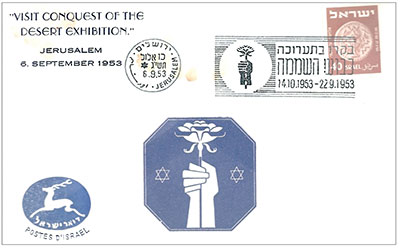
Thus, at the end of the day, the Conquest of the Desert Fair and Exhibition combined genuinely useful technical exchange with clear national branding. It brought engineers and agronomists together, placed Israel’s desert projects in an international frame, provided a major boost to Jerusalem’s institutional standing, and advanced networks that helped future Israeli technical exports. But the exhibition also functioned as an instrument of political messaging – about capital status, national renewal, and Israel’s self-image as a pioneer of arid land development – and it must be read critically: many claims on display were aspirational and required long follow-through to achieve durable technical results.